Outdoor Kitchens
Best Built-In Grills (2026): Gas Grill Inserts for Outdoor Kitchens
Quick answer
The best built-in grill for most outdoor kitchens is the Blaze Premium LTE+ 32 in., with a rear infrared burner, lighted knobs and a lifetime warranty on a published 30 5/8 by 21 1/4 inch cutout. On a wood-framed island, install the manufacturer's insulated jacket. For big islands, the 40 inch Lion L90000 has 802 sq in.
A built-in grill, also called a drop-in grill head or grill insert, is a grill without a cart, designed to sit in a cutout in a counter. The grill head has to match the cutout, the island's construction and the gas supply, so the right answer starts with installation facts, not features.
Our top pick, the Blaze Premium LTE+ 32 in. Built-In Grill (Propane) ($2,499.00), shares its cutout with the lower-priced Blaze Prelude LBM 32 in. Built-In Grill (Propane) ($1,749.00), so you can frame an island once and choose the head later. Plan the full island with the outdoor kitchen planning guide and size the cooking area with the grill size calculator.
On this page
- What are the best built-in grills?
- What is the best gas grill insert for an outdoor kitchen?
- What are the cutout dimensions for built-in grills?
- Do built-in grills need an insulated jacket?
- What does a safe grill island need besides the grill?
- Beginner pick: a first island build
- Intermediate pick: more heat and a finished-kitchen feel
- Expert pick: rotisserie and a 40 inch head
- How do built-in grills compare on specs?
- What components go with a built-in grill?
What are the best built-in grills?
Built-in grills are dominated by a handful of outdoor kitchen brands that publish cutout dimensions and sell matching doors, drawers and side burners: Blaze, Bull, Napoleon and Lion. The best choice depends on the island you are building:
- Blaze Premium LTE+ 32: the best finished-kitchen head, with a rear infrared burner, lighted knobs and a lifetime warranty.
- Blaze Prelude LBM 32: the value pick, four 14,000 BTU 304 stainless tube burners and the same cutout.
- Bull Outlaw: 60,000 BTU from four welded stainless burners, 575 sq in and NSF and CSA certification.
- Napoleon Built-In 700 Series 32: rotisserie cooking, 9 mm wave grids and a 2 inch cutout tolerance for easier installs.
- Lion L90000 40: 802 sq in and a 16-gauge 304 stainless body for large islands.
Blaze and Napoleon are compared head to head in Blaze vs Napoleon built-in grill.
What is the best gas grill insert for an outdoor kitchen?
For a first island, the Blaze Prelude LBM 32. Blaze publishes everything a builder needs: overall size of 32.5 inches wide by 25.75 deep by 21.25 high, a cutout of 30 5/8 by 21 1/4 by 8 1/2 inches, removable heat zone separators, flame stabilizing grids and a lifetime residential warranty. Because the Premium LTE+ uses the same cutout, the Prelude is a safe starting point that does not lock you in.
If you already have a natural gas line at the patio, the Napoleon Built-In 500 Series 32 in. Grill Head (Natural Gas) is built for it from the factory: four stainless burners at 48,000 BTU across 531 sq in with 7.5 mm stainless grids. Should you build an island at all? Built-in vs freestanding grill covers when a cart grill in a prep station is smarter.
What are the cutout dimensions for built-in grills?
Frame the opening only after you have the grill's installation manual in hand: cutouts vary by model and even by production year. The figures below are the manufacturers' published numbers from the product listings at the time of writing.
| Model | Overall W x D x H (in) | Cutout W x D x H (in) | Burners and output | Primary area |
|---|---|---|---|---|
| Blaze Prelude LBM 32 | 32.5 x 25.75 x 21.25 | 30 5/8 x 21 1/4 x 8 1/2 | 4 x 14,000 BTU (56,000) | not published |
| Blaze Premium LTE+ 32 | 32.5 x 25.75 x 21.25 (114 lb) | 30 5/8 x 21 1/4 x 8 1/2 | 4 main plus rear infrared | not published |
| Lion L90000 40 | 40 x 24.25 x 21.5 (200 lb) | 38.5 x 21.5 x 9.625 | Cast stainless plus rear infrared | 802 sq in |
| Napoleon 700 Series 32 | 32 wide | see manual; 2 in tolerance | 66,000 BTU incl. rear burner | 29.5 x 18 in (531 sq in) |
| Bull Outlaw | not published | see manual | 4 x 15,000 BTU (60,000) | 575 sq in |
| Blaze single side burner | 12.5 x 19.5 x 4.5 | 11 1/4 x 18 x 2 13/16 | 12,000 BTU | n/a |
Always confirm against the installation manual shipped with your unit before cutting a countertop.
Do built-in grills need an insulated jacket?
If the island is framed with wood or any other combustible material, yes: install the grill manufacturer's insulating jacket (also called an insulated liner). A grill head radiates heat downward and sideways, and the jacket is what the manufacturer relied on when it set safe clearances for combustible construction. Using a grill in a combustible island without it can void the warranty and create a fire risk inside the cabinet. Order the exact jacket listed in your manual, for example Blaze insulated jackets for 32 in. grills or Napoleon built-in insulated jackets.
Islands built from steel studs with cement board, or from masonry, are non-combustible, and many manufacturers do not require a jacket in that case. The manual decides, not the salesperson. The same logic applies to side burners and to any heat-producing component.
What does a safe grill island need besides the grill?
The grill head is the easy part. These are the construction details that keep an island safe and inspectable.
| Requirement | Wood or combustible frame | Steel stud with cement board, or masonry |
|---|---|---|
| Insulated jacket for the grill head | Required per the grill manufacturer | Often not required; follow the manual |
| Vent panels in the cabinet | Required for gas; place low for propane, which is heavier than air | Required for gas; same placement rules |
| Gas line | Licensed plumber or gas fitter, permit where required, shutoff valve accessible | Same |
| Countertop | Non-combustible surface around the cutout | Non-combustible surface around the cutout |
| Electrical for lights or rotisserie | GFCI-protected outdoor circuit by a licensed electrician | Same |
| Clearance to the house and overhangs | Per grill manual; add a rated vent hood if under a roof | Same |
Summarized from common manufacturer installation requirements. Local code and your specific manual take precedence.
Beginner pick: a first island build
Your first outdoor kitchen, a straight island and a budget that has to cover doors, a countertop and the gas line too.

Blaze Prelude LBM 32 in. Built-In Grill (Propane)
$1,749.00Four 14,000 BTU 304 stainless burners, heat zone separators, a published cutout and a lifetime residential warranty. Upgrading to the Premium LTE+ later uses the same opening.
Best for: first outdoor kitchen islands
Check price on Amazon
Napoleon Built-In 500 Series 32 in. Grill Head (Natural Gas)
$1,679.00Four stainless burners at 48,000 BTU over 531 sq in, 7.5 mm stainless grids and dual-level marine-grade stainless sear plates, factory-built for a natural gas line.
Best for: a natural gas island on a moderate budget
Check price on AmazonIntermediate pick: more heat and a finished-kitchen feel
You cook often, entertain at night and want a head that looks and works like a centerpiece.
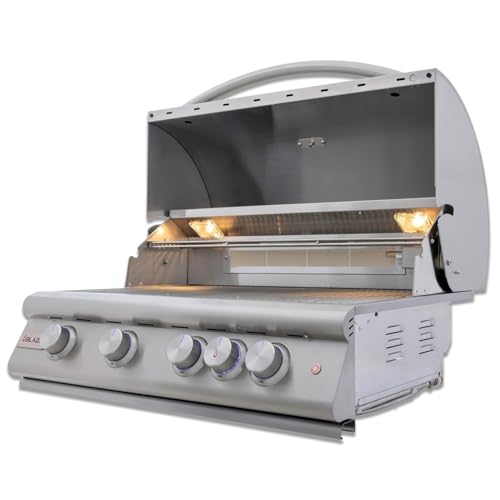
Blaze Premium LTE+ 32 in. Built-In Grill (Propane)
$2,499.00A rear infrared burner, illuminated control knobs, improved interior lighting, a lift-assist double-lined hood and a removable warming rack, with Blaze's lifetime warranty on the stainless housing, burners and valves.
Best for: night grilling in a finished outdoor kitchen
Check price on Amazon
Bull Outlaw Drop-In Grill Head (Propane)
$1,749.00Four welded 15,000 BTU stainless burners totaling 60,000 BTU, 575 sq in of primary space plus a 176 sq in warming rack, solid stainless grates and a dual-lined hood, with NSF and CSA certification.
Best for: high heat output in an island
Check price on AmazonExpert pick: rotisserie and a 40 inch head
A large island built for crowds and rotisserie cooking, with the budget for matching components.

Napoleon Built-In 700 Series 32 in. Grill with Infrared Rear Burner (Propane)
$2,219.00Four stainless main burners plus an infrared rear burner with a commercial-grade rotisserie kit, 9 mm stainless wave grids, battery-free jet-flame ignition and a design with longer wiring and flex line for easier installs.
Best for: rotisserie cooking in a built-in island
Check price on Amazon
Lion L90000 40 in. Built-In Grill with Rear Infrared Burner (Propane)
$2,599.00A 40 inch, 16-gauge 304 stainless head with 802 sq in of main grilling area, cast stainless burners, an infrared rotisserie system, a smoker box and interior lights.
Best for: large islands built for crowds
Check price on AmazonWho should not buy this tier: Skip this tier if your island is still a sketch or you cook for six or fewer. A 40 inch head needs a longer run of counter, more gas and a jacket if the frame is combustible, and the Lion weighs 200 lb, which affects how you frame the opening. Most families are fully served by a 32 inch head.
How do built-in grills compare on specs?
| Model | Price | Burners | Output | Primary cooking area | Width | Rotisserie | Grates |
|---|---|---|---|---|---|---|---|
| Blaze Prelude LBM 32 in. Built-In Grill (Propane) | $1,749.00 | 4 | 56,000 BTU | - | 32.5 in | - | - |
| Napoleon Built-In 500 Series 32 in. Grill Head (Natural Gas) | $1,679.00 | 4 | 48,000 BTU | 531 sq in | 32 in | - | stainless steel |
| Blaze Premium LTE+ 32 in. Built-In Grill (Propane) | $2,499.00 | 4 | - | - | 32.5 in | - | - |
| Bull Outlaw Drop-In Grill Head (Propane) | $1,749.00 | 4 | 60,000 BTU | 575 sq in | - | - | stainless steel |
| Napoleon Built-In 700 Series 32 in. Grill with Infrared Rear Burner (Propane) | $2,219.00 | 4 | - | - | 32 in | Yes | stainless steel |
| Lion L90000 40 in. Built-In Grill with Rear Infrared Burner (Propane) | $2,599.00 | - | - | 802 sq in | 40 in | Yes | - |
What components go with a built-in grill?
Buy components from the same family where you can, so finishes and cutouts line up. Plan the rest of the island in best outdoor kitchen islands.

Bullet by Bull Outdoor Kitchen Set with 4-Burner Grill (Propane)
$1,697.00A Bullet 4-burner built-in grill, a side burner and a single access door bundled as a matched stainless starter set.
Best for: buying grill, burner and door in one order
Check price on Amazon
Blaze 12,000 BTU Drop-In Single Side Burner (Propane)
$479.00A 12,000 BTU 304 stainless drop-in burner with a brass-plated head, removable cover and a published 11 1/4 by 18 inch cutout.
Best for: sauces and sides in a compact island
Check price on Amazon
Whynter BOR-53024-SSW 24 in. Built-in Outdoor Beverage Fridge
$1,112.99A 24 inch, 5.3 cu ft outdoor-rated stainless fridge with a 32 to 64 F range and a cylinder lock, for standard under-counter openings.
Best for: standard 24 inch under-counter bays
Check price on AmazonHow we chose
We did not test these products in person. Picks are researched from manufacturer specifications and owner manuals, engine and safety certifications where they apply, warranty terms, public recall records, and the recurring themes in verified owner reviews. We favor established brands with large review counts and parts support, match each pick to a real yard size or task, and place it in the tier where its price and capability actually belong.
Frequently asked questions
Are built-in grills better than freestanding grills?
Not better at cooking, just integrated. A built-in head and a cart grill at the same price cook similarly, but the built-in costs far more once you add the island, countertop, jacket, doors and gas line. Built-ins make sense when you want a permanent outdoor kitchen with counter space and storage. A quality cart grill beside a prep cart gets most of the function for a fraction of the cost.
What size built-in grill should I get?
A 32 inch head with roughly 500 to 575 sq in of primary grate cooks for six to eight people and is the most common island size. Choose 36 to 40 inches if you regularly cook for ten or more; the Lion L90000 40 lists 802 sq in. Remember that a larger head needs a longer counter run, more gas and, in wood islands, a larger jacket.
Can I put a built-in grill in a wood frame island?
Only with the manufacturer's insulated jacket and the clearances its manual specifies. Wood framing is combustible, and grill heads radiate heat into the cabinet. The jacket creates the air gap and insulation the manufacturer tested for. Many builders avoid the issue by framing with steel studs and cement board, which is non-combustible and often does not require a jacket.
Do outdoor kitchen islands need vents?
Yes, any enclosed island cabinet with gas lines or a propane tank needs vent panels so leaking gas cannot collect. Propane is heavier than air, so vents belong near the bottom of the cabinet; natural gas rises, so high venting matters too. Manufacturers typically call for vents on more than one side. Follow the grill manual and local code for size and placement.
Can a built-in grill be converted from propane to natural gas?
Some can with the manufacturer's approved conversion kit, installed by a qualified technician, and some cannot. The orifices and regulator differ between fuels, so never connect a grill to a fuel it is not set up for. The simplest route is to buy the fuel version you will use, such as the natural gas Napoleon Built-In 500, and confirm conversion options in the manual.
How long do built-in grills last?
A 304 stainless built-in grill that is covered and cleaned commonly lasts well over a decade, with burners, igniters and flame tamers replaced along the way. Warranty terms are the best signal of expected life: Blaze lists a lifetime residential warranty on the Prelude and Premium LTE+. Lower-grade stainless can pit and rust near salt air, so confirm the steel grade.
Researched, not professional advice. This page is compiled from published specifications, manuals, labels and owner-review consensus, not hands-on testing. Follow the manufacturer's instructions and product label, and consult a qualified professional where safety, chemicals, fuel or structures are involved. As an Amazon Associate we earn from qualifying purchases.