Mowers
Lawn Size Calculator: Square Feet and Acres of Your Yard
Quick answer
Measure each section of lawn, multiply length by width for rectangles, use 3.1416 x radius squared for circles and half of base x height for triangles, then subtract beds and patios. Divide square feet by 43,560 for acres: a quarter acre is 10,890 square feet and a half acre is 21,780 square feet.
Almost every yard decision starts with one number: how much grass you actually mow. Lot size is not lawn size, because the house, driveway, patio and planting beds can take up a third of a typical suburban lot. Add each section of lawn below, subtract anything that is not grass, and the calculator converts the total to square feet, acres and square meters. It then estimates mowing time, seed and fertilizer, and filters mowers and robot mowers that fit. Once you have the number, size the mower with the mower deck size calculator or plan seeding with the grass seed calculator.
Lawn size calculator
Add a row for each section of lawn. Set a row to Subtract for beds, patios or anything inside a lawn area that is not grass.
Your lawn
Mowers that fit your lawn size
Top matches update when you calculate.

EGO POWER+ LM2135SP 21 in. Select Cut Self-Propelled Mower Kit
$749.00Select Cut ships with mulching, high-lift bagging and extended-runtime lower blades, and Touch Drive varies speed from 0.9 to 3.1 mph on a 7.5Ah battery rated for up to 60 minutes.
Best for: Mid-size lawns, especially for existing EGO 56V owners
Check price on Amazon
Greenworks 80V 21 in. Self-Propelled Mower Kit
$479.99Rear-wheel drive with variable speed and an 80V brushless motor, rated to cut up to half an acre on the included 4.0Ah battery with a 4-year tool and battery warranty.
Best for: Half-acre lawns with some slope
Check price on Amazon
Honda HRX-BE 21 in. Battery Self-Propelled Mower
$999.00Honda pairs its twin-blade MicroCut deck and 4-in-1 Versamow with two battery bays (one 12Ah pack included, about 0.37 acre per charge) and a 5-year residential warranty backed by its dealer network.
Best for: Buyers who value dealer service and bagging quality
Check price on Amazon
Greenworks 80V 25 in. Self-Propelled Mower Kit
$717.27A 25-inch deck with a brushless motor and rear-wheel drive, rated to cut up to three quarters of an acre on the included 4.0Ah battery.
Best for: Open lawns approaching an acre
Check price on Amazon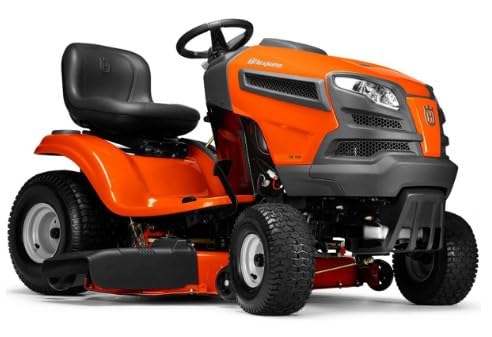
Husqvarna TS 120 42 in. Lawn Tractor
$2,799.00A 19 HP, 540cc Briggs & Stratton engine, 42-inch twin-blade stamped deck and pedal-operated transmission, the lowest-cost way onto a seat in this list.
Best for: Smaller, fairly flat properties
Check price on Amazon
EGO POWER+ Z6 ZT4204L 42 in. Electric Zero Turn Mower
$3,599.00Four included 10.0Ah batteries are rated for 2 acres at up to 8 mph and recharge in about two hours, and the 42-inch deck mulches, bags or side discharges.
Best for: Up to 2 acres at the lowest EGO rider price
Check price on Amazon
Husqvarna Z248F 48 in. Zero Turn Mower
$3,899.00A 23 HP Kawasaki FR651V engine, fabricated 48-inch 3-blade deck and Hydro-Gear ZT-2200 transmission, with a headlight and armrests.
Best for: Mid-size lawns with trees and beds
Check price on Amazon
Husqvarna Z254F 54 in. Zero Turn Mower
$3,985.00A 24 HP, 726cc FR730 engine on a 54-inch fabricated deck gives the widest cut of the Z200 models for a small step up in price over the 48-inch.
Best for: Large, fairly open lawns
Check price on Amazon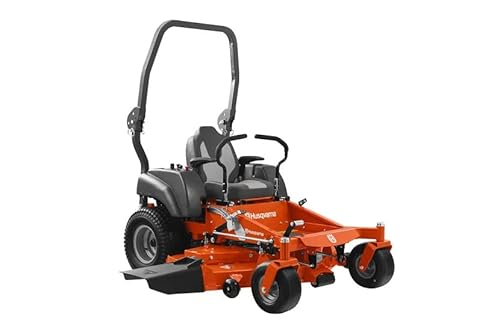
Husqvarna MZ61 61 in. Zero Turn Mower with ROPS
$5,965.00A 61-inch 3-blade fabricated deck, commercial-grade Hydro-Gear ZT-3100 transmission, 5-gallon tank, rollover protection bar and a 4-year consumer warranty.
Best for: Large properties mowed every week
Check price on Amazon
Segway Navimow i105N Robot Mower
$799.00RTK plus vision positioning with no perimeter wire, AI-assisted mapping and a camera that recognizes 150+ obstacle types, sized for yards up to 1/8 acre.
Best for: Small, simple lawns
Check price on Amazon
Segway Navimow i210 AWD Robot Mower
$1,299.00All-wheel drive with electronic stability control climbs 45% slopes, and network RTK with vision needs no wire, rated for up to 1/4 acre.
Best for: Sloped quarter-acre yards
Check price on Amazon
Husqvarna Automower 430X Robot Mower
$2,167.79A buried boundary wire gives a steady signal under heavy shade where satellite models can struggle, rated for 0.8 acre with a 9.45-inch cut width.
Best for: Heavily shaded lawns
Check price on Amazon
Husqvarna Automower 440iQ Robot Mower
$2,649.99The largest iQ model is rated for up to 2 acres on 45% slopes, using EPOS positioning instead of boundary wire, with GPS theft tracking and a 4-year warranty.
Best for: Large lawns up to 2 acres
Check price on AmazonOn this page
- How do I calculate the square footage of my lawn?
- What are the area formulas for each lawn shape?
- How many square feet is a quarter acre, half acre and 1 acre?
- Can I measure my lawn size from a satellite map?
- Why does lawn size matter when buying a mower?
- How much seed and fertilizer does my lawn size need?
How do I calculate the square footage of my lawn?
Break the lawn into simple shapes, measure each one and add them up. A 100 foot tape or a measuring wheel is the easiest tool; pacing works for a rough estimate if you first measure your own stride over 50 feet. Work in feet and round to the nearest foot, which is accurate enough for buying seed, fertilizer or a mower.
- Sketch the yard and divide the grass into rectangles, triangles and circles.
- Measure each shape and calculate its area with the formulas below.
- Add the lawn shapes together.
- Subtract anything inside those shapes that is not grass: the house footprint, driveway, patio, pool deck, sheds and planting beds.
- Divide the total by 43,560 to convert square feet to acres.
What are the area formulas for each lawn shape?
| Shape | Formula | Example |
|---|---|---|
| Rectangle or square | length x width | 40 ft x 60 ft = 2,400 sq ft |
| Circle | 3.1416 x radius x radius | 20 ft across: 3.1416 x 10 x 10 = 314 sq ft |
| Triangle | base x height / 2 | 30 ft base, 20 ft tall = 300 sq ft |
| Oval | 3.1416 x half-length x half-width | 40 x 20 ft: 3.1416 x 20 x 10 = 628 sq ft |
| L-shape | split into two rectangles and add | 30 x 50 + 20 x 25 = 2,000 sq ft |
| Irregular curve | split into rectangles and triangles, or average several widths x length | widths 32, 38, 35 ft over 80 ft = 2,800 sq ft |
How many square feet is a quarter acre, half acre and 1 acre?
One acre is 43,560 square feet. The mower column assumes the whole area is open lawn; use your measured grass area for a real recommendation.
| Lot | Square feet | Acres | Square meters | Deck if all lawn |
|---|---|---|---|---|
| Small city lot | 5,000 | 0.11 | 465 | 20 to 22 in |
| Typical suburban lot | 7,500 | 0.17 | 697 | 20 to 22 in |
| Quarter acre | 10,890 | 0.25 | 1,012 | 20 to 22 in |
| Large suburban lot | 15,000 | 0.34 | 1,394 | 21 to 30 in |
| Half acre | 21,780 | 0.5 | 2,023 | 21 to 30 in |
| Three quarters of an acre | 32,670 | 0.75 | 3,035 | 30 to 42 in |
| 1 acre | 43,560 | 1 | 4,047 | 30 to 42 in |
| 2 acres | 87,120 | 2 | 8,093 | 42 to 48 in |
Can I measure my lawn size from a satellite map?
Yes, and it is often faster than a tape for large or irregular yards. Most free online map services have a measure distance or measure area tool in satellite view: right-click a starting point, choose the measure option, then click around the edge of each lawn section to trace it. Some county property appraiser sites also show parcel dimensions. Satellite tracing is usually accurate to within a few percent, but trees hide lawn edges, so walk the yard to check beds and shaded corners before you buy seed or fertilizer by the bag. Enter the traced areas in the calculator as rectangles with a width of 1 and a length equal to the square footage if the tool gives you area directly.
Why does lawn size matter when buying a mower?
Mowing time scales directly with area and inversely with deck width. A 21 inch walk-behind covers about 0.43 acres an hour, so a half acre of lawn is more than an hour of walking every week of the season. A 42 inch zero-turn covers about 1.9 acres an hour. For under about a third of an acre, a battery walk-behind such as the EGO POWER+ LM2135SP 21 in. Select Cut Self-Propelled Mower Kit is the sensible buy. From half an acre to 1.5 acres a 42 inch rider such as the Husqvarna TS 120 42 in. Lawn Tractor or the battery EGO POWER+ Z6 ZT4204L 42 in. Electric Zero Turn Mower saves hours each month, and past 2 acres a 48 to 54 inch zero-turn like the Husqvarna Z254F 54 in. Zero Turn Mower is the standard choice. Robot mowers are rated by area: check that your lawn is under about 80 percent of the rating, as with the Husqvarna Automower 430X Robot Mower rated for 0.8 acres. See the best mowers for 1 acre and robot mower size by lawn area.
How much seed and fertilizer does my lawn size need?
Seed and fertilizer are sold by coverage, so the square footage converts straight to bags. Tall fescue is seeded at about 6 to 8 pounds per 1,000 square feet for a new lawn and roughly half that for overseeding, so a 5,000 square foot lawn needs about 35 pounds for bare soil. A fertilizer with 32 percent nitrogen takes about 3.1 pounds of product to apply 1 pound of nitrogen per 1,000 square feet, so the same lawn uses about 16 pounds per application. Always follow the rate on the product label. Exact amounts by grass type are in the grass seed calculator and the fertilizer calculator.
Frequently asked questions
How big is the average lawn in the United States?
Lot sizes vary widely by region, but many suburban lots fall between about 7,000 and 11,000 square feet, a sixth to a quarter of an acre. After subtracting the house, driveway, patio and beds, the mowed lawn on those lots is often 3,000 to 7,000 square feet. Rural and exurban properties commonly have one to several acres of grass, which is why mower advice differs so much by location.
How many square feet are in an acre?
An acre is 43,560 square feet, about 4,047 square meters. A quarter acre is 10,890 square feet, a half acre is 21,780 square feet and three quarters of an acre is 32,670 square feet. A square acre measures about 208.7 feet on each side, although most lots are rectangles, such as roughly 100 by 436 feet or 150 by 290 feet.
Should I measure lot size or lawn size?
Measure the lawn, meaning only the area you mow, fertilize or seed. Lot size includes the house, driveway, sidewalks, patio and planting beds, which together can be a third or more of a suburban lot. Using lot size overestimates seed and fertilizer costs and pushes you toward a bigger mower than you need. Property records give lot size, so use them only as a starting point.
How accurate is pacing a lawn instead of measuring?
Pacing is usually within about 10 percent if you calibrate your stride first: walk a measured 50 feet, count your steps and divide. That is accurate enough for choosing a mower size. For buying seed, fertilizer or weed control, where overapplying wastes money and underapplying leaves gaps, a tape measure, measuring wheel or satellite map tracing is worth the extra few minutes.
How do I measure an irregular shaped lawn?
Lay a long straight baseline through the middle of the lawn, then measure the width across it every 10 or 20 feet. Average those widths and multiply by the baseline length. Alternatively, split the shape into rectangles and triangles, calculate each, and add them. Curved beds can be approximated with triangles or subtracted as ovals using 3.1416 times half the length times half the width.
Researched, not professional advice. This page is compiled from published specifications, manuals, labels and owner-review consensus, not hands-on testing. Follow the manufacturer's instructions and product label, and consult a qualified professional where safety, chemicals, fuel or structures are involved. As an Amazon Associate we earn from qualifying purchases.