Landscaping
Mulch Calculator: How Much Mulch Do I Need in Yards and Bags
Quick answer
Multiply bed area in square feet by depth in inches, then divide by 324 to get cubic yards. One cubic yard covers 108 square feet at 3 inches deep and equals 13.5 bags of 2 cubic feet or 9 bags of 3 cubic feet. A 200 square foot bed at 3 inches needs about 1.85 yards, or 25 small bags.
Mulch is sold two ways, by the cubic yard in bulk and by the bag in cubic feet, and the math between them trips people up. Enter each bed's size and the depth you want, choose a bag size, and the calculator returns cubic yards, bags, approximate weight and how many wheelbarrow or cart loads it takes to move. Buying gravel or topsoil instead? Use the gravel calculator or the topsoil calculator.
Mulch calculator
Mulch needed
Move and edge it with less work
Top matches update when you calculate.

Jackson MP1010 10 cu ft Poly 2-Wheel Wheelbarrow
$689.94A contractor-size 10 cu ft poly tray on an all-steel undercarriage with two 16 inch pneumatic wheels, stable enough for big loads of mulch or leaves.
Best for: heavy, frequent loads
Check price on Amazon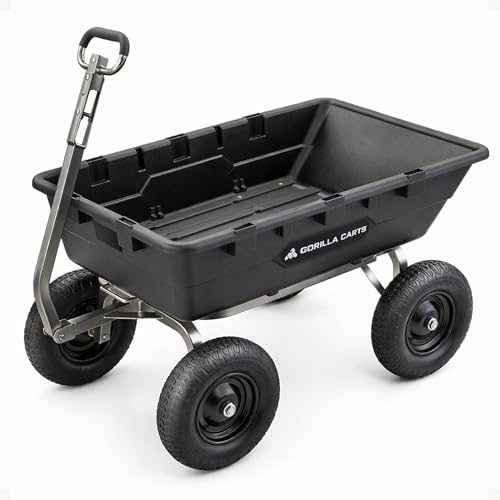
Gorilla Carts Poly Dump Cart, 1,500 lb, 10 cu ft
$389.99A 10 cu ft, 1,500 lb poly cart whose handle converts to a hitch for a lawn tractor or ATV, with 16 inch pneumatic tires and quick-release dump.
Best for: hand-pull or tow hauling on mid-size properties
Check price on Amazon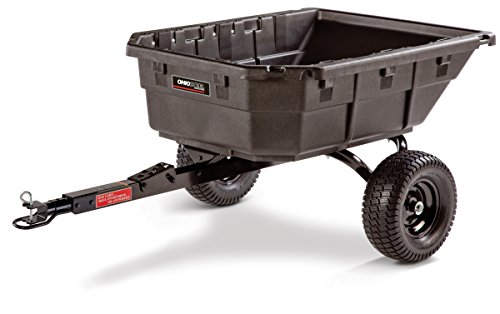
Ohio Steel 4048P-HYB 15 cu ft Poly Swivel Hybrid Dump Cart
$558.13A 15 cu ft structural-foam bed rated to 1,250 lb with a foot-pedal swivel dump across 100 degrees, rotating hitch and 16 inch commercial tires.
Best for: heavy hauling on acreage
Check price on Amazon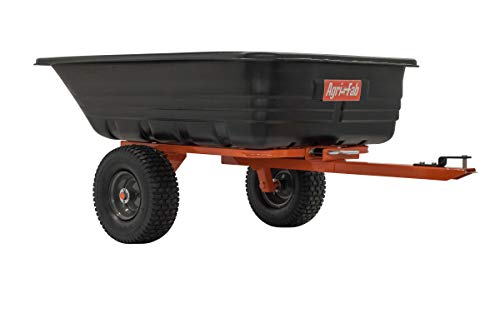
Agri-Fab 12 cu ft Tow-Behind Poly Swivel Dump Cart, 700 lb
$312.00A made-in-Illinois tow cart with an 80 degree swivel and 52 degree dump angle, 700 lb capacity and 12 inch ground clearance on pneumatic turf tires.
Best for: dumping mulch exactly where it goes
Check price on Amazon
Gorilla Carts Poly Dump Cart, 1,200 lb, 6 cu ft
$199.99A rust-proof poly bed with a quick-release dump, rated to 1,200 lb in a 40 by 25.6 inch bed, easier on the back than a single-wheel barrow.
Best for: hauling bags of seed and fertilizer
Check price on Amazon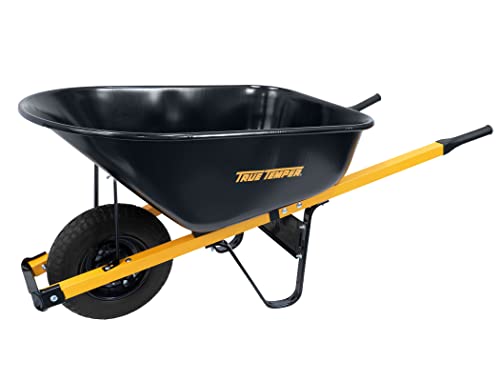
True Temper 6 cu ft Steel Wheelbarrow with Never Flat Tire
$229.00A seamless steel tray with a sloped front for dumping, steel handles and a flat-free tire, shipped in one box for mulch, soil and stone.
Best for: general yard hauling
Check price on Amazon
Truper TruTough 10-Tine Ensilage Fork
$51.97A 10-tine fork head on a 30 in. wood handle with poly D-grip, the tine spacing used for moving loose mulch, compost and bedding.
Best for: loading and spreading bulk mulch from a pile
Check price on Amazon
Bully Tools 16 in. Bow Rake
$37.99A 16 in. head of 10-gauge USA steel with robotically overwelded tines on a fiberglass handle for breaking up soil and spreading mulch.
Best for: grading topsoil and spreading mulch in beds
Check price on Amazon
DeWitt Pro-5 Weed Barrier Fabric (6 x 250 ft.)
$156.99A 5 oz commercial woven fabric that passes air and water, resists tears during install and has alignment stripes every 12 in.
Best for: large beds and gravel paths that need long-term weed control
Check price on Amazon
EasyFlex Heavy Duty No-Dig Edging Kit (100 ft.)
$44.37A 100 ft coil of 1.7 in. tall recycled plastic edging with 40 anchoring spikes that forms curves and tree rings without trenching.
Best for: quick curved bed borders without digging
Check price on Amazon
Edge Right Hammer-In COR-TEN Steel Edging (5 x 48 in.)
$130.00Five 48 in. strips of 16-gauge COR-TEN steel with a rounded top and 6 in. depth that weathers to a rust patina and shrugs off string trimmers.
Best for: crisp permanent edges between lawn and gravel
Check price on AmazonOn this page
How much mulch do I need for my bed size?
Cubic yards and 2 cubic foot bags by bed area and depth.
| Bed area | 2 in deep | 3 in deep | 4 in deep |
|---|---|---|---|
| 50 sq ft | 0.31 yd / 5 bags | 0.46 yd / 7 bags | 0.62 yd / 9 bags |
| 100 sq ft | 0.62 yd / 9 bags | 0.93 yd / 13 bags | 1.23 yd / 17 bags |
| 200 sq ft | 1.23 yd / 17 bags | 1.85 yd / 25 bags | 2.47 yd / 34 bags |
| 300 sq ft | 1.85 yd / 25 bags | 2.78 yd / 38 bags | 3.7 yd / 50 bags |
| 500 sq ft | 3.09 yd / 42 bags | 4.63 yd / 63 bags | 6.17 yd / 84 bags |
| 1000 sq ft | 6.17 yd / 84 bags | 9.26 yd / 125 bags | 12.35 yd / 167 bags |
How many bags of mulch are in a yard?
| Unit | Bags per cubic yard | Covers at 2 in | Covers at 3 in | Covers at 4 in |
|---|---|---|---|---|
| 2 cu ft bag | 13.5 | 12 sq ft | 8 sq ft | 6 sq ft |
| 3 cu ft bag | 9 | 18 sq ft | 12 sq ft | 9 sq ft |
| 1.5 cu ft bag | 18 | 9 sq ft | 6 sq ft | 4.5 sq ft |
| 1 cubic yard (bulk) | 1 | 162 sq ft | 108 sq ft | 81 sq ft |
How is mulch calculated?
Mulch volume is area times depth, converted to cubic yards:
- Cubic feet = area in square feet x depth in inches / 12
- Cubic yards = cubic feet / 27, which simplifies to area x depth in inches / 324
- Bags = cubic feet / bag size in cubic feet, rounded up
For a circle, area is 3.1416 x radius x radius, so a 6 foot ring around a tree (3 foot radius) is 28 square feet, minus the trunk. For a curved bed, measure the length along its center and average several widths. The calculator's weight estimate uses a typical 400 to 800 pounds per cubic yard for dry shredded wood mulch; wet mulch weighs much more, which matters when you are deciding between a wheelbarrow and a cart.
How deep should mulch be?
| Situation | Depth | Why |
|---|---|---|
| Annual refresh over existing mulch | 1 in | Enough to restore color; deeper layers pile up year over year |
| Shredded hardwood or bark, new beds | 2 to 3 in | The standard range for weed suppression and moisture |
| Pine straw | 2 to 3 in settled (3 to 4 in fluffed) | Settles quickly; spread thicker at first |
| Wood chips or nuggets | 3 in | Larger pieces need a little more depth to block light |
| Around trees | 2 to 3 in, pulled back 3 to 6 in from the trunk | Never pile against the trunk (no mulch volcanoes) |
| Rubber mulch or play areas | Follow the product and safety surfacing guidance | Play surfaces need far more depth than beds |
Is bulk mulch cheaper than bags?
Usually, once you need more than about 2 to 3 cubic yards. Bulk mulch is priced per yard plus a delivery fee, so small jobs favor bags and large jobs favor a delivered pile. The hidden cost of bulk is moving it: 3 yards is roughly 20 to 30 loads in a standard 6 cubic foot wheelbarrow, or about half that in a 10 to 15 cubic foot cart. A two-wheel wheelbarrow like the Jackson MP1010 10 cu ft Poly 2-Wheel Wheelbarrow or a poly dump cart like the Gorilla Carts Poly Dump Cart, 1,500 lb, 10 cu ft halves the trips and is far more stable for older backs, and a lawn tractor with a tow-behind cart such as the Ohio Steel 4048P-HYB 15 cu ft Poly Swivel Hybrid Dump Cart makes a big delivery a short job. A 10 tine fork like the Truper TruTough 10-Tine Ensilage Fork loads mulch faster than a shovel. Carts are compared in wheelbarrow vs yard cart.
Should I put landscape fabric under mulch?
Under stone and gravel, yes: fabric keeps rock from sinking into the soil. Under wood mulch, it is optional and often counterproductive, because the mulch breaks down into a thin soil layer on top of the fabric where weeds root anyway, and fabric makes adding plants later harder. Where you do want it, under paths or rock beds, a woven commercial-grade barrier such as the DeWitt Pro-5 Weed Barrier Fabric (6 x 250 ft.) lasts far longer than thin spun fabric. Clean bed edges do more to keep mulch in place than fabric: no-dig edging like EasyFlex Heavy Duty No-Dig Edging Kit (100 ft.) is an afternoon job. See how to mulch landscape beds.
Frequently asked questions
How many bags of mulch do I need for 100 square feet?
At 3 inches deep, 100 square feet needs 25 cubic feet of mulch, which is about 0.93 cubic yards. That is 13 bags of 2 cubic feet or 9 bags of 3 cubic feet. At 2 inches deep, the same bed needs 9 small bags. Add a bag or two for uneven ground and edges.
How much does a yard of mulch cover?
One cubic yard of mulch covers 324 square feet at 1 inch deep, 162 square feet at 2 inches, 108 square feet at 3 inches and 81 square feet at 4 inches. For most beds, plan on 3 inches for new mulch and 1 inch for a yearly top-up, so a yard covers about 108 square feet of new bed or about 324 square feet of refresh.
How many bags of mulch make a yard?
A cubic yard is 27 cubic feet, so it takes 13.5 bags of 2 cubic feet, 9 bags of 3 cubic feet or 18 bags of 1.5 cubic feet to equal one yard of bulk mulch. When comparing prices, divide the bulk price per yard by the bag count to get an equivalent price per bag, then add any delivery fee.
Should I remove old mulch before adding new mulch?
Usually not. Old mulch that has broken down is improving the soil. Rake it to loosen any matted crust, pull back anything piled against trunks or siding, and add about 1 inch of fresh mulch to restore color. Remove old mulch only if the total depth is already over 3 to 4 inches, it is moldy and compacted, or you are changing to stone.
How much does a cubic yard of mulch weigh?
Dry shredded hardwood or bark mulch typically weighs roughly 400 to 800 pounds per cubic yard, and wet mulch can weigh considerably more. Rubber mulch is heavier. That matters for pickup trucks, which often carry 1 to 2 yards safely, and for how much you load into a wheelbarrow at once. A 2 cubic foot bag of dry mulch usually weighs about 20 to 30 pounds.
Researched, not professional advice. This page is compiled from published specifications, manuals, labels and owner-review consensus, not hands-on testing. Follow the manufacturer's instructions and product label, and consult a qualified professional where safety, chemicals, fuel or structures are involved. As an Amazon Associate we earn from qualifying purchases.