Landscaping
Mulch Coverage Chart: Yards and Bags by Bed Size
Quick answer
One cubic yard of mulch covers 162 square feet at 2 inches deep and 108 square feet at 3 inches, and equals 13.5 bags of 2 cubic feet. A 200 square foot bed at 3 inches needs 1.85 cubic yards, about 25 small bags.
Mulch is sold two ways, by the cubic yard in bulk and by the cubic foot in bags, and converting between them is where most people get their order wrong. The rule to remember is that a cubic yard is 27 cubic feet, so it is 13.5 bags of 2 cubic feet or 9 bags of 3 cubic feet.
Use the chart for your bed area and depth, then add 5 to 10 percent for uneven ground and settling. The mulch calculator handles circles, multiple beds and bag sizes.
On this page
How much mulch do I need for my bed size?
| Bed area | 1 in deep | 2 in deep | 3 in deep | 4 in deep |
|---|---|---|---|---|
| 50 sq ft | 0.15 yd, 3 bags | 0.31 yd, 5 bags | 0.46 yd, 7 bags | 0.62 yd, 9 bags |
| 100 sq ft | 0.31 yd, 5 bags | 0.62 yd, 9 bags | 0.93 yd, 13 bags | 1.23 yd, 17 bags |
| 200 sq ft | 0.62 yd, 9 bags | 1.23 yd, 17 bags | 1.85 yd, 25 bags | 2.47 yd, 34 bags |
| 300 sq ft | 0.93 yd, 13 bags | 1.85 yd, 25 bags | 2.78 yd, 38 bags | 3.70 yd, 50 bags |
| 500 sq ft | 1.54 yd, 21 bags | 3.09 yd, 42 bags | 4.63 yd, 63 bags | 6.17 yd, 84 bags |
| 1,000 sq ft | 3.09 yd, 42 bags | 6.17 yd, 84 bags | 9.26 yd, 125 bags | 12.35 yd, 167 bags |
Bags are 2 cubic feet and rounded up. Cubic yards = area x depth in inches / 324.
How many bags of mulch are in a yard?
| Unit | Bags per cubic yard | Covers at 2 in | Covers at 3 in | Covers at 4 in |
|---|---|---|---|---|
| 1.5 cu ft bag | 18 | 9 sq ft | 6 sq ft | 4.5 sq ft |
| 2 cu ft bag | 13.5 | 12 sq ft | 8 sq ft | 6 sq ft |
| 3 cu ft bag | 9 | 18 sq ft | 12 sq ft | 9 sq ft |
| 1 cubic yard, bulk | 1 | 162 sq ft | 108 sq ft | 81 sq ft |
One cubic yard is 27 cubic feet and covers 324 square feet at 1 inch deep.
How deep should mulch be?
| Situation | Depth | Why |
|---|---|---|
| Annual refresh over existing mulch | 1 in | Restores color without the total depth creeping up year after year |
| Shredded hardwood or bark, new beds | 2 to 3 in | The standard range for weed suppression and moisture |
| Pine straw | 2 to 3 in settled, 3 to 4 in fluffed | Settles quickly, so spread thicker at first |
| Wood chips or nuggets | 3 in | Larger pieces need more depth to block light |
| Around trees | 2 to 3 in, pulled back 3 to 6 in from the trunk | Never pile mulch against a trunk |
| Rubber mulch and play areas | Follow the product safety surfacing guidance | Play surfaces need far more depth than beds |
Depths follow common university extension guidance. Deeper is not better: more than about 3 to 4 inches of fine mulch keeps soil too wet and starves roots of air.
How is mulch calculated?
Mulch volume is area times depth, converted to cubic yards:
- Cubic feet = area in square feet x depth in inches / 12
- Cubic yards = cubic feet / 27, which simplifies to area x depth in inches / 324
- Bags = cubic feet / bag size in cubic feet, rounded up
For a circle, area is 3.1416 x radius x radius, so a 6 foot ring around a tree has a 3 foot radius and covers about 28 square feet before subtracting the trunk. For a curved bed, measure the length along its center line and average several widths. Dry shredded mulch weighs roughly 400 to 800 pounds per cubic yard, and wet mulch considerably more, which matters when choosing between a wheelbarrow and a cart.
Is bulk mulch cheaper than bags?
Usually, once you need more than about 2 to 3 cubic yards. Bulk is priced per yard plus delivery, so small jobs favor bags and large jobs favor a delivered pile. The hidden cost of bulk is moving it: 3 yards is roughly 20 to 30 loads in a standard 6 cubic foot wheelbarrow, or about half that in a 10 to 15 cubic foot cart.
A two-wheel barrow such as the Jackson MP1010 or a dump cart like the Gorilla Carts 10 cu ft at $389.99 halves the trips and is far more stable for older backs. Behind a lawn tractor, the Ohio Steel 15 cu ft cart turns a big delivery into a short job. A ten tine fork such as the Truper TruTough loads mulch faster than a shovel. See wheelbarrow vs yard cart.
Do I need landscape fabric under mulch?
Under stone and gravel, yes: fabric keeps rock from sinking into soil. Under wood mulch it is optional and often counterproductive, because mulch breaks down into a thin soil layer on top of the fabric where weeds root anyway, and fabric makes adding plants later much harder.
Where you do want it, under paths or rock beds, a woven commercial-grade barrier such as DeWitt Pro-5 lasts far longer than thin spun fabric. Clean edges do more to keep mulch in place than fabric does: no-dig edging like EasyFlex at $44.37 is an afternoon job. See how to mulch landscape beds.
What do I need to move and spread mulch?
The difference between a miserable weekend and a short morning is the cart. Picks are in the best yard carts and wheelbarrows.
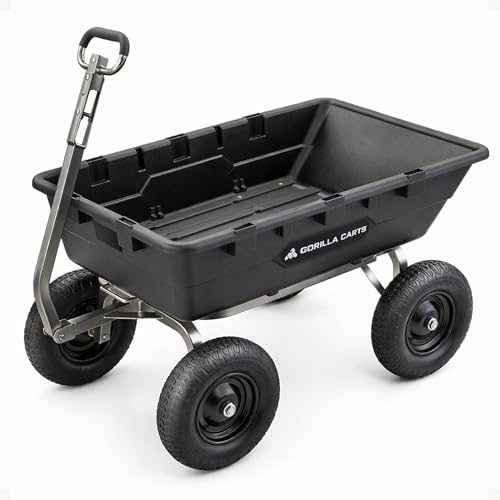
Gorilla Carts Poly Dump Cart, 1,500 lb, 10 cu ft
$389.99Ten cubic feet and a 1,500 pound rating means roughly three wheelbarrow loads per trip, with a dump lever instead of a lift.
Best for: two yards of mulch or more
Check price on Amazon
Jackson MP1010 10 cu ft Poly 2-Wheel Wheelbarrow
$689.94A two-wheel poly barrow at 10 cubic feet is far harder to tip on a slope than a single-wheel wheelbarrow, which matters loaded.
Best for: sloped yards and narrow gates
Check price on Amazon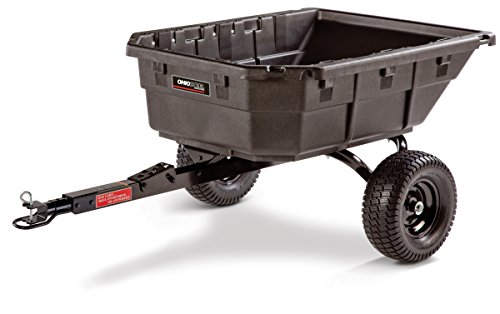
Ohio Steel 4048P-HYB 15 cu ft Poly Swivel Hybrid Dump Cart
$558.13A 15 cubic foot tow-behind swivel dump cart moves a delivered pile in a handful of trips rather than dozens.
Best for: large properties with a rider
Check price on Amazon
Truper TruTough 10-Tine Ensilage Fork
$51.97A ten tine fork picks up far more shredded mulch per scoop than a shovel and shakes soil and fines through.
Best for: loading bulk mulch by hand
Check price on Amazon
Bully Tools 16 in. Bow Rake
$37.99A steel bow rake levels mulch to an even depth quickly, which is what stops thin spots from sprouting weeds.
Best for: finishing beds
Check price on Amazon
EasyFlex Heavy Duty No-Dig Edging Kit (100 ft.)
$44.37A hundred feet of no-dig edging holds mulch inside beds and off the lawn, which cuts how often beds need topping up.
Best for: beds that spill into the lawn
Check price on AmazonHow we chose
We did not test these products in person. Picks are researched from manufacturer specifications and owner manuals, engine and safety certifications where they apply, warranty terms, public recall records, and the recurring themes in verified owner reviews. We favor established brands with large review counts and parts support, match each pick to a real yard size or task, and place it in the tier where its price and capability actually belong.
Frequently asked questions
How many bags of mulch do I need for 100 square feet?
At 3 inches deep, 100 square feet needs 25 cubic feet of mulch, about 0.93 cubic yards, which is 13 bags of 2 cubic feet or 9 bags of 3 cubic feet. At 2 inches deep the same bed takes 9 small bags. Add a bag or two for uneven ground and edges, because beds are never perfectly flat.
How much does a yard of mulch cover?
One cubic yard covers 324 square feet at 1 inch deep, 162 square feet at 2 inches, 108 square feet at 3 inches and 81 square feet at 4 inches. For planning, most people use 3 inches for new beds and 1 inch for a yearly refresh, so a yard covers about 108 square feet of new bed or about 324 square feet of top-up.
How many bags of mulch make a yard?
A cubic yard is 27 cubic feet, so it takes 13.5 bags of 2 cubic feet, 9 bags of 3 cubic feet or 18 bags of 1.5 cubic feet to equal one yard. When comparing prices, divide the bulk price per yard by the bag count to get an equivalent per-bag price, then add any delivery fee before deciding.
Should I remove old mulch before adding new?
Usually not. Old mulch that has broken down is improving the soil. Rake it to break up any matted crust, pull back anything piled against trunks or siding, and add about 1 inch of fresh mulch to restore color. Remove it only if the total depth already exceeds 3 to 4 inches, it is compacted and moldy, or you are switching to stone.
How much does a cubic yard of mulch weigh?
Dry shredded hardwood or bark mulch typically weighs roughly 400 to 800 pounds per cubic yard, and wet mulch weighs considerably more. Rubber mulch is heavier again. That matters for pickup trucks, which often carry 1 to 2 yards safely, and for how much you load into a barrow at once. A 2 cubic foot bag usually weighs about 20 to 30 pounds.
Researched, not professional advice. This page is compiled from published specifications, manuals, labels and owner-review consensus, not hands-on testing. Follow the manufacturer's instructions and product label, and consult a qualified professional where safety, chemicals, fuel or structures are involved. As an Amazon Associate we earn from qualifying purchases.