Robot Mowers
Robot Mower Calculator: Coverage, Slope and Boundary Wire Length
Quick answer
Choose a robot mower rated for about a third more area than your lawn, so it runs near 75 percent of capacity: a quarter-acre lawn of 10,890 square feet needs a model rated for about 14,500 square feet. Match the slope rating too, where 45 percent equals about 24 degrees, and budget roughly 1.1 feet of boundary wire per foot of edge for wired models.
Robot mowers are sold by maximum rated area and maximum slope, and both ratings assume a simple, open lawn mowed on the manufacturer's schedule. Enter your lawn area, steepest slope, how many separate zones and narrow passages it has, and its edge length, and the calculator recommends the minimum rated area, the slope rating you need, a boundary type and, for wired models, how much wire and how many stakes to buy. Measure first with the lawn size calculator if you need the square footage.
Robot mower calculator
Look for a rated area of at least
Robot mowers that fit your lawn
Top matches update when you calculate.

Husqvarna Automower 440iQ Robot Mower
$2,649.99The largest iQ model is rated for up to 2 acres on 45% slopes, using EPOS positioning instead of boundary wire, with GPS theft tracking and a 4-year warranty.
Best for: Large lawns up to 2 acres
Check price on Amazon
Mammotion LUBA 3 AWD 5000 Robot Mower
$3,299.00360-degree LiDAR, network RTK and dual-camera vision combine for navigation, with four-motor drive for 80% slopes and a rated 1.25 acres.
Best for: Steep or complex lawns up to 1.25 acres
Check price on Amazon
Husqvarna Automower 520H EPOS Robot Mower
$2,999.00A pro-grade wire-free EPOS Automower rated for 1.25 acres and 45% slopes, with a 0.8 to 2.4 inch cut range suited to low-cut turf.
Best for: Well-kept turf up to 1.25 acres
Check price on Amazon
ECOVACS GOAT A3000 LiDAR Robot Mower
$2,999.99Dual LiDAR mapping needs no wire or RTK antenna, the 13-inch cut width speeds coverage, and ECOVACS lists a 45-minute recharge, rated for 3/4 acre.
Best for: Yards near buildings or trees where satellite signal is weak
Check price on Amazon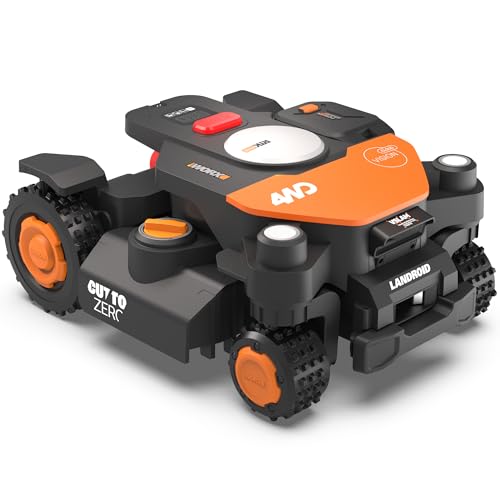
WORX Landroid Vision Cloud WR342 4WD Robot Mower
$2,069.99Cloud RTK needs no local antenna, 4WD climbs slopes up to 84%, and the Cut-to-Zero offset blade trims closer to borders, rated for 1/2 acre.
Best for: Hilly half-acre yards
Check price on Amazon
Husqvarna Automower 430X Robot Mower
$2,167.79A buried boundary wire gives a steady signal under heavy shade where satellite models can struggle, rated for 0.8 acre with a 9.45-inch cut width.
Best for: Heavily shaded lawns
Check price on Amazon
Mammotion LUBA 2 AWD 3000X Robot Mower
$1,998.00Four-wheel drive climbs 80% slopes, RTK plus AI vision handles mapping and edge cutting, and a 15.8-inch dual-blade disc covers up to 0.75 acre, with 4G tracking.
Best for: Sloped lawns up to 3/4 acre
Check price on Amazon
Husqvarna Automower 420iQ Robot Mower
$1,841.66The same wire-free EPOS system and 1 to 4 inch cut range as the 410iQ, rated for up to 1 acre on 45% slopes.
Best for: Lawns up to 1 acre
Check price on Amazon
Husqvarna Automower 410iQ Robot Mower
$1,829.99EPOS positioning replaces boundary wire, onboard radar helps avoid obstacles, and it handles 45% slopes up to 1/2 acre with a 4-year warranty.
Best for: Half-acre lawns
Check price on Amazon
Segway Navimow i215 LiDAR Robot Mower
$1,599.00Solid-state LiDAR fused with vision navigates without satellites or antennas, so it suits yards where trees or houses block RTK, up to 0.37 acre.
Best for: Tree-covered yards up to about a third of an acre
Check price on Amazon
Segway Navimow i210 AWD Robot Mower
$1,299.00All-wheel drive with electronic stability control climbs 45% slopes, and network RTK with vision needs no wire, rated for up to 1/4 acre.
Best for: Sloped quarter-acre yards
Check price on Amazon
Segway Navimow i105N Robot Mower
$799.00RTK plus vision positioning with no perimeter wire, AI-assisted mapping and a camera that recognizes 150+ obstacle types, sized for yards up to 1/8 acre.
Best for: Small, simple lawns
Check price on Amazon
Segway Navimow Garage S
$199.00A fitted shelter that shades the mower from sun and rain without blocking its positioning signal, with a flip-up cover for panel access.
Best for: Navimow i-series owners
Check price on Amazon
Husqvarna Automower House for iQ Series
$171.99Protects an iQ Automower from rain and sun at the charging station, and the foldable top keeps the keypad reachable.
Best for: Husqvarna iQ owners
Check price on AmazonOn this page
What size robot mower do I need for my lawn?
Minimum rated area at about 75 percent loading, with the two lowest-priced catalog models that meet it.
| Lawn | Square feet | Rated area to look for | Models that fit |
|---|---|---|---|
| 0.1 acres | 4,356 | 5,808 | Segway Navimow i210 AWD Robot Mower, Segway Navimow i215 LiDAR Robot Mower |
| 0.25 acres | 10,890 | 14,520 | Segway Navimow i215 LiDAR Robot Mower, Husqvarna Automower 410iQ Robot Mower |
| 0.5 acres | 21,780 | 29,040 | Husqvarna Automower 420iQ Robot Mower, Mammotion LUBA 2 AWD 3000X Robot Mower |
| 0.75 acres | 32,670 | 43,560 | Husqvarna Automower 420iQ Robot Mower, Husqvarna Automower 440iQ Robot Mower |
| 1 acre | 43,560 | 58,080 | Husqvarna Automower 440iQ Robot Mower |
| 1.5 acres | 65,340 | 87,120 | Husqvarna Automower 440iQ Robot Mower |
| 2 acres | 87,120 | 116,160 | No catalog model; consider two mowers or a rider |
How steep a slope can a robot mower handle?
| Degrees | Percent | Rise over run | Catalog robots rated for it |
|---|---|---|---|
| 5 degrees | 9 percent | 1 ft rise in 11.1 ft | 10 of 12 |
| 10 degrees | 18 percent | 1 ft rise in 5.6 ft | 10 of 12 |
| 15 degrees | 27 percent | 1 ft rise in 3.7 ft | 10 of 12 |
| 20 degrees | 36 percent | 1 ft rise in 2.8 ft | 10 of 12 |
| 24.2 degrees | 45 percent | 1 ft rise in 2.2 ft | 10 of 12 |
| 30 degrees | 58 percent | 1 ft rise in 1.7 ft | 3 of 12 |
| 35 degrees | 70 percent | 1 ft rise in 1.4 ft | 3 of 12 |
| 38.7 degrees | 80 percent | 1 ft rise in 1.3 ft | 3 of 12 |
How does the robot mower calculator work?
It works in three steps:
- Rated area needed = lawn area / 0.75, then increased by 10 percent for each extra zone beyond the first and 10 percent if the mower must travel through narrow passages to reach part of the lawn, because travel time is time not mowing.
- Slope needed = your steepest slope in percent, converted from degrees if needed (percent = tangent of the angle x 100).
- Boundary wire = (edge length + 25 feet for each tree, bed or obstacle you wire around + a guide wire about half the lawn's length) x 1.1 for slack and joins. Stakes are estimated at one every 2.5 feet, but follow the spacing in your mower's installation manual.
Wire-free models using RTK satellite positioning, cameras or LiDAR need no perimeter wire, but RTK units need a clear view of the sky for their reference station and can struggle under dense tree canopy, while vision models can struggle in poor light. That trade-off is covered in boundary wire vs RTK robot mowers.
Do I need a wire-free robot mower?
Wire-free is worth paying for when your lawn edges change often, when you have several zones you would otherwise wire and connect, or when you do not want to bury or stake several hundred feet of cable. The Segway Navimow i105N Robot Mower ($799.00) brings wire-free mowing to small lawns, the Mammotion LUBA 2 AWD 3000X Robot Mower combines RTK and vision with all-wheel drive for slopes, and the Husqvarna Automower 420iQ Robot Mower uses Husqvarna's EPOS satellite positioning. A wired model such as the Husqvarna Automower 430X Robot Mower costs less for its rated area and does not depend on satellite reception, which makes it a sound choice for simple lawns under heavy tree cover. Picks are ranked in robot mowers without boundary wire and robot mowers for hills.
How long does a robot mower take to mow a lawn?
Robot mowers do not mow in one session. They cut a little every day, usually in random or systematic passes at under 1 mph with a narrow blade disc, then return to charge. A mower loaded at 75 percent of its rating typically needs most of its scheduled daily hours to keep up in peak growing season, and less later in the year. That is why rated area matters more than blade width: a mower that is too small for the lawn simply falls behind and the grass gets away from it. Quiet electric operation means many owners run them overnight or while at work, but keep children and pets off the lawn while any robot mower is running.
Frequently asked questions
What size robot mower do I need for a half acre?
A half acre is 21,780 square feet, so look for a robot mower rated for at least about 29,000 square feet, which leaves roughly 25 percent headroom. Models rated for 0.75 acres or more fit comfortably. If the half acre is split into front and back zones connected by a narrow side yard, size up again, since the mower spends time traveling between areas instead of cutting.
How much boundary wire do I need for a robot mower?
Measure the lawn edge, add about 25 feet for each tree, bed or obstacle you loop the wire around, add a guide wire of roughly half the lawn length, and multiply by 1.1 for slack and splices. A simple 100 by 100 foot lawn with two islands needs about 550 feet. Most wired kits include 500 to 800 feet, and extra wire and stakes are sold separately.
Can a robot mower handle hills?
Yes, within its rated slope. Many two-wheel-drive models are rated around 35 to 45 percent, which is about 19 to 24 degrees, while all-wheel-drive models such as AWD Automowers, Mammotion Luba and Segway Navimow AWD are rated higher. Ratings apply to the steepest section, and wet grass reduces traction, so leave margin rather than running a mower at its limit.
Is a robot mower worth it for a small yard?
For lawns under a quarter acre, a robot mower is mostly a convenience purchase: a battery walk-behind costs less and mows the same area in about half an hour a week. Robots make the most sense where your time is scarce, mowing is physically difficult, or the lawn is large enough that daily automatic cutting saves hours. Their daily trimming also leaves a very even finish.
Do robot mowers work in the rain and at night?
Most robot mowers are weatherproofed and can mow in light rain, and many include rain sensors or app settings to pause mowing when wet, which protects the lawn and traction on slopes. Many can run at night, but owners and wildlife groups often recommend daytime schedules to avoid harming animals. Check your model manual for the recommended weather and scheduling settings.
Researched, not professional advice. This page is compiled from published specifications, manuals, labels and owner-review consensus, not hands-on testing. Follow the manufacturer's instructions and product label, and consult a qualified professional where safety, chemicals, fuel or structures are involved. As an Amazon Associate we earn from qualifying purchases.