Patio Heat and Fire Pits
Propane vs Wood Fire Pit: Heat, Smoke, Cost and Burn Bans
Quick answer
Choose propane for instant, ash-free, spark-free fires on patios and during most campfire bans: the Outland Firebowl 883 lists 58,000 BTU for $214.99. Choose wood for stronger radiant heat, the crackle and cooking over the fire: a smokeless pit like the Solo Stove Basecamp cuts smoke with secondary burn.

Outland Living Firebowl 883 Mega 24 in. Propane Fire Pit
$214.99Instant, ash-free flame with no sparks.
Best for: ash-free fires on a patio
Check price on Amazon
Solo Stove Basecamp 24 in. Fire Pit with Stand
$399.99Real radiant heat with secondary burn to cut smoke.
Best for: a mid-size smokeless pit for a deck
Check price on AmazonA propane fire pit is a gas burner under lava rock or fire glass, lit with a knob and shut off the same way. A wood fire pit is a steel bowl or double-wall chamber you load with seasoned logs. Smokeless wood pits add a second wall with holes near the top, so preheated air reignites smoke before it escapes, a design called secondary combustion.
Which is better depends on where you burn and what you want from the fire. The Outland Living Firebowl 883 Mega 24 in. Propane Fire Pit is $214.99 and the Solo Stove Basecamp 24 in. Fire Pit with Stand is $399.99. Check your seating circle with the fire pit size calculator and your local burn rules before buying either.
On this page
- How does a propane fire pit compare with a wood fire pit?
- Which should you choose, propane or wood?
- Can you use a propane fire pit during a burn ban?
- Which gives off more heat, a propane or wood fire pit?
- Are smokeless wood fire pits really smokeless?
- What does each type cost to run?
- Which propane and wood fire pits are worth buying?
How does a propane fire pit compare with a wood fire pit?
| Factor | Propane fire pit | Wood fire pit |
|---|---|---|
| Example | Outland Firebowl 883 Mega, $214.99 | Solo Stove Basecamp 24, $399.99 |
| Size | 24 by 24 by 13 in. | 24.6 in. diameter, 30.5 lb with stand |
| Fuel | 20 lb propane tank on a 10 ft hose | Dry, seasoned firewood |
| Starting | Turn the knob; no tools to set up | Build and light a fire, tend it to a steady burn |
| Heat | 58,000 BTU input; moderate radiant heat over lava rock | Coal bed radiates strongly at seat height; no BTU rating |
| Smoke | None | Reduced by 360 degree airflow; some at startup or with damp wood |
| Sparks and embers | None | Yes; a spark screen helps near decks and dry grass |
| Cleanup | None | Empty the removable ash pan when cold |
| Burn bans | CSA approved; the maker says usable during most campfire bans, check local rules | Usually prohibited during bans |
| Running cost on high | About 2.7 lb per hour, about $2.20; about 7.4 hours per 20 lb tank | Depends on firewood source; efficient pits burn wood quickly |
| Cooking | Not designed for it; follow the manual | Roasting is traditional; some pits accept cooking accessories |
Cost examples use propane at $3.50 per gallon (4.24 lb per gallon, about 83 cents per pound) and 21,548 BTU per pound; swap in your local price.
Which should you choose, propane or wood?
Choose a propane fire pit if
- You want a fire in seconds and off with a knob, with no ash or smoke in the house.
- You camp or live where campfire bans are common; the Outland Living Firebowl 870 Premium 19 in. Propane Fire Pit is CSA approved and marketed for use during most bans.
- Neighbors, asthma or close lot lines make wood smoke a problem.
- You want a fire near a patio edge where sparks would be a risk.
Choose a wood fire pit if
- You want real radiant warmth around a seated circle.
- The sound and smell of a wood fire is the point.
- You want to roast or cook over live fire; the Breeo X Series 24 Corten Steel Smokeless Fire Pit accepts Breeo cooking accessories.
- You have a free or cheap wood supply.
Can you use a propane fire pit during a burn ban?
Often, but not always. Many fire restrictions allow gas-fueled devices that can be turned off instantly and throw no sparks, which is why Outland describes its CSA-approved Firebowls as safe to use during most campfire bans while telling buyers to check current restrictions. Stricter stages of restriction can ban all open flames, including propane. Your local fire department, park agency or county sets the rule on any given day, and HOAs can add their own limits. Wood fires are almost always prohibited once a burn ban is declared.
Which gives off more heat, a propane or wood fire pit?
A wood fire, for people sitting around it. Propane pits are rated by burner input, and 58,000 BTU sounds large, but much of that heat leaves as hot gas rising above the flame, and lava rock radiates only modestly. A wood fire builds a glowing coal bed that radiates in every direction at seat height, which is the warmth people feel on their shins and hands. Smokeless wood pits push heat upward as well, so owners of stainless pits commonly report sitting close for warmth. If warmth matters more than flame, add a Fire Sense 61130 Standing Propane Patio Heater, 48,000 BTU or read patio heater vs fire pit.
Are smokeless wood fire pits really smokeless?
They are low-smoke, not no-smoke. Secondary combustion burns off much of the smoke once the fire is hot, but a cold start, damp wood, overloading above the air holes or a gust can still send smoke your way. The single biggest factor is fuel: burn dry, seasoned hardwood that has been split and stored under cover, and keep logs below the top air holes. Kiln-dried firewood is the most consistent option. Owners commonly report that these pits burn wood faster than an open bowl because combustion is so efficient, so budget more wood per evening.
What does each type cost to run?
Propane holds 21,548 BTU per pound. The Outland Firebowl 883 lists 58,000 BTU, so on full flame it burns about 2.7 lb per hour, roughly $2.20 at $3.50 per gallon, and a 20 lb tank lasts about 7.4 hours. Most people run a lower flame, stretching that toward 10 to 15 hours. The Ignik FireCan Elite Portable Propane Fire Pit lists 55,000 BTU and uses propane at a similar rate. Wood costs range from free, if you have trees, to expensive if you buy small bundles at a store; a cord or face cord from a local supplier is far cheaper per fire. The propane tank burn time chart covers other burner sizes.
Which propane and wood fire pits are worth buying?
Two propane bowls and two wood pits from our catalog.
Outland Living Firebowl 883 Mega 24 in. Propane Fire Pit
$214.99A 24 inch, 58,000 BTU propane bowl that sets up without tools, with a 10 ft hose, adjustable regulator, lava rock and a weather cover.
Best for: ash-free fires on a patio
Check price on Amazon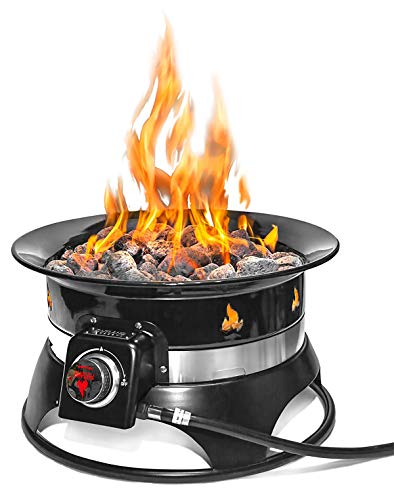
Outland Living Firebowl 870 Premium 19 in. Propane Fire Pit
$199.99A 19 inch, 58,000 BTU CSA-approved bowl with matchless auto-ignition and a cover and carry kit, marketed for use during most campfire bans.
Best for: camping where wood fires are restricted
Check price on Amazon Solo Stove Basecamp 24 in. Fire Pit with Stand
$399.99A 24.6 inch stainless pit with patented 360 degree airflow, a removable ash pan and a protective stand, at 30.5 lb.
Best for: low-smoke backyard wood fires for five to seven
Check price on Amazon
Breeo X Series 24 Corten Steel Smokeless Fire Pit
$599.00A made-in-USA double-wall corten steel pit with X Airflow secondary combustion that accepts Breeo live-fire cooking accessories.
Best for: a permanent fire centerpiece that also cooks
Check price on AmazonHow we chose
We did not test these products in person. Picks are researched from manufacturer specifications and owner manuals, engine and safety certifications where they apply, warranty terms, public recall records, and the recurring themes in verified owner reviews. We favor established brands with large review counts and parts support, match each pick to a real yard size or task, and place it in the tier where its price and capability actually belong.
Frequently asked questions
Is a propane or wood fire pit better?
Propane is better for convenience, patios, close neighbors and burn-ban areas: instant on and off, no smoke, sparks or ash. Wood is better for radiant heat, atmosphere and cooking over the fire. For a typical suburban patio, a propane bowl like the Outland Firebowl 883 is easier to live with, while a large yard with firewood on hand suits a smokeless wood pit.
Can you roast marshmallows over a propane fire pit?
Check your fire pit manual first, because many propane fire pit makers advise against cooking over the burner, and food drippings can clog burner ports and foul lava rock or fire glass. If the manual allows it, keep it to occasional marshmallows held above the flame. For regular cooking over fire, a wood-burning pit designed for it, such as one that accepts cooking accessories, is the right tool.
How long does a 20 lb tank last in a propane fire pit?
A 20 lb tank holds about 431,000 BTU. A 58,000 BTU fire pit at full flame burns it in about 7.4 hours, and a 40,000 BTU fire table lasts about 11 hours. At the medium flame most people use for ambiance, expect roughly 10 to 15 hours from a tank on a 58,000 BTU bowl. A tank scale tells you what is left before guests arrive.
Can you convert a wood fire pit to propane?
Only with a gas burner insert that is certified for that use and compatible with that pit, installed as its instructions require. Never improvise by setting a burner or hose inside a wood-burning bowl, because heat and trapped gas create fire and explosion risks, and wood pit drainage and airflow are not designed for gas. Buying a purpose-built propane fire pit is usually simpler and safer.
Do wood fire pits need a spark screen?
A spark screen is strongly recommended anywhere embers could reach a deck, dry grass, leaves or pine needles, and some local rules require one. Softwoods and damp wood pop more than seasoned hardwood. Solo Stove sells a fitted Bonfire Shield for its Bonfire, with removal tools. Even with a screen, keep water or an extinguisher nearby and supervise the fire until it is out.
Researched, not professional advice. This page is compiled from published specifications, manuals, labels and owner-review consensus, not hands-on testing. Follow the manufacturer's instructions and product label, and consult a qualified professional where safety, chemicals, fuel or structures are involved. As an Amazon Associate we earn from qualifying purchases.