Outdoor Power Tools
Straight vs Curved Shaft String Trimmer: Which Is Better?
Quick answer
Choose a straight shaft trimmer if you are tall, trim under shrubs, decks and fences, or want blade and attachment options; the Husqvarna 130L cuts an 18 in path. Choose a curved shaft like the Husqvarna 128C if you are shorter, want a compact, well-balanced trimmer and mostly trim open lawn edges and beds.

Husqvarna 130L 28cc Straight Shaft Gas String Trimmer
$279.0028cc engine, 18 in cutting width and a straight shaft that reaches under shrubs and fences.
Best for: rural lots, ditches and fence lines beyond battery range
Check price on Amazon
Husqvarna 128C 28cc Curved Shaft Gas String Trimmer
$199.9928cc engine, 17 in cutting path and a curved shaft at about 11 lb.
Best for: first-time gas trimmer buyers with average residential lawns
Check price on AmazonA straight shaft trimmer runs a solid driveshaft to a gearbox at the cutting head, which puts the head farther out in front of you and lets you reach under obstacles. A curved shaft trimmer bends near the head, usually with a flexible drive cable inside, which brings the head closer, shortens the tool and makes it feel lighter and easier to guide for shorter users. Both of the Husqvarna examples here use the same 28cc engine class, so the shaft is the real difference.
For most lawns either works. The straight shaft matters most for taller people, rough property edges and anyone who might want a brush blade later. The curved shaft 128C ($199.99) costs less than the straight 130L ($279.00). Battery trimmers largely sidestep the debate with straight, often telescopic shafts, such as the EGO ST1623T.
On this page
- How do straight and curved shaft trimmers compare?
- Which should you choose, straight or curved shaft?
- Is a straight shaft string trimmer better?
- Do battery string trimmers come in curved shafts?
- What does each cost to own over 5 years?
- What do owners commonly report?
- Straight and curved shaft trimmers worth a look
How do straight and curved shaft trimmers compare?
| Factor | Straight: {{p:husqvarna-130l|Husqvarna 130L}} | Curved: {{p:husqvarna-128c|Husqvarna 128C}} |
|---|---|---|
| Engine | 28cc two-cycle | 28cc two-cycle |
| Cutting width | 18 in | 17 in |
| Reach | Longer; head well out in front | Shorter; head closer to your feet |
| Under shrubs, decks, fences | Easy to slide under | Harder; head angle limits reach |
| Best user height | Average to tall | Shorter to average |
| Drive | Solid driveshaft and gearhead (typical) | Flexible cable (typical) |
| Blades and attachments | Straight shafts are the type that can accept blades, only if the manual allows | Generally not |
| Starting aids | Smart Start, Air Purge, digital ignition | Smart Start (Husqvarna: 40 percent less pull effort), Air Purge |
| Trimmer head | Rapid Replace head | T25 Tap n Go bump head |
| Catalog price | $279.00 | $199.99 |
Specs from Husqvarna listings. Drive types describe typical gas trimmer construction; check the manual for a specific model.
Which should you choose, straight or curved shaft?
Choose a straight shaft trimmer if:
- You are tall, or you want to stand upright without hunching over the tool.
- You trim under shrubs, low branches, decks, benches and fence rails.
- You clear ditches, slopes, fence rows or rough property edges.
- You might add a brush blade or attachments later, as allowed by the manual.
Choose a curved shaft trimmer if:
- You are shorter and a long straight shaft feels unwieldy.
- You mostly trim along beds, walkways and around the house.
- You want the lowest-cost gas trimmer that still has a full-size engine.
- You value close control and visibility near flower beds.
Is a straight shaft string trimmer better?
For heavier work, generally yes. A solid driveshaft and gearhead handle dense weeds and long sessions well, and the extra length keeps debris farther from your legs and lets you cut under obstacles without bending. That is why commercial trimmers such as the ECHO SRM-2620T use straight shafts. The costs are a longer tool that is harder to store and maneuver in tight spots and, for some users, a head that feels farther away to control.
A curved shaft is not a lesser tool for ordinary lawn trimming. Husqvarna describes the 128C curved shaft as giving a comfortable working angle and good visibility around beds and obstacles, and at about 11 lb it is an easy first gas trimmer. It is simply not the one to pick for brush or for regular work under low obstacles.
Do battery string trimmers come in curved shafts?
Rarely, and it matters less. Every battery trimmer in the catalog uses a straight shaft, and several solve the height problem with adjustable length: the EGO ST1623T has a telescopic carbon fiber shaft. Attachment-capable power heads, like the RYOBI 40V attachment trimmer and DEWALT DCST972X1, split into straight sections that also run edgers and pole saws. If you are choosing between gas designs because you are short, a battery trimmer with an adjustable shaft and handle may fit you better than either. Compare in the best string trimmers.
What does each cost to own over 5 years?
Running costs are nearly identical: both 28cc Husqvarnas need two-cycle fuel mixed to the ratio in the manual, line, an air filter and a spark plug. A straight shaft gearhead may need periodic grease per the manual. The bigger long-term cost is fuel care: two-stroke trimmers that sit with ethanol fuel are the usual source of hard-starting complaints, and ethanol-free premix like VP Racing SEF 50:1 reduces that risk. Use the two-cycle mix ratio calculator for exact oil amounts and the line size chart to match line.
What do owners commonly report?
Husqvarna 128C owners commonly praise easy starting and value as a first gas trimmer, and some complain about the bump-feed head and line tangling. Straight shaft owners, including 130L buyers, often praise reach under obstacles and comfort for taller users, and note the extra length when storing it. Across both, taller owners who bought curved shafts are the group most likely to report back strain or regret.
Straight and curved shaft trimmers worth a look
The gas pair plus two straight shaft alternatives.
Husqvarna 130L 28cc Straight Shaft Gas String Trimmer
$279.00A 28cc engine with an 18 in cutting width, Smart Start and Air Purge, digital ignition, LowVib and a Rapid Replace head.
Best for: rural lots, ditches and fence lines
Check price on Amazon Husqvarna 128C 28cc Curved Shaft Gas String Trimmer
$199.99A 28cc engine with a 17 in cutting path, a curved shaft for close control, Smart Start and a T25 Tap n Go head at about 11 lb.
Best for: first gas trimmer for an average lawn
Check price on Amazon
EGO Power+ ST1623T 16 in. String Trimmer Kit with 4.0Ah Battery
$299.00A telescopic carbon fiber shaft you set to your height, an auto-feeding LINE IQ head and up to 60 minutes on the included 4.0Ah battery.
Best for: users who want to skip gas and fit the tool to their height
Check price on Amazon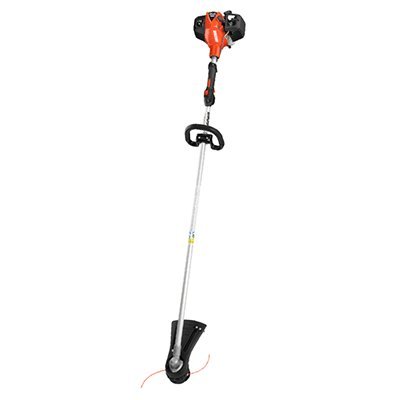
ECHO SRM-2620T 25.4cc High Torque Gas String Trimmer
$479.99A high torque 25.4cc engine with the Speed-Feed head on a straight shaft, built for dense weeds and daily use.
Best for: acreage and heavy weeds
Check price on AmazonHow we chose
We did not test these products in person. Picks are researched from manufacturer specifications and owner manuals, engine and safety certifications where they apply, warranty terms, public recall records, and the recurring themes in verified owner reviews. We favor established brands with large review counts and parts support, match each pick to a real yard size or task, and place it in the tier where its price and capability actually belong.
Frequently asked questions
Is a curved shaft trimmer good for tall people?
Usually not. A curved shaft is shorter and brings the cutting head close, so taller users tend to hunch over it, and owners in that group are the most likely to report back strain. A straight shaft like the Husqvarna 130L lets you stand upright. A battery trimmer with a telescopic shaft, such as the EGO ST1623T, adjusts to your height.
Can you put a blade on a curved shaft trimmer?
Generally no. Blade kits need a straight shaft, a gearhead designed for the load, a proper blade guard, a handlebar or J-handle and often a harness. Curved shaft trimmers with flexible cable drives are not built for that. Even on straight shaft models, fit a blade only if the manufacturer's manual allows it and supplies the correct guard. For brush, consider a dedicated brush cutter.
Which is lighter, a straight or curved shaft trimmer?
Curved shaft trimmers are usually a little lighter and feel easier to handle because they are shorter and the head sits closer. Husqvarna lists the 128C at about 11 lb. Straight shafts add some length and a gearhead, and the head sits farther out, which can make them feel heavier at arm's length even when the difference on the scale is small. Check each listing for exact weight.
Do straight shaft trimmers cut better?
They cut the same grass; the engine, line and head matter more than the shaft for ordinary trimming. Straight shafts do better in dense weeds and long sessions because the solid driveshaft and gearhead handle load well, and they reach under obstacles. The 130L cuts an 18 in path versus 17 in on the 128C, a small difference.
What trimmer line size should I use?
Use the size your trimmer manual lists. Many battery trimmers take .080 in line, such as Oregon Gatorline .080, while gas and high-voltage battery trimmers often take .095 in, like MaxPower .095. Thicker line lasts longer in heavy weeds but draws more power and can overload small motors. The line size chart covers more sizes.
Researched, not professional advice. This page is compiled from published specifications, manuals, labels and owner-review consensus, not hands-on testing. Follow the manufacturer's instructions and product label, and consult a qualified professional where safety, chemicals, fuel or structures are involved. As an Amazon Associate we earn from qualifying purchases.