Lawn Care
Best Lawn Spreaders for Fertilizer and Grass Seed (2026)
Quick answer
For an acre or more, the best lawn spreader is the Brinly BS361BH-A, a 175 lb tow-behind with stainless hardware. Walking a half-acre, the Chapin 8401C 80 lb push model is the step up. Under 15,000 sq ft, the Scotts EdgeGuard DLX is enough.
The right spreader is sized to your lawn, not your budget. A hopper that covers your whole yard in one fill gives you an even application with no refill seams, and a rotary (broadcast) spreader covers ground several times faster than a drop spreader. That is why the top pick here is a tow-behind: the Brinly BS361BH-A ($439.00) holds 175 lb, about 3.5 cu ft, which Brinly sizes for yards of 1 acre or larger.
If you do not own a riding mower, a commercial push spreader such as the Chapin 8401C or the EarthWay 2150 is the durable choice. Small lawns do fine with a Scotts EdgeGuard DLX. Measure first with the lawn size calculator, then work out bag counts with the fertilizer calculator.
On this page
- What is the best lawn fertilizer spreader for my lawn size?
- Beginner pick: a pre-calibrated push spreader for lawns under a third of an acre
- Intermediate pick: commercial push or entry tow-behind for half an acre
- Expert pick: 175 lb tow-behinds and stainless push spreaders for acreage
- How do the spreader picks compare on specs?
- Drop spreader vs rotary: which is better for fertilizer and grass seed?
- How many pounds of fertilizer per 1,000 sq ft should a spreader put down?
- Should I buy a tow-behind spreader for a riding mower?
- Other spreaders worth a look
- Lawn spreader buying tips: what matters most?
What is the best lawn fertilizer spreader for my lawn size?
A lawn spreader is a hopper on wheels that meters granules through an adjustable gate. A broadcast (rotary) spreader drops them onto a spinning plate that throws a wide fan; a drop spreader lets them fall straight down between the wheels. For most people the decision is really about lawn size and whether you own a tractor or zero-turn to pull a tow-behind.
The rule of thumb: pick a hopper that covers at least half your lawn per fill. A handheld Scotts Whirl is rated for about 1,500 sq ft of Scotts product, fine for patch seeding but tiring beyond that. The EdgeGuard DLX holds up to 15,000 sq ft of product, roughly a third of an acre. Above that, you are refilling constantly with a consumer push spreader, and a 50 to 80 lb commercial push model or a tow-behind saves real time.
| Lawn size | Spreader type | Hopper | Example pick |
|---|---|---|---|
| Under 2,000 sq ft | Handheld broadcast | About 1,500 sq ft of product | Scotts Whirl |
| 2,000 to 15,000 sq ft | Consumer push broadcast | Up to 15,000 sq ft of product | Scotts EdgeGuard DLX |
| 1/4 to 1/2 acre, rough ground | Commercial push broadcast | 50 lb | EarthWay 2150 |
| 1/2 to 1 acre on foot | Commercial push broadcast | 80 lb | Chapin 8401C |
| 1/2 acre with a riding mower | Tow-behind broadcast | 130 lb, up to 25,000 sq ft | Agri-Fab 130 lb |
| 1 acre and up | Tow-behind broadcast | 175 lb | Brinly BS361BH-A |
| Beds, ponds, property lines | Tow or push drop | 120 to 175 lb | Agri-Fab 175 lb drop, Spyker P70 |
Hopper ratings are from manufacturer listings. Product density varies, so a hopper covers less ground with heavy lime or coated seed than with light fertilizer.
Beginner pick: a pre-calibrated push spreader for lawns under a third of an acre
For a typical suburban lot, the goal is even coverage with no guesswork. Scotts prints settings for its own spreaders on its bags, which removes the calibration step that trips up most first-time users.

Scotts Turf Builder EdgeGuard DLX Broadcast Spreader
$94.97Ships assembled and pre-calibrated, holds up to 15,000 sq ft of Scotts product, and the EdgeGuard side shield blocks the throw on one side so granules stay off beds, driveways and sidewalks. Owners commonly note it is plastic throughout, so treat it gently and rinse it after use.
Best for: lawns up to about a third of an acre
Check price on Amazon
Scotts Whirl Hand-Powered Spreader
$27.57A crank handheld with an adjustable arm support that holds up to 1,500 sq ft of product. It is the right tool for overseeding bare spots, spreading ice melt on steps, or seeding a strip along a fence.
Best for: spot seeding and small side yards
Check price on AmazonIntermediate pick: commercial push or entry tow-behind for half an acre
Once you spread four or five times a year, gearboxes and tires matter. Commercial push spreaders use enclosed gearboxes and pneumatic tires that roll over bumps without bouncing the rate.

EarthWay 2150 Commercial 50 lb Broadcast Spreader
$279.99Thirteen inch pneumatic stud tires ride over uneven turf, the fully enclosed gearbox keeps working in damp conditions, and the 3-hole drop system with side-spread control feathers the edges. The slide-out grate breaks up clumps before they clog the gate.
Best for: bumpy quarter to half-acre lawns
Check price on Amazon
Agri-Fab 130 lb Tow-Behind Broadcast Spreader
$249.99A 130 lb hopper Agri-Fab rates for up to 25,000 sq ft per fill, with a 10 to 12 ft spread width and a universal hitch that fits most lawn tractors and riders. It is the lowest-cost way to stop walking behind a spreader.
Best for: half-acre lawns with a riding mower
Check price on AmazonExpert pick: 175 lb tow-behinds and stainless push spreaders for acreage
These are for owners who feed, seed and treat an acre or more several times a season, or who need exact edges near water and beds.

Brinly BS361BH-A Deluxe 175 lb Tow-Behind Broadcast Spreader
$439.00Stainless hardware on every part that touches fertilizer, glass-filled nylon gears in a sealed gearbox, and directional spread pattern control that lets you center the throw for materials that spread unevenly. Brinly says the Autoflow design stops the flow when the tractor stops, which cuts the heavy spots at turns.
Best for: acreage owners who want even edges
Check price on Amazon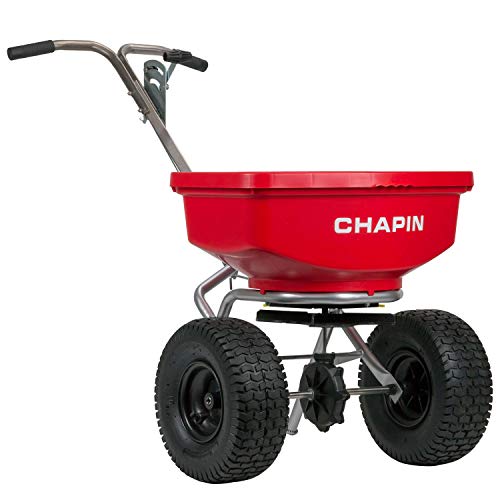
Chapin 8401C 80 lb Professional SureSpread Turf Spreader
$360.33An 80 lb hopper on a stainless frame with stainless gate linkage, 14 inch pneumatic tires and a limited-lifetime warranty, made in the USA. Chapin notes it is not recommended for rock salt, sand, pelletized lime or lime powders, so use a different spreader for liming.
Best for: acre-sized lawns spread on foot
Check price on Amazon
Spyker P70-12010 Commercial Drop Spreader
$649.00A 120 lb commercial walk-behind drop spreader with a 36 inch spread width and powder-coated steel frame. A drop pattern puts product only where the wheels go, which is the safest choice beside ponds, gardens and a neighbor's lawn.
Best for: exact edges on formal lawns
Check price on AmazonWho should not buy this tier: Skip this tier if your lawn is under half an acre: a 175 lb hopper is heavy to fill and turn, and a $400 to $650 spreader will not spread any more evenly than a well-calibrated push model on a small lot. Skip tow-behinds if your lawn has slopes steeper than your tractor manual allows or tight gates, and skip the drop spreader if you are not willing to overlap wheel tracks carefully, because misses show up as green and yellow stripes.
How do the spreader picks compare on specs?
| Model | Price | Type | Capacity | Capacity |
|---|---|---|---|---|
| Brinly BS361BH-A Deluxe 175 lb Tow-Behind Broadcast Spreader | $439.00 | tow behind broadcast | 175 lb | - |
| Chapin 8401C 80 lb Professional SureSpread Turf Spreader | $360.33 | push broadcast | 80 lb | - |
| Spyker P70-12010 Commercial Drop Spreader | $649.00 | push drop | 120 lb | - |
| Agri-Fab 130 lb Tow-Behind Broadcast Spreader | $249.99 | tow behind broadcast | 130 lb | 25,000 sq ft |
| EarthWay 2150 Commercial 50 lb Broadcast Spreader | $279.99 | push broadcast | 50 lb | - |
| Scotts Turf Builder EdgeGuard DLX Broadcast Spreader | $94.97 | push broadcast | - | 15,000 sq ft |
Drop spreader vs rotary: which is better for fertilizer and grass seed?
A rotary (broadcast) spreader is better for most lawns because it covers an 8 to 12 ft swath and the edges of each pass fade out, which hides small overlap mistakes. A drop spreader is better where precision matters: next to flower beds, water, a driveway you do not want stained, or a property line. The trade is time. A 36 inch drop spreader needs roughly three times as many passes as a rotary throwing 10 ft, and any gap between wheel tracks leaves a visible stripe. The full breakdown is on the drop vs broadcast spreader comparison.
For grass seed, both work. Rotary spreaders throw light seed like Kentucky bluegrass unevenly in wind, so seed on a calm day. Many owners broadcast the open lawn and switch to a drop spreader or the EdgeGuard shield along beds.
| Factor | Rotary (broadcast) | Drop |
|---|---|---|
| Swath width | About 8 to 12 ft (Agri-Fab lists 10 to 12 ft) | Wheel width, 36 to 42 in on the picks |
| Passes for 1 acre | Fewer | About 3x more |
| Overlap forgiveness | High, edges feather | Low, gaps show as stripes |
| Near beds and water | Needs an edge shield | Best choice |
| Wind sensitivity | Higher, especially light seed | Low |
| Typical use | Whole-lawn fertilizer and seed | Edges, ponds, formal lawns |
How many pounds of fertilizer per 1,000 sq ft should a spreader put down?
Set the spreader to the label rate. The bag is the law for weed and feed and pre-emergent products, and for straight fertilizer the label rate is built around the nitrogen dose. Extension services generally recommend no more than about 1 lb of nitrogen per 1,000 sq ft per feeding for most lawns. To find how many pounds of product deliver 1 lb of nitrogen, divide 100 by the first number on the bag. A 32-0-3 needs about 3.1 lb per 1,000 sq ft; a 6-4-0 organic needs about 16.7 lb.
If your spreader is not listed on the bag, calibrate it: mark out 1,000 sq ft, weigh the product before and after one pass at a trial setting, and adjust. Extension guides also suggest setting the spreader to half rate and making two passes at right angles, which evens out streaks. The fertilizer rate chart and the guide on how to read a fertilizer label go deeper.
| Bag analysis | Nitrogen % | Lb product per 1,000 sq ft | Lb product per acre |
|---|---|---|---|
| 32-0-3 | 32 | 3.1 | 136 |
| 29-0-3 | 29 | 3.4 | 150 |
| 24-6-12 | 24 | 4.2 | 182 |
| 24-25-4 starter | 24 | 4.2 | 182 |
| 16-4-8 | 16 | 6.3 | 272 |
| 8-0-5 organic | 8 | 12.5 | 545 |
| 6-4-0 organic | 6 | 16.7 | 726 |
Formula: 100 divided by nitrogen percent. This is nitrogen math, not a label rate; always apply at the rate printed on the product you bought.
Should I buy a tow-behind spreader for a riding mower?
Yes, if you already own a lawn tractor or zero-turn and your lawn is half an acre or more. A tow-behind turns a 45 minute walk into a 15 minute ride and holds enough product to finish without refilling. The Agri-Fab 130 lb ($249.99) is the entry point; the Brinly is the one to buy if you spread often and want stainless parts that survive corrosive fertilizer.
If you do not yet have a rider, size that first: the best riding lawn mowers and best zero-turn mowers roundups cover the tractors that pull these, and the intermediate 1 acre lawn setup shows a complete kit with a mower, spreader and aerator that work together. A tow-behind drop spreader like the Agri-Fab 175 lb drop is the precise alternative for lots with ponds or long bed lines.
Other spreaders worth a look
Two more commercial options for specific jobs.

Lesco 50 lb Commercial Push Spreader
$445.00An enclosed gearbox on a powder-coated carbon steel frame, and many professional fertilizer bags print a setting for it. It costs more than the EarthWay for the same 50 lb capacity, so buy it if you use pro products with Lesco settings.
Best for: pro-grade bagged products
Check price on Amazon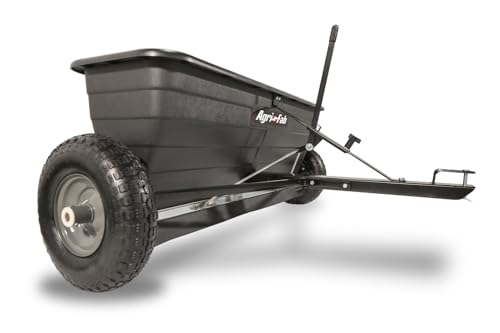
Agri-Fab 175 lb Tow-Behind Drop Spreader, 42 in
$329.00A 42 inch tow drop spreader holding 175 lb, which Agri-Fab rates for about 40,000 sq ft per fill. It places material straight down with no throw, so it is the tow-behind to buy for properties with ponds, gardens or tight property lines.
Best for: acreage with water features and beds
Check price on AmazonLawn spreader buying tips: what matters most?
- Enclosed gearbox. Fertilizer dust and moisture destroy open gears. Every intermediate and expert pick here has a sealed or enclosed gearbox.
- Pneumatic tires. Bouncing hard wheels change the flow rate over bumps. Tires of 13 to 14 inches roll smoother.
- Stainless or poly where it counts. Hoppers should be poly; shafts, agitators and gate linkage last longest in stainless.
- An edge control. A shield, side-spread control or directional pattern control keeps product off pavement and out of storm drains.
- Lime needs. Check the manual. The Chapin 8401C is not recommended for lime, so owners who lime often pick a different model for that job.
- Cleaning. Rinse and dry the spreader after every use and run the gate open and closed so salts do not seize it.
How we chose
We did not test these products in person. Picks are researched from manufacturer specifications and owner manuals, engine and safety certifications where they apply, warranty terms, public recall records, and the recurring themes in verified owner reviews. We favor established brands with large review counts and parts support, match each pick to a real yard size or task, and place it in the tier where its price and capability actually belong.
Frequently asked questions
What is the best lawn fertilizer spreader for a small yard?
For lawns under about 15,000 sq ft, a pre-calibrated consumer push broadcast spreader such as the Scotts EdgeGuard DLX is the practical choice. It ships assembled, Scotts bags list its settings, and the edge shield keeps granules off beds and pavement. Under 2,000 sq ft, a crank handheld like the Scotts Whirl is enough. Spending more on a commercial spreader buys durability, not better coverage, on a small lot.
What is the best grass seed spreader?
A broadcast spreader works best for seeding whole lawns because its wide, feathered pattern hides overlap errors. Use a calm day, since light seeds such as Kentucky bluegrass drift. Set the gate from the seed bag or calibrate on a measured 1,000 sq ft area, then spread half the rate in two directions. For bare patches, a handheld spreader or the seed bag itself is faster than wheeling out a push spreader.
Is a drop spreader or rotary spreader better?
Rotary spreaders are better for most homeowners because they cover 8 to 12 ft per pass and blend the edges of each pass. Drop spreaders are better for precision near flower beds, water and property lines, but they need about three times as many passes and leave stripes if you miss between wheel tracks. Many owners use a rotary for the open lawn and a drop spreader or edge shield along beds.
What size tow-behind spreader do I need for 1 acre?
For 1 acre, look for a hopper of about 130 to 175 lb. Agri-Fab rates its 130 lb tow spreader for up to half an acre per fill, so an acre takes two fills, while Brinly sizes its 175 lb BS361BH-A for yards of 1 acre or more. Dense products such as lime and coated seed cover less area per fill than light fertilizer.
How do I calibrate a lawn spreader?
Mark a 1,000 sq ft area, such as 20 by 50 ft. Weigh some product, spread the area at a trial setting, and weigh what is left. The difference is your pounds per 1,000 sq ft. Adjust the setting until it matches the label rate. Extension guides suggest spreading at half rate in two perpendicular passes for more even results, and recalibrating whenever you switch products.
Can I use a fertilizer spreader for lime and ice melt?
Many spreaders are labeled for seed, fertilizer, salt and ice melt, including the Scotts EdgeGuard DLX and Agri-Fab tow models. Lime is harder on metal parts, and some models, such as the Chapin 8401C, are not recommended for lime or rock salt. Check the manual, and rinse the spreader thoroughly afterward because salt and lime corrode gears and gate linkage.
Researched, not professional advice. This page is compiled from published specifications, manuals, labels and owner-review consensus, not hands-on testing. Follow the manufacturer's instructions and product label, and consult a qualified professional where safety, chemicals, fuel or structures are involved. As an Amazon Associate we earn from qualifying purchases.