Lawn Care
Drop Spreader vs Broadcast (Rotary) Spreader: Which Is Better?
Quick answer
A broadcast (rotary) spreader is the better choice for most lawns: it throws an 8 to 12 ft swath, covers ground about three times faster and hides small overlap errors. A drop spreader places product only between its wheels, best beside beds, ponds and driveways, but it leaves stripes if you miss. Many owners pair broadcast with an edge guard.

Spyker P70-12010 Commercial Drop Spreader
$649.00A 120 lb commercial drop spreader with a 36 in spread width.
Best for: exact-edge work on large, formal lawns
Check price on Amazon
EarthWay 2150 Commercial 50 lb Broadcast Spreader
$279.99A 50 lb commercial push broadcast spreader with side-spread control.
Best for: rough or bumpy lawns
Check price on AmazonA broadcast spreader, also called a rotary spreader, drops granules onto a spinning plate that flings them in a wide fan. A drop spreader lets granules fall straight down through holes in the bottom of a hopper as wide as the wheelbase. The broadcast pattern is heaviest in the middle and fades at the edges, so overlapping passes blend in. The drop pattern has hard edges, so every pass must meet the last exactly.
For open lawns, broadcast wins on speed and forgiveness; the EarthWay 2150 ($279.99) is a durable push model. Drop spreaders earn their place on formal lawns and around water, beds and hardscape, where the Spyker P70-12010 ($649.00) keeps every granule inside a 36 in path. Work out how much product you need with the fertilizer calculator.
On this page
- How does a drop spreader compare with a broadcast spreader?
- Which should you choose, drop or broadcast?
- Drop spreader vs rotary: which is more accurate?
- How do you avoid stripes with either spreader?
- Which spreader is better for grass seed, fertilizer and pre-emergent?
- What do owners commonly report?
- Drop and broadcast spreaders worth a look
How does a drop spreader compare with a broadcast spreader?
| Factor | Drop spreader | Broadcast spreader |
|---|---|---|
| Pattern | Straight down between the wheels, hard edges | Wide fan, heavy center, feathered edges |
| Swath width | 36 in (Spyker P70); 42 in (Agri-Fab 175 lb tow) | About 8 to 12 ft; Agri-Fab lists 10 to 12 ft for its 130 lb tow spreader |
| Passes for the same lawn | About 3 times as many | Fewest |
| Overlap forgiveness | Low; gaps and doubles show as stripes | High; edges blend |
| Near beds, ponds, driveways | Best choice | Needs an edge guard or side-spread control |
| Wind sensitivity | Low | Higher, especially with light seed |
| Mixed particle sizes | Falls evenly | Heavier granules throw farther, which can skew the pattern |
| Calibration | Simple: measure one pass width | Needs the effective swath measured |
| Push examples | Spyker P70-12010 | EarthWay 2150, Scotts EdgeGuard DLX |
| Catalog price | $329.00 (tow) to $649.00 (push) | $94.97 (push) to $439.00 (tow) |
Widths and capacities from manufacturer listings.
Which should you choose, drop or broadcast?
Choose a drop spreader if:
- Your lawn borders flower beds, a pond, a stream or a neighbor who does not want your weed control.
- You have a small, formal lawn and want exact placement.
- You spread near a driveway that fertilizer granules could stain.
- You are willing to overlap wheel tracks carefully on every pass.
Choose a broadcast spreader if:
- Your lawn is larger than a few thousand square feet.
- You want to finish quickly and hide small steering errors.
- You spread seed, fertilizer and pellets across open turf.
- You can use an edge guard, like the Scotts EdgeGuard DLX shield or EarthWay 2150 side-spread control, along beds and pavement.
Drop spreader vs rotary: which is more accurate?
A drop spreader is more precise about where product lands; a rotary spreader is usually more even across a whole lawn in normal hands. That sounds contradictory, but the forgiveness is the point. A drop spreader applies an exact rate inside its path and zero outside it, so a 3 in gap between passes leaves a strip with no fertilizer or no pre-emergent, which shows up weeks later as a yellow stripe or a line of crabgrass. A rotary's tapered edges mean a slightly off pass still gets partial coverage.
Rotary accuracy has its own limits. Wind pushes light seed, and blends with mixed particle sizes can separate in the throw. Consumer plastic broadcasts also vary the throw with walking speed, so walk at a steady pace. Many pros use a rotary for the field and a drop spreader or shield for the edges.
How do you avoid stripes with either spreader?
With a broadcast spreader: find the effective swath on a driveway or tarp, then space passes so the edge of each throw just reaches the wheel tracks of the previous pass. Extension guides also suggest setting the spreader to half the label rate and making two passes at right angles, which evens out any heavy or light bands. Close the gate before you turn at the end of each row.
With a drop spreader: overlap each pass by a wheel width so the wheel of the spreader runs in the previous wheel track. Start with two header strips across both ends of the lawn so you can shut the gate while turning on already-treated ground. Keep product dry, since damp granules bridge over the holes and cause skips. Detailed rate math is in the fertilizer rate chart.
Which spreader is better for grass seed, fertilizer and pre-emergent?
For grass seed on an open lawn, broadcast, on a calm day, half rate in two directions. Drop spreaders work for seed but take longer and stripe if you miss. For fertilizer, broadcast for speed, drop along beds and water. For pre-emergent crabgrass control, even coverage matters most, because any untreated gap lets weeds through; a broadcast spreader with crisscross passes is the safer choice for most homeowners, with an edge guard near beds. Always set the rate from the bag, and read how to read a fertilizer label if the numbers are unfamiliar.
What do owners commonly report?
First-time drop spreader owners most often report stripes from missed overlaps, and clogging with damp product. Owners of inexpensive plastic broadcast spreaders commonly report uneven throw, flimsy gate controls and gearboxes that fail after a few seasons; commercial models with enclosed gearboxes and pneumatic tires, such as the EarthWay 2150 and Lesco 50 lb, draw far fewer durability complaints. Rinsing and drying any spreader after use is the most repeated piece of owner advice.
Drop and broadcast spreaders worth a look
The full lineup, including tow-behinds for acreage, is in the best lawn spreaders roundup.
EarthWay 2150 Commercial 50 lb Broadcast Spreader
$279.99Thirteen inch pneumatic tires, a fully enclosed gearbox, a slide-out grate and a 3-hole drop system with side-spread control for feathered edges.
Best for: quarter to half-acre lawns
Check price on Amazon
Scotts Turf Builder EdgeGuard DLX Broadcast Spreader
$94.97Ships pre-calibrated with settings on Scotts bags, holds up to 15,000 sq ft of product and has an EdgeGuard shield for beds and pavement.
Best for: lawns up to about a third of an acre
Check price on Amazon Spyker P70-12010 Commercial Drop Spreader
$649.00A 120 lb commercial walk-behind drop spreader with a 36 in spread width and a powder-coated steel frame.
Best for: exact edges on formal lawns
Check price on Amazon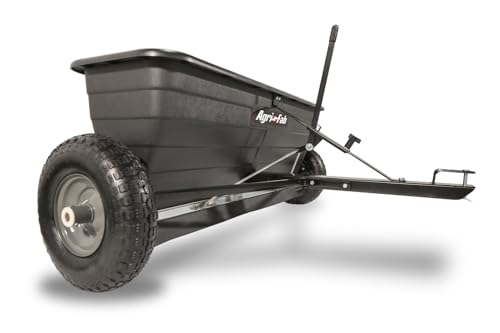
Agri-Fab 175 lb Tow-Behind Drop Spreader, 42 in
$329.00A 42 in tow drop spreader holding 175 lb, rated for about 40,000 sq ft per fill, with no throw beyond the hopper.
Best for: acreage with ponds and long bed lines
Check price on AmazonHow we chose
We did not test these products in person. Picks are researched from manufacturer specifications and owner manuals, engine and safety certifications where they apply, warranty terms, public recall records, and the recurring themes in verified owner reviews. We favor established brands with large review counts and parts support, match each pick to a real yard size or task, and place it in the tier where its price and capability actually belong.
Frequently asked questions
Is a drop spreader or broadcast spreader better for fertilizer?
For most lawns, a broadcast spreader. It covers 8 to 12 ft per pass and its feathered edges hide small overlap errors, so the overall application looks more even. A drop spreader is better where precision matters, beside beds, water, driveways and property lines. Many homeowners use a broadcast spreader with an edge guard, such as the Scotts EdgeGuard DLX, instead of owning both.
Why does my lawn have stripes after fertilizing?
Stripes come from uneven coverage. With a drop spreader, green and yellow bands mean gaps or doubled strips between passes; overlap by a wheel width next time. With a broadcast spreader, stripes usually mean passes were spaced too far apart or walking speed changed. Setting the spreader to half the label rate and making two passes at right angles fixes most striping.
Can you spread grass seed with a drop spreader?
Yes. Drop spreaders place seed accurately and are not affected by wind, which suits small lawns and edges. They are slow on large areas, and any gap between passes leaves a bare strip. For overseeding a whole lawn, a broadcast spreader at half rate in two directions is faster and more forgiving. Check the seed bag for a setting, or calibrate on a measured area.
What spreader setting should I use?
Use the setting printed on the product bag for your spreader model. Scotts bags list Scotts spreaders, and many professional bags list Lesco and other commercial models. If yours is not listed, calibrate: spread a measured 1,000 sq ft, weigh the product used, and adjust until it matches the label rate. The fertilizer calculator converts label rates for your lawn size.
Do I need an edge guard on a broadcast spreader?
If your lawn borders beds, pavement or water, yes. An edge guard or side-spread control blocks the throw on one side so granules stay off driveways, sidewalks and gardens, where fertilizer can stain concrete and wash into storm drains, and weed control can damage plants. The Scotts EdgeGuard DLX has a shield, and the EarthWay 2150 has side-spread control.
Researched, not professional advice. This page is compiled from published specifications, manuals, labels and owner-review consensus, not hands-on testing. Follow the manufacturer's instructions and product label, and consult a qualified professional where safety, chemicals, fuel or structures are involved. As an Amazon Associate we earn from qualifying purchases.