Snow Removal
Battery vs Gas Snow Blower: Cost, Runtime and Cold Weather
Quick answer
A battery snow blower is the better buy for driveways up to about three cars if you value quiet, push-button starts and no engine upkeep: the EGO SNT2405 is rated for 18 cars per charge. Gas wins on price and unlimited runtime: a comparable 24-inch PowerSmart 212cc costs about $899.99.

EGO Power+ SNT2405 24 in. Self-Propelled Two-Stage Snow Blower Kit
$1,649.0024-inch two-stage, two 7.5Ah batteries included.
Best for: mid-sized driveways that get deep, wet snow and end-of-driveway plow piles
Check price on Amazon
PowerSmart 24 in. Two-Stage Gas Snow Blower with 212cc Engine
$899.9924-inch two-stage, 212cc engine with electric start.
Best for: standard two-car driveways that need two-stage throw distance
Check price on AmazonBattery snow blowers stopped being toys when two-stage models arrived. The EGO SNT2405 has the same 24-inch width as a mainstream gas two-stage, a 20-inch intake and a 50-foot throw, and EGO rates it for an 18-car driveway of 8-inch snow per charge. The case against it is money: at $1,649.00 it costs roughly $750 more than the gas PowerSmart 24 in 212cc, which has a 21-inch intake and 45-foot throw.
So the choice is less about power than about what you are willing to pay to skip gas, oil and pull-starting in the cold. Compare the numbers for your own use in the gas vs battery cost calculator. Everything here is drawn from published specifications and owner reports, rather than side-by-side testing.
On this page
How do battery and gas snow blowers compare?
| Battery: EGO SNT2405 | Gas: PowerSmart 24 in 212cc | |
|---|---|---|
| Price | $1,649.00 with 2 batteries and charger | $899.99 |
| Clearing width and intake | 24 in wide, 20 in tall | 24 in wide, 21 in tall |
| Maker-rated throw | 50 ft | 45 ft |
| Runtime | Rated 18-car driveway of 8 in snow per charge | As long as you have fuel |
| Starting | Push-button, no priming | Electric start plus recoil backup |
| Drive | Variable-speed self-propel with reverse | 6 forward, 2 reverse speeds |
| Routine maintenance | Clean, store batteries indoors | Oil, fuel stabilizer, spark plug, belts, shear bolts |
| Cold weather | Capacity drops when batteries are cold | Engines start harder in deep cold; electric start helps |
| Fumes | None | Exhaust and carbon monoxide; outdoor use only |
| Off-season storage | Batteries indoors at the manual's storage charge | Stabilize or run fuel dry per the manual |
| Existing tool platform | Batteries run other EGO 56V tools | None |
Runtime ratings are the manufacturer's. Heavy, wet snow drains batteries faster than the rated 8-inch benchmark.
Should I buy a battery or gas snow blower?
Choose battery if:
- Your driveway is one to three cars, or a single lane up to about 250 feet.
- You hate pull cords, fuel cans and carburetors that gum up over summer.
- You clear early in the morning and neighbors are close.
- You already own EGO 56V tools, which makes the tool-only EGO SNT2420 ($1,199.00) a cheaper entry.
Choose gas if:
- You want the lowest price for two-stage capacity; the WEN SB209E is $493.77.
- You clear a very long driveway, a shared private lane or neighbors' drives in the same session.
- Your storms are routinely heavy and wet, where battery runtime shrinks.
- You want track drive, which in our catalog means gas, such as the Honda HSS928AATD.
How long does a battery snow blower run on a charge?
EGO rates its machines by driveway size: 10 cars of 8-inch snow for the SNT2122 on two 4.0Ah batteries, 18 cars for the SNT2405 on two 7.5Ah batteries, 24 cars for the SNT2410 with two 10.0Ah batteries, and 32 cars for the SNT2807 on two 12.0Ah batteries. Treat those as best-case figures. Wet snow, a deep plow berm and cold batteries all cut the real number, sometimes by a lot.
Even at half the rating, most homes are covered. A 22 by 30-foot two-car driveway takes about 8 minutes of moderate snow with a 24-inch machine, and a 12 by 250-foot single lane about 19 minutes. If your job regularly runs past 45 minutes of heavy snow, gas is the safer choice. The snow clearing time calculator gives your number.
Do battery snow blowers work in extreme cold?
They work, but lithium-ion batteries deliver less capacity when cold. The practical fix is simple and comes straight from the manuals: store and charge batteries indoors at room temperature, and install them just before you head out. Greenworks' listing for its 80V 20-inch blower even advises warming a cold battery indoors for 10 minutes if the unit will not start.
Gas has its own cold problem. Recoil-start engines get hard to pull in deep cold, which is why electric start matters. Poulan Pro rates its 99cc single-stage to start at -22 F, and Honda uses an automotive-style DC electric key start. Neither fuel type is immune to cold; each needs a different habit.
Which costs less over 5 years, a battery or gas snow blower?
For typical residential use, gas usually does. A season of short driveway clearings burns a modest amount of fuel, and an annual oil change, fuel stabilizer, a spark plug and a few shear bolts are small line items. Those running costs are unlikely to close a purchase gap of about $750 within 5 years unless you use the machine heavily. A battery machine uses very little electricity, but its batteries are the expensive consumable: EGO's warranty on its single-stage kit covers batteries for 3 years, and replacement packs are not cheap.
The better way to think about it: a battery snow blower is a convenience purchase, not a savings purchase. You are paying to eliminate fuel storage, cold pull-starts, engine exhaust and spring carburetor trouble. For many older homeowners, that is well worth it. For a budget buyer with a gravel drive, a gas two-stage is the rational choice. The battery snow blower buying guide covers battery sizing.
Which battery and gas snow blowers are the best matches?
EGO Power+ SNT2405 24 in. Self-Propelled Two-Stage Snow Blower Kit
$1,649.00A complete kit with two 7.5Ah batteries and self-propel with reverse; rated for an 18-car driveway of 8-inch snow per charge.
Best for: two and three-car driveways going gas-free
Check price on Amazon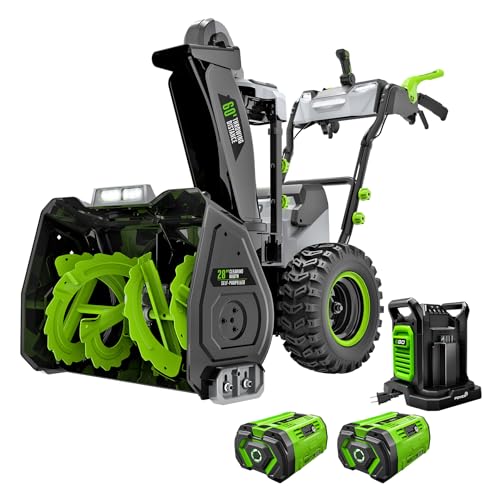
EGO Power+ SNT2807 28 in. Self-Propelled Two-Stage Snow Blower Kit
$2,308.28A 28-inch path, 21-inch intake, 60-foot throw and two 12.0Ah batteries rated for 32 cars per charge, with heated grips.
Best for: long driveways in heavy-snow regions
Check price on Amazon PowerSmart 24 in. Two-Stage Gas Snow Blower with 212cc Engine
$899.99A 212cc OHV engine with electric and recoil start, steel auger and impeller, 21-inch intake and 45-foot throw.
Best for: standard two-car driveways on a budget
Check price on Amazon
Husqvarna ST124 24 in. Two-Stage Gas Snow Blower
$999.00A 212cc two-stage with a 21-inch intake and all-steel chute, covered by a 3-year bumper-to-bumper and 5-year engine warranty.
Best for: buyers who weigh warranty heavily
Check price on AmazonHow we chose
We did not test these products in person. Picks are researched from manufacturer specifications and owner manuals, engine and safety certifications where they apply, warranty terms, public recall records, and the recurring themes in verified owner reviews. We favor established brands with large review counts and parts support, match each pick to a real yard size or task, and place it in the tier where its price and capability actually belong.
Frequently asked questions
Are battery snow blowers as powerful as gas?
The larger battery two-stage models are comparable to mainstream gas two-stage machines on the specs that matter. The EGO SNT2405 has a 24-inch width, 20-inch intake and 50-foot throw, against 24 inches, 21 inches and 45 feet for the PowerSmart 212cc gas model. Gas still leads on sustained runtime in heavy, wet snow and at the top end, where machines like the Honda HSS1332AATD have no battery equivalent.
How long do snow blower batteries last before they need replacing?
Lithium-ion packs lose capacity gradually with charge cycles and age, and heat and storing them fully drained both shorten their life. Manufacturers do not publish a fixed number of seasons. Warranty terms are the best signal you have: EGO covers the batteries in its SNT2122 kit for 3 years. Store batteries indoors at the charge level the manual recommends during the off-season to get the most years from them.
Can a battery snow blower handle heavy wet snow?
A battery two-stage can, but expect the runtime to fall well below the maker's rating, which is based on 8 inches of typical snow. Heavy, wet snow takes more energy to move and throw. Clear in narrower bites, keep the auger speed up, and if you often face wet storms on a long driveway, either size up the batteries or choose a gas two-stage that you can refuel and keep running.
Is it cheaper to own a gas or battery snow blower?
For most homeowners, gas is cheaper to own over 5 years because battery machines cost several hundred dollars more to buy and gas running costs are modest for short residential clearings. The battery model makes up for it in convenience: no fuel storage, oil changes, carburetor cleaning or cold pull-starts. Use the gas vs battery cost calculator with your own driveway size and expected use to see the break-even point.
Can I store a gas snow blower in an attached garage?
Most manuals allow storing a gas snow blower in a garage once the engine is off and fully cool, away from pilot lights, furnaces, water heaters and anything that sparks. What you should never do is start it or let it idle inside. Carbon monoxide builds quickly in an enclosed space, even with the garage door open. Push the machine outside, start it there and let it warm up outdoors.
Researched, not professional advice. This page is compiled from published specifications, manuals, labels and owner-review consensus, not hands-on testing. Follow the manufacturer's instructions and product label, and consult a qualified professional where safety, chemicals, fuel or structures are involved. As an Amazon Associate we earn from qualifying purchases.