Chainsaws and Wood
Electric vs Gas Log Splitter: How Many Tons Do You Need?
Quick answer
Choose an electric log splitter of 5 to 7 tons for seasoned softwood and small hardwood up to about 10 to 12 in across; the PowerSmart 7-ton runs quietly with no fumes. Choose a 20 to 22 ton gas splitter such as the SuperHandy 20-ton for hardwood rounds up to about 20 to 24 in and several cords a season.

PowerSmart 7-Ton Electric Log Splitter
$379.99A 15 amp, 7 ton splitter for logs up to 20 in long and 10 in across, with a 20 second cycle.
Best for: light-duty home firewood splitting
Check price on Amazon
SuperHandy 20-Ton Gas Log Splitter
$869.00A 7 HP, 20 ton splitter for logs up to 20 in long and 16 in across, with a 7.5 second cycle.
Best for: several cords a season of mixed hardwood
Check price on AmazonA log splitter uses a hydraulic ram to push a log into a steel wedge. Electric splitters drive the hydraulic pump with a 15 amp motor from a household outlet; gas splitters use a small engine and a larger two-stage pump. The rated tonnage is the ram's maximum force, and it decides the diameter and toughness of wood you can split. Cycle time, the seconds for the ram to extend and return, decides how much you get done in an afternoon.
Most people burning wood in a fireplace or fire pit split under a cord a year, and a 5 to 7 ton electric handles that at a fraction of a gas splitter's price. Heating a home with hardwood is a different job. Size yours with the log splitter tonnage calculator, and compare the PowerSmart 7-ton ($379.99) with the SuperHandy 20-ton ($869.00).
On this page
How do electric and gas log splitters compare?
| Factor | Electric | Gas |
|---|---|---|
| Splitting force | 5 to 7 tons (Sun Joe LJ602E, BILT HARD 6.5-ton, PowerSmart 7-ton) | 8 to 28 tons (Champion 8-ton to Full Boar 28-ton) |
| Max log diameter listed | About 10 in | 16 in on the SuperHandy 20-ton |
| Max log length | 20 to 20.5 in | 20 to 21 in on catalog models |
| Cycle time | 18 to 20 seconds | 7 to 7.5 seconds on 20 to 22 ton models; 20 seconds on the compact 8-ton |
| Power | 15 amp motor on an outlet | 79cc to 212cc engines |
| Where it runs | Garage, carport or patio; fume-free | Outdoors only, away from buildings |
| Noise | Motor and pump hum | Engine noise; hearing protection advised |
| Upkeep | Hydraulic fluid level | Hydraulic fluid, engine oil, fuel and air filter |
| Moving it | Small wheels, roll by hand | Larger wheels; the BILT HARD 22-ton tows at up to 25 MPH |
| Catalog price range | $319.99 to $399.99 | $789.00 to $1,399.00 |
Specs from manufacturer listings. SuperHandy notes hydraulic fluid is not included and recommends AW32.
Which should you choose, electric or gas?
Choose an electric log splitter if:
- You split well under a cord a year for a fireplace, wood stove supplement or fire pit.
- Your wood is mostly seasoned softwood or straight-grained hardwood under about 10 in across.
- You want to split in a garage or under a carport without fumes.
- Noise matters and you prefer no engine maintenance.
Choose a gas log splitter if:
- You heat with wood and split multiple cords each season.
- You split hardwood rounds from 12 to 24 in across, or knotty, crotchy wood.
- You work where the wood is, away from outlets.
- Speed matters: 7 second cycles get through a pile far faster than 20 second cycles.
How many tons of log splitter do I need?
As general guidance, a 4 to 7 ton electric splitter handles seasoned softwood up to about 10 to 12 in across, and a 20 to 22 ton gas splitter handles hardwood up to about 20 to 24 in. Green wood, knots, crotches and stringy species such as elm need more force than clean, dry, straight-grained wood of the same size, which is where 25 to 28 ton machines like the Full Boar 28-ton earn their price. The log splitter tonnage chart lists more species and sizes.
| Wood | Diameter | Suggested force | Catalog example |
|---|---|---|---|
| Seasoned softwood (pine, fir) | Up to 10 to 12 in | 4 to 7 tons | PowerSmart 7-ton |
| Seasoned straight-grain hardwood | Up to about 10 in | 6.5 to 7 tons, may stall on knots | BILT HARD 6.5-ton |
| Small rounds, no power available | Up to 8 in | 10 tons, hand pumped | Sun Joe LJ10M |
| Mixed firewood, compact gas | 10 to 14 in | 8 tons, easier loading | Champion 8-ton |
| Seasoned hardwood (oak, maple) | Up to 16 to 20 in | 20 tons | SuperHandy 20-ton |
| Hardwood rounds | Up to 20 to 24 in | 20 to 22 tons | BILT HARD 22-ton |
| Knotty, green or stringy wood | 20 in plus | 25 to 28 tons | Full Boar 28-ton |
General guidance. Always stay within the maximum log length and diameter printed in your splitter manual.
Is an electric log splitter strong enough for oak?
For seasoned, straight-grained oak within the listed capacity, usually yes. Electric splitters list a maximum log diameter around 10 in, and 5 to 7 tons will push through clean seasoned oak that size. Where they struggle is knots, crotches and green wood, and owners of electric splitters commonly report the ram stalling on those pieces. Do not force it: rotate the log, split a smaller piece off the edge, or set knotty rounds aside for a maul. Larger rounds need to be halved first or processed with a gas unit. Buck logs to length with the right saw; see gas vs battery chainsaw.
What does each cost over 5 years?
An electric splitter costs the purchase price plus a little electricity and occasional hydraulic fluid. A gas splitter adds fuel, engine oil changes, air filters and winter fuel care, and costs two to four times as much up front in the catalog. If you split only a cord or two once a year, renting a gas splitter for a day can be cheaper than owning one; if you heat with wood every winter, owning a 20 to 22 ton gas unit pays back in time saved. The gas vs battery cost calculator helps compare engine and electric running costs.
What do owners commonly report?
Electric splitter owners commonly praise quiet, fume-free operation and ease of storage, and complain about slow cycles and stalling on knots. Many electric models need a vent or bleed screw opened before use; missing that step is a frequent source of leak and performance complaints, so read the manual first. Gas splitter owners praise speed and force and complain about weight when moving the machine by hand, hard starts after storage and needing to buy hydraulic fluid separately on some models. A few owners report shipping damage on heavy units, so inspect on delivery.
Log splitters to compare
More picks in the best log splitters roundup.
PowerSmart 7-Ton Electric Log Splitter
$379.99A 15 amp induction motor at 7 tons with a 20 second cycle for logs up to 20 in long and 10 in across, plus a 2-year warranty.
Best for: fireplace and fire pit wood
Check price on Amazon
BILT HARD 6.5-Ton Electric Log Splitter
$319.99A 15 amp motor with 6.5 tons, an 18 second cycle and capacity for 20.5 by 9.8 in logs, marketed as fume-free for garage or patio use.
Best for: small batches of seasoned wood
Check price on Amazon SuperHandy 20-Ton Gas Log Splitter
$869.00A 7 HP engine and two-stage Bucher gear pump at 20 tons with rapid auto return and a 7.5 second cycle for logs up to 16 in across.
Best for: several cords of mixed hardwood
Check price on Amazon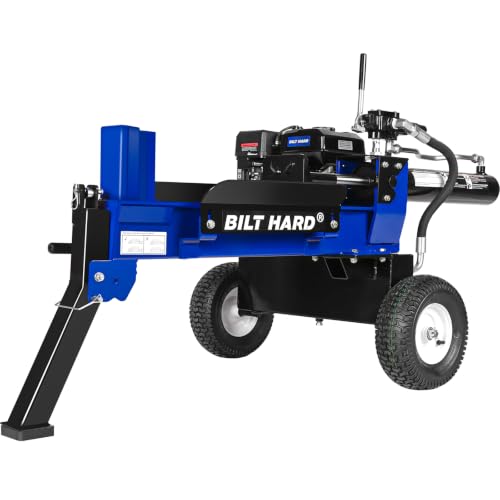
BILT HARD 22-Ton Gas Log Splitter
$1,099.99A 209cc engine with a 14 GPM two-stage pump, a 7 second cycle, 21 in log capacity and towing at up to 25 MPH.
Best for: heating with wood on acreage
Check price on AmazonHow we chose
We did not test these products in person. Picks are researched from manufacturer specifications and owner manuals, engine and safety certifications where they apply, warranty terms, public recall records, and the recurring themes in verified owner reviews. We favor established brands with large review counts and parts support, match each pick to a real yard size or task, and place it in the tier where its price and capability actually belong.
Frequently asked questions
What size log splitter do I need for firewood?
For seasoned softwood and small hardwood up to about 10 to 12 in, a 5 to 7 ton electric splitter is enough. For hardwood rounds up to about 20 to 24 in, choose 20 to 22 tons. Knotty, green or stringy wood benefits from 25 tons or more. Also check maximum log length, usually 20 to 21 in. The tonnage calculator gives a specific number.
Can you use an electric log splitter indoors?
Electric splitters produce no exhaust, and BILT HARD markets its 6.5-ton model for garage or patio use. A dry garage or carport with good lighting and room to work is fine. Keep the cord and plug dry, follow the manual on extension cords, and keep the area clear of people. Never run a gas splitter in any enclosed space, including an open garage.
How fast is a gas log splitter compared with electric?
Much faster per split. The SuperHandy 20-ton lists a 7.5 second cycle and the BILT HARD 22-ton 7 seconds, while electric models list 18 to 20 seconds. That difference adds up quickly across a cord of wood. Compact gas splitters are not always quick: the Champion 8-ton lists 20 seconds, about 180 cycles per hour.
Is a manual hydraulic log splitter worth it?
For small amounts of wood where there is no power, yes. The Sun Joe LJ10M makes 10 tons by hand pumping and splits rounds up to 18 in long and 8 in across, with no fuel or cord. It is slow and physical, so it suits cabins, camps and occasional fire pit wood, not heating a home.
Can a 7 ton log splitter split oak?
Seasoned, straight-grained oak within the machine's listed capacity, around 10 in across on the PowerSmart 7-ton, generally splits. Green oak, knots and crotch pieces can stall a 7 ton ram. Split larger rounds into halves or take slabs off the edge first, and set aside pieces that refuse. If most of your wood is large oak, a 20 ton gas splitter is the better tool.
Researched, not professional advice. This page is compiled from published specifications, manuals, labels and owner-review consensus, not hands-on testing. Follow the manufacturer's instructions and product label, and consult a qualified professional where safety, chemicals, fuel or structures are involved. As an Amazon Associate we earn from qualifying purchases.