Robot Mowers
Robot Mower vs Push Mower: Is Automating a Small Lawn Worth It?
Quick answer
For a quarter-acre lawn, a push mower does the job in about 35 minutes a week for far less money: the EGO LM2114 costs $499.00. A robot mower like the Segway Navimow i210 AWD ($1,299.00) is worth it if you want that time back, have slopes, or find mowing physically hard. You will still need a trimmer.

Segway Navimow i210 AWD Robot Mower
$1,299.00Quarter acre, 45 percent slopes, no wire.
Best for: Sloped quarter-acre yards
Check price on Amazon
EGO POWER+ LM2114 21 in. Push Mower Kit
$499.0021 in battery push, up to 55 min runtime.
Best for: Flat, smaller lawns
Check price on AmazonOn a small lawn, this is a question of time and body, not capability. A 21-inch walk-behind at 3 mph covers about 0.43 acre per hour, so a quarter acre takes about 35 minutes, roughly 15 hours over a 26-mow season. The robot takes that away, keeps the grass consistently short and handles a 45 percent slope, for about $800 more than a quality battery push mower.
There are honest limits. The i210's cut height starts at 2 inches, which is higher than some warm-season lawns are kept. Robots cannot cut right to fences and beds, so a string trimmer stays in the shed. And a robot needs a reasonably tidy yard. Figures here come from published specifications and owner reports, rather than side-by-side testing. Check your yard in the robot mower calculator.
On this page
How does a robot mower compare with a push mower?
| Robot: Navimow i210 AWD | Push: EGO LM2114 | |
|---|---|---|
| Price | $1,299.00 | $499.00 |
| Rated area | Up to 1/4 acre | About 0.4 acre per charge at 3 mph |
| Your time, 1/4 acre | Near zero after setup | About 35 min per mow |
| Cutting width | 7.1 in | 21 in |
| Cut height | 2 to 3.6 in | 1.25 to 4 in |
| Slopes | Rated 45 percent, with electronic stability control | Mow across slopes; effort rises |
| Navigation | Network RTK plus vision, no boundary wire | You |
| Battery | 5.1Ah, up to 2,690 sq ft per charge | 56V 6.0Ah, up to 55 min |
| Edges | Leaves a strip at fences and beds | Cuts close; trimmer still needed |
| Security | GPS alerts if lifted or moved out of zone | Stored in the garage |
| Warranty in listing | Not stated; check Segway terms | 5-year tool, 3-year battery |
From each maker's Amazon listing. Push mower area assumes 3 mph, 15 percent overlap and 80 percent efficiency.
Should I buy a robot mower or a push mower?
Choose a robot mower if:
- Mowing is physically difficult or unsafe for you.
- Your small lawn has a slope that makes walking a mower hard.
- You travel often and want the lawn maintained while you are away.
- You value the time more than the price difference.
Choose a push mower if:
- You do not mind 30 to 40 minutes of walking once a week.
- You keep a warm-season lawn cut below 2 inches.
- Your yard has lots of toys, sticks or clutter to pick up first.
- You want the lowest total cost; the gas PowerSmart 21 in push is $249.99.
Does a robot mower cut short enough?
For most cool-season lawns, yes. Tall fescue and Kentucky bluegrass are typically kept around 2.5 to 4 inches, well inside the i210's 2 to 3.6-inch range. Warm-season grasses are different: Bermudagrass is often kept around 1 to 2 inches, so a 2-inch minimum may not suit a lawn managed short. Husqvarna's iQ models go down to 1 inch, and the pro-grade Automower 520H EPOS to 0.8 inch. Check your grass on the mowing height chart and the Bermudagrass page before choosing.
How long does a robot mower take to mow a quarter acre?
Longer than you would, spread across the week. The i210 cuts a 7.1-inch path, a third of a push mower's width, and Segway lists up to 2,690 square feet per charge. A quarter acre is 10,890 square feet, so a full pass takes about four charges, with the robot returning to its station and resuming where it stopped. That is how robots work: many short sessions rather than one long one. The result is grass that never gets long, with clippings small enough to fall into the turf. The robot mower size for a quarter acre page compares models.
What does a robot mower need that a push mower does not?
- A tidy lawn. Sticks, toys, hoses, dog waste and fallen fruit need picking up, just as before a push mow, but more often.
- Setup. Mapping the lawn, placing the charging station and setting zones; wire-free robots like the i210 map by driving the edge in the app.
- Signal. Network RTK needs a reasonable view of the sky; under heavy tree cover, a LiDAR model like the Navimow i215 is designed to work without satellites.
- Blade changes and cleaning. Small blades dull and are replaced periodically.
- Winter storage. Most owners bring robots indoors for the off-season, following the manual.
The robot mower installation guide covers each step.
Which robot and push mowers fit a small yard?
Segway Navimow i210 AWD Robot Mower
$1,299.00All-wheel drive with stability control for 45 percent slopes, network RTK plus vision with no wire, and up to 20 zones, rated for a quarter acre.
Best for: sloped quarter-acre yards
Check price on Amazon
Segway Navimow i105N Robot Mower
$799.00RTK plus vision with no perimeter wire and a camera that recognizes over 150 obstacle types, sized for up to 1/8 acre.
Best for: small, simple lawns
Check price on Amazon EGO POWER+ LM2114 21 in. Push Mower Kit
$499.00A 21-inch deck, 6.0Ah battery rated for up to 55 minutes, 1.25 to 4-inch cut and a 5-year tool warranty.
Best for: flat lawns up to about a third of an acre
Check price on Amazon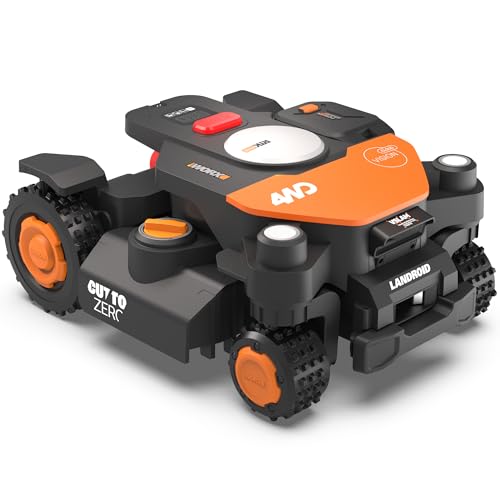
WORX Landroid Vision Cloud WR342 4WD Robot Mower
$2,069.99Cloud RTK with no local antenna, 4WD for 84 percent slopes and a Cut-to-Zero offset blade for closer edges, rated for 1/2 acre.
Best for: steep yards up to half an acre
Check price on AmazonHow we chose
We did not test these products in person. Picks are researched from manufacturer specifications and owner manuals, engine and safety certifications where they apply, warranty terms, public recall records, and the recurring themes in verified owner reviews. We favor established brands with large review counts and parts support, match each pick to a real yard size or task, and place it in the tier where its price and capability actually belong.
Frequently asked questions
Is a robot mower worth it for a small yard?
It is worth it if your time, your health or a slope makes mowing a real burden. A quarter acre takes about 35 minutes a week with a 21-inch push mower, and a robot like the Segway Navimow i210 AWD costs about $800 more than a quality battery push mower. If you do not mind the weekly walk and have a flat lawn, the push mower is the better value.
Do I still need a trimmer with a robot mower?
Almost always. Robot mowers leave a narrow uncut strip along fences, walls, beds and obstacles, because their blades sit inside the body. Some models reduce it: Segway lists EdgeSense for close edge cutting on the i215, and WORX lists a Cut-to-Zero offset blade on the Landroid Vision. Plan on a string trimmer pass every week or two either way.
Can a robot mower mow a lawn with slopes?
Yes, and slopes are one of the best reasons to buy one. The Segway Navimow i210 AWD is rated for 45 percent slopes with electronic stability control, and the WORX Landroid Vision Cloud WR342 is rated for 84 percent. With a push mower, mowing a slope means working across it with a lot of effort, and very steep grades are unsafe to walk with any mower.
How often does a robot mower mow?
Most robots are scheduled to mow several times a week, cutting a small amount each time, often in multiple short sessions between recharges. Segway lists up to 2,690 square feet per charge for the i210, so a quarter acre takes several charge cycles to cover fully. Frequent cutting keeps grass at a steady height and produces fine clippings that do not need bagging.
Do robot mowers need a boundary wire?
Many current models do not. The Segway Navimow i210 uses network RTK with vision, and the i215 uses LiDAR with vision, both mapped in an app without wire. Some models still use a buried boundary wire, such as the Husqvarna Automower 430X, which gives a steady signal under heavy shade. See boundary wire vs RTK robot mowers for the trade-offs.
Researched, not professional advice. This page is compiled from published specifications, manuals, labels and owner-review consensus, not hands-on testing. Follow the manufacturer's instructions and product label, and consult a qualified professional where safety, chemicals, fuel or structures are involved. As an Amazon Associate we earn from qualifying purchases.