Sheds and Storage
How to Choose a Storage Shed: Size, Material, Base and Permits
Quick answer
Size a shed from what you store plus about 35 percent for a walkway: a push mower and tools fit a 7 by 7 foot shed, while a lawn tractor needs 8 by 10 to 10 by 12 feet with a door 6 inches wider than the machine. Resin sheds like the Lifetime 8 x 10 ft. Outdoor Storage Shed suit most homeowners.
A storage shed is a detached outbuilding for yard equipment, tools and seasonal gear, and choosing one comes down to five decisions: size, material, the base it sits on, the door and ramp, and what your town and HOA allow. Most shed regrets are about size, especially a riding mower that does not fit through the doors, so start there and let the rest follow.
Run your equipment through the shed size calculator, then compare models in the best storage sheds. For most homeowners a steel-reinforced resin shed with a floor, such as the Lifetime 8 x 10 ft. Outdoor Storage Shed at $1,478.85, balances low upkeep and space. If a lawn tractor is in the plan, size up to something like the Suncast Tremont 8 x 13 ft. Resin Storage Shed now, because a bigger shed costs far less than a second one.
On this page
- What size shed do I need?
- What fits in each standard shed size?
- Which shed material is best: resin, steel, wood or vinyl?
- Resin or metal shed: which should I buy?
- Does a shed need a foundation?
- How wide should shed doors be for a riding mower?
- What snow and wind load should a shed handle?
- Do I need a permit for a storage shed?
- How do I anchor a shed?
- How do I stop condensation and mildew in a shed?
- Is a deck box or vertical storage shed enough?
- How do I choose a shed step by step?
- Which storage sheds are worth buying?
What size shed do I need?
Add the floor space of everything you store, multiply by about 1.35 so roughly a third of the floor stays open as a walkway, and round up to a standard shed size. Hang trimmers, blowers and rakes on the walls to save floor.
| Item | Floor space | Widest point for the door |
|---|---|---|
| 21 in push or self-propelled mower | 6 sq ft | 24 in |
| 42 to 46 in lawn tractor | 23 sq ft | 58 in |
| 48 to 54 in zero-turn mower | 30 sq ft | 66 in |
| Two-stage snow blower | 9 sq ft | 32 in |
| Wheelbarrow or yard cart | 7 sq ft | 28 in |
| Trimmer, blower and rakes on the wall | 4 sq ft | Wall |
| Bicycle, each | 6 sq ft | n/a |
| Gas grill stored for winter | 8 sq ft | n/a |
| Stacked patio chairs and cushions | 8 sq ft | n/a |
| Shelving, per 4 ft run | 8 sq ft | Wall |
Measure your own machine: mower width with the discharge chute or bagger attached is often the deciding number.
What fits in each standard shed size?
| Shed size | Floor area | Usable after walkway | Holds about | Catalog examples |
|---|---|---|---|---|
| 4 x 10 lean-to | 40 sq ft | 30 sq ft | Push mower, trimmer, tools and bins | Arrow Yardsaver 4x10 |
| 7 x 7 | 49 sq ft | 36 sq ft | Push mower, snow blower, wheelbarrow and tools | Lifetime 7x7, Suncast Modernist 7x7 |
| 8 x 8 | 64 sq ft | 47 sq ft | Small tractor if the door fits, or push mower plus bikes | Keter Factor 8x8 |
| 7 x 10 | 70 sq ft | 52 sq ft | Push mower, snow blower, cart, bikes and shelving | Rubbermaid 7x10 |
| 8 x 10 | 80 sq ft | 59 sq ft | Lawn tractor or push mower setup with room to walk | Lifetime 8x10, Suncast Tremont 8x10 |
| 10 x 10 | 100 sq ft | 74 sq ft | Lawn tractor plus snow blower, or a workbench wall | Duramax Woodbridge Plus 10x10 |
| 8 x 13 | 104 sq ft | 77 sq ft | Lawn tractor, snow blower, cart and tools | Suncast Tremont 8x13 |
| 10 x 12 or 15 x 8 | 117 to 120 sq ft | About 89 sq ft | Zero-turn plus tools, cart and seasonal gear | Arrow Elite 10x12, Lifetime 15x8 |
Usable area is floor area divided by 1.35. Floor area alone does not guarantee a riding mower fits: confirm the listed door opening against your machine.
Which shed material is best: resin, steel, wood or vinyl?
| Material | Upkeep | Strengths | Weaknesses | Example |
|---|---|---|---|---|
| Resin (HDPE or polypropylene, often steel-reinforced) | Wash occasionally | No rust or rot, no painting, floor usually included, quick assembly | Limited shelving loads, can look plain, very light sheds need anchoring | Suncast Tremont 8x10 |
| Steel (galvanized or Galvalume) | Touch up scratches to prevent rust | Most floor area per dollar, fire resistant, strong walls | Floor and anchoring sold or built separately, condensation, dents, fiddly assembly | Arrow Classic 10x8 |
| Wood | Paint or stain and roofing to maintain | Easiest to customize with shelves, hooks, windows and lofts, traditional look | Rot and insects if neglected, heaviest build, paint and shingles often extra | Handy Home Beachwood 8x12 |
| Vinyl-clad | Wash occasionally | Low-maintenance exterior with a traditional look | Fewer size options, check the frame and floor system | Duramax Woodbridge Plus |
Resin or metal shed: which should I buy?
For most homeowners, resin. Resin sheds such as the Lifetime 8 x 10 ft. Outdoor Storage Shed, Suncast Tremont 8 x 10 ft. Resin Storage Shed and Rubbermaid Extra Large 7 x 10 ft. Resin Storage Shed include floors, never need paint and do not rust where a mower deck scrapes a wall. Rubbermaid rates its wall panels to hold 75 pounds each with its shed accessories.
Steel wins on floor space for the money: the Arrow Classic 10 x 8 ft. Steel Storage Shed gives 74 square feet for $614.99, and the Arrow Shed Elite 10 x 12 ft. Steel Storage Shed adds Galvalume panels and vented gables. Budget for a floor or slab, anchors and time, since metal sheds have many small parts. Wood, like the Handy Home Beachwood 8 x 12 ft. Wood Storage Shed, is the choice when you want a workshop feel, a loft or custom shelving, and are willing to paint and roof it. The full breakdown is in resin vs metal sheds, with rankings in the best resin sheds and the best metal sheds.
Does a shed need a foundation?
Every shed needs a level, well-drained base, even kits that include a floor. An uneven base racks the frame, so doors stop closing and panels pull apart, and ground contact wicks moisture into floors. Manufacturer instructions specify how level the base must be; follow them. Common bases:
- Compacted gravel pad: a frame of treated timbers filled with compacted crushed stone, commonly about 4 inches deep, extending a little past the shed footprint. It drains well and suits resin sheds with floors. A Bully Tools Steel Hand Tamper compacts it, and the gravel calculator gives tons.
- Concrete slab: the strongest base and the best anchoring surface for steel sheds and riding mowers. Most steel sheds without floor kits are designed to sit on one.
- Pavers: a leveled paver pad over compacted base; plan with the paver calculator.
- Wood platform on skids or blocks: common for wood sheds like the Handy Home Beachwood 8 x 12 ft. Wood Storage Shed, which includes a framed OSB floor.
Some kits include a base: the Duramax Woodbridge Plus 10 x 10 ft. Vinyl Shed is sold with a foundation kit, while the Arrow Yardsaver 4 x 10 ft. Steel Lean-To Shed floor kit is sold separately. Place the shed on high ground, not in a low spot that collects runoff.
How wide should shed doors be for a riding mower?
Plan for a door opening at least 6 inches wider than your widest machine. A 42 to 46 inch lawn tractor is commonly about 58 inches wide with the discharge chute, and a 48 to 54 inch zero-turn about 66 inches, so many sheds with a single door or a narrow double door will not take a riding mower even when the floor is big enough. Measure your mower with the chute down and any bagger attached, and compare it to the listed door opening, not the shed width.
- Double doors are the norm for riding mowers. The Handy Home Beachwood 8 x 12 ft. Wood Storage Shed lists pre-hung 64 inch double doors.
- Dual entry helps long or bulky items: the Lifetime 15 x 8 ft. Dual Entry Outdoor Storage Shed has double doors on the front and side.
- Ramps: a riding mower needs a sturdy ramp over the door sill and base edge. Check whether a ramp is included and its rating; otherwise build or buy one sized for the machine's weight.
- Door height matters for tall handles and a mower with a roll bar.
If you store a zero-turn, see shed size for a zero-turn mower, and for tractors shed size for a riding mower.
What snow and wind load should a shed handle?
Use only the ratings a manufacturer actually publishes, and ask when you cannot find one. Among the catalog sheds, the Suncast Modernist 7 x 7 ft. Storage Shed lists a roof rated for 40 pounds per square foot of snow; for the others, check the product manual or contact the maker before buying in heavy snow country. Local building departments set design snow and wind loads for permitted structures, and a shed that needs a permit may need to meet them.
- Snow: steeper roofs shed snow better. Clear heavy accumulations from low-slope resin and steel roofs with a roof rake from the ground rather than climbing on the roof.
- Wind: light resin and steel sheds can slide or lift in high winds, especially when empty. Anchoring is the fix, not weight inside.
- Trees: do not place a shed under dead limbs or large overhanging branches.
Do I need a permit for a storage shed?
Often not for small sheds, but check before you buy. Model residential codes exempt small one-story detached accessory buildings under a size limit, commonly 120 or 200 square feet depending on the code edition your area adopted, but many towns set their own limits, and even exempt sheds must meet zoning rules:
- Setbacks: minimum distances from property lines, the house and other structures.
- Easements: many lots have utility or drainage easements where structures are not allowed.
- Height and placement: some towns limit height or bar sheds from front yards.
- HOA rules: homeowners associations frequently regulate size, color, material and location, and may require approval first.
- Electricity: running power to a shed usually requires a permit and a licensed electrician.
Call your local building department with the shed's footprint and height, and call 811 before digging a base or driving ground anchors. For installation and foundation cost estimates, HouseProjectCalc covers contractor pricing.
How do I anchor a shed?
Anchor every shed as its manufacturer specifies, because the instructions are designed around that shed's frame and weight. The anchor depends on the base:
- Concrete slab: concrete wedge or sleeve anchors through the floor frame or anchor brackets.
- Gravel pad or soil: auger-style ground anchors screwed deep into the soil and attached to the frame with cable or brackets, or anchoring to the timber frame of the pad.
- Wood platform: lag screws or brackets into the floor framing, with the platform itself tied down.
Steel shed makers commonly sell anchor kits separately, such as an Arrow shed anchor kit, and several void wind coverage without anchoring. Anchor before loading the shed and before the first storm, not after. Call 811 before driving long ground anchors.
How do I stop condensation and mildew in a shed?
Condensation forms when warm humid air meets a cold surface, and steel roofs and walls are the worst for it: water drips onto tools on cool mornings. Resin sheds sweat less but still trap humidity.
- Ventilate. Choose sheds with vents: the Lifetime 7 x 7 ft. Outdoor Storage Shed has two, the Keter Factor 8 x 8 ft. Resin Storage Shed has built-in vents and the Arrow Shed Elite 10 x 12 ft. Steel Storage Shed has vented high gables. Add vents where the maker allows.
- Block ground moisture. A vapor barrier under a slab, a gravel base that drains, and gutters or downspout extensions like the Amerimax 4601 Downspout Extension (2-Pack) on nearby roofs keep water away.
- Store equipment dry. Brush off wet clippings and let snow melt off blowers before closing them in.
- Keep things off the floor on shelves and wall hooks, with gaps for airflow.
Is a deck box or vertical storage shed enough?
If you only need to store cushions, hoses and a few hand tools, a walk-in shed is overbuying. A deck box like the Keter Luma 230 Gallon Deck Box holds 230 gallons, and a vertical unit such as the Suncast XL Vertical Storage Shed (106 cu. ft.) (106 cubic feet, with a floor and double doors) fits a push mower. The Suncast Glidetop Horizontal Storage Shed (98 cu. ft.) is a low-profile option under a window. These need no permit in most places and no base beyond level ground or a patio. Once you add a snow blower or a second mower, a 7 by 7 foot shed is the better value. More options are on the best deck boxes.
How do I choose a shed step by step?
- List what you will store. Include equipment you plan to buy in the next few years, especially a riding mower or snow blower.
- Size it. Add floor space, multiply by 1.35 and round up to a standard size, or use the shed size calculator.
- Check the rules. Ask the building department and HOA about size limits, permits, setbacks and easements for your lot.
- Pick the spot. Choose high, level, well-drained ground with room to open doors and a clear path for the mower.
- Choose the material. Resin for low upkeep, steel for space per dollar, wood for customizing, vinyl for a traditional low-maintenance look.
- Confirm the door and ramp. Compare the listed door opening with your widest machine plus 6 inches, and plan a ramp.
- Plan the base and anchors. Build a level gravel, concrete, paver or timber base per the instructions, and buy the anchor kit the maker specifies. Call 811 before digging.
- Plan ventilation and storage. Confirm vents, and budget for shelves and wall hooks so the floor stays clear.
Which storage sheds are worth buying?
These sheds cover the common needs, from a compact tool shed to a tractor-sized resin shed. All figures come from the manufacturers' listings.

Lifetime 8 x 10 ft. Outdoor Storage Shed
$1,478.85Dual-wall HDPE panels with steel supports and trusses, a slip-resistant HDPE floor, roof skylight and lockable steel-reinforced doors.
Best for: push mower, snow blower and tools
Check price on Amazon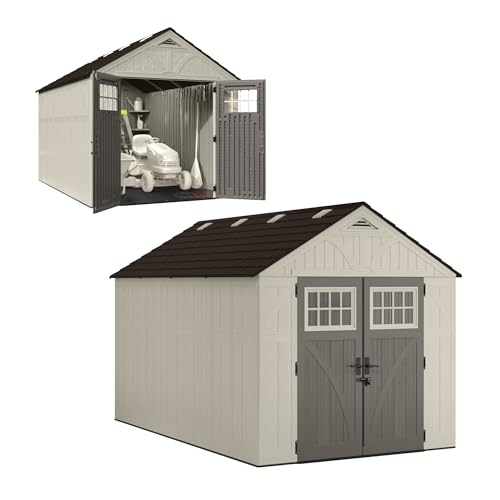
Suncast Tremont 8 x 13 ft. Resin Storage Shed
$2,299.99The stretched Tremont with 715 cu. ft. of storage, eight skylights and four adjustable corner shelves, sized for a lawn tractor.
Best for: lawn tractor owners
Check price on Amazon
Lifetime 15 x 8 ft. Dual Entry Outdoor Storage Shed
$1,999.00Double doors on the front and side, five steel roof trusses, eight skylights and a 90 in. shelf with tool corral.
Best for: long items and two machines
Check price on Amazon
Arrow Shed Elite 10 x 12 ft. Steel Storage Shed
$1,580.10Galvalume steel with 72 in. walls, vented high gables and key-lock swing doors for 117 sq. ft. of floor; plan a slab or floor and anchors.
Best for: maximum floor area
Check price on Amazon
Handy Home Beachwood 8 x 12 ft. Wood Storage Shed
$2,446.60A DIY wood shed with a framed OSB floor, 7 ft sidewalls and pre-hung 64 in. double doors; paint and shingles are bought separately.
Best for: custom shelving and workshop use
Check price on Amazon
Lifetime 7 x 7 ft. Outdoor Storage Shed
$1,177.85A steel-reinforced HDPE shed with a full-length skylight, two windows, two vents and a long shelf plus two corner shelves included.
Best for: small yards and hand tools
Check price on AmazonHow we chose
We did not test these products in person. Picks are researched from manufacturer specifications and owner manuals, engine and safety certifications where they apply, warranty terms, public recall records, and the recurring themes in verified owner reviews. We favor established brands with large review counts and parts support, match each pick to a real yard size or task, and place it in the tier where its price and capability actually belong.
Frequently asked questions
What size shed do I need for a riding mower?
A lawn tractor typically needs an 8 by 10 foot shed or larger, and a 48 to 54 inch zero-turn is more comfortable in 10 by 12 feet, once you add room for tools and a walkway. The door matters as much as the floor: plan an opening at least 6 inches wider than the mower with its chute down. The Suncast Tremont 8 x 13 ft. Resin Storage Shed is sized for a lawn tractor.
Do resin sheds last?
Quality steel-reinforced resin sheds hold up for many years because the panels do not rust, rot or need paint. The weak points are usually the base and anchoring rather than the panels: an unlevel base racks the frame so doors misalign. Choose double-wall or dual-wall panels with steel supports, like the Lifetime 8 x 10 ft. Outdoor Storage Shed, build a level base and anchor as the maker specifies.
Can I put a shed directly on the ground?
It is not recommended. Bare ground settles unevenly and holds moisture, which racks the frame, rots wood floors and lets water in. Even resin sheds with built-in floors need a level, well-drained base such as compacted gravel in a timber frame, pavers or a concrete slab. Check the manufacturer's base requirements, since some warranties depend on them.
How big can a shed be without a permit?
Many areas exempt small one-story sheds under 120 or 200 square feet from building permits, depending on which code edition the town adopted, but local rules vary widely. Zoning setbacks, easements and HOA rules still apply to exempt sheds, and adding electricity usually requires a permit. Call your local building department with the footprint and height before buying.
Should I buy a metal or resin shed for a snowy area?
Choose based on the published roof rating and the base, not just the material. Few shed listings publish a snow load; the Suncast Modernist 7 x 7 ft. Storage Shed lists 40 pounds per square foot. Steeper roofs shed snow better, and any shed should be anchored and kept clear of heavy accumulation with a roof rake from the ground. Ask the manufacturer for load ratings before buying in heavy snow country.
Researched, not professional advice. This page is compiled from published specifications, manuals, labels and owner-review consensus, not hands-on testing. Follow the manufacturer's instructions and product label, and consult a qualified professional where safety, chemicals, fuel or structures are involved. As an Amazon Associate we earn from qualifying purchases.