Snow Removal
What Size Snow Blower for a Steep Driveway?
Quick answer
A steep driveway of about 12 by 50 feet in moderate snow needs a 24 to 26-inch two-stage snow blower, ideally with track drive. A 24-inch machine clears it in 8 passes and about 6 minutes. Tracks grip where wheels spin, and the Honda HSS928AATD adds hydrostatic drive. Always clear up and down the slope.
On a steep driveway, traction and control matter more than width. The 12 by 50-foot driveway here takes only about 6 minutes with a 24-inch machine, but every pass either climbs or descends, often over packed snow and ice. A machine that spins its wheels on the way up or pulls you on the way down is the real problem to solve.
Our top pick is the Honda HSS928AATD 28 in. Two-Stage Track Snow Blower at $3,599.00. It is 28 inches, slightly wider than the 24 to 26-inch range, because the priced track-drive machines in our catalog are Honda's 28 and 31.9-inch models; the 24-inch Ariens Compact 24 RapidTrak fits the range but is currently out of stock. See best snow blowers for steep driveways for more.
On this page
- How long does a steep driveway take to clear?
- What is the best snow blower for a steep driveway?
- Are tracks or wheels better on a steep driveway?
- How do I snow blow a steep driveway safely?
- Do I need ice melt on a steep driveway?
- Does a battery snow blower work on a hill?
- Which snow blowers fit a steep driveway?
How long does a steep driveway take to clear?
| Clearing width | Passes | Time | Fit |
|---|---|---|---|
| 12 in | 15 | 11 min | Slow or underpowered |
| 18 in | 10 | 8 min | Slow or underpowered |
| 21 in | 9 | 7 min | Slow or underpowered |
| 24 in | 8 | 6 min | Recommended |
| 28 in | 7 | 5 min | More than needed |
| 32 in | 6 | 5 min | More than needed |
About 600 square feet. Recommended: 24 to 26 inch two-stage. Times assume a 15 percent overlap, walking speeds of 150, 120 and 85 feet per minute in light, moderate and heavy snow, and 20 seconds per turn.
What is the best snow blower for a steep driveway?
A 24 to 26-inch two-stage with track drive, or failing that a self-propelled two-stage with reverse. On a 12 by 50-foot driveway a 24-inch path makes 8 passes in about 6 minutes and a 28-inch makes 7 passes in about 5 minutes, so the wider Honda costs nothing in time. Single-stage machines are a poor match for slopes: they have no drive, and auger-propelled models lose their pull as soon as the auger lifts off an icy surface.
Are tracks or wheels better on a steep driveway?
Tracks. They put far more rubber on the ground than two tires, grip packed snow and ice, and keep the machine from sliding sideways on a crowned or cambered driveway. The trade-off is effort in turns. Wheeled machines work on moderate slopes with bare pavement underneath; some owners add snow blower tire chains for ice, if the manual allows them.
| Model | Width | Drive | On a slope | Price |
|---|---|---|---|---|
| Honda HSS928AATD | 28 in | Hydrostatic, rubber tracks | Best grip; smooth speed control downhill | $3,599.00 |
| Honda HSS1332AATD | 31.9 in | Hydrostatic, rubber tracks, GX390 | Best grip; large and heavy for short driveways | $4,099.00 |
| Ariens Compact 24 RapidTrak | 24 in | Track that turns like wheels | Track grip in the recommended width | Out of stock at writing |
| Honda HSS928AAWD | 28 in | Hydrostatic, pneumatic tires | Good on bare pavement; can spin on ice | $3,399.00 |
| EGO SNT2410 XP | 24 in | Self-propelled, trigger steering | Good on moderate slopes; batteries sold separately | $1,319.00 |
| PowerSmart 24 212cc | 24 in | 6 forward, 2 reverse speeds, wheels | Fine on gentle grades; low gear downhill | $899.99 |
Traction notes summarize how each drive type behaves; they are not maker slope ratings. Check your operator manual for the maximum slope.
How do I snow blow a steep driveway safely?
- Clear up and down the slope, never across it. A heavy machine working across a grade can slide or tip sideways. Stay inside the slope limit in your operator manual.
- Keep the machine in a low gear or at low hydrostatic speed going downhill so it never pulls you along. Release the drive, not the handles, if it starts to run away.
- Clear early. Tires and boots pack fresh snow into ice on a slope within hours.
- Wear traction cleats over your boots on icy grades.
- Treat the surface after clearing so it does not refreeze into a sheet.
The general technique is in our snow blower safety guide.
Do I need ice melt on a steep driveway?
Usually, because a cleared slope refreezes into the most dangerous surface on the property. Spread a thin, even layer with a hand spreader like the Chapin 8705A SaltPro ($24.99) rather than dumping it in piles. If pets or new plantings are near the driveway, a salt-free product such as Safe Paw is effective to -2 F. Avoid rock salt on concrete poured within the last year. On very steep grades, sand or grit adds traction where deicers alone do not.
Does a battery snow blower work on a hill?
A self-propelled battery two-stage does, within limits. EGO's 24 and 28-inch two-stage machines drive their wheels with variable speed and reverse, and the SNT2410 XP and SNT2807 add trigger steering that helps turn a heavy machine at the top and bottom of each pass. They have no fuel to slosh and start instantly on a cold slope. What they lack is track grip, so on a steep, icy grade a track machine remains the safer choice. The general comparison is in track vs wheel snow blower.
Which snow blowers fit a steep driveway?
Track-drive and self-propelled two-stage machines, led by Honda's hydrostatic track models. Read the Honda HSS928AATD review for its full specs.
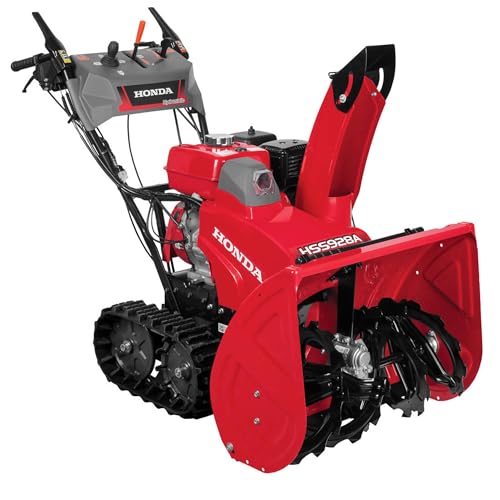
Honda HSS928AATD 28 in. Two-Stage Track Snow Blower
$3,599.00Honda GX270 power, cleated low-temperature rubber tracks, hydrostatic drive and auger height control, rated at 1,900 pounds per minute and a 52-foot throw with no assembly required.
Best for: steep or icy driveways where wheels lose traction
Check price on Amazon
Honda HSS1332AATD 32 in. Two-Stage Track Snow Blower
$4,099.00A commercial-grade Honda GX390 with electric key start, hydrostatic track drive and a 31.9-inch path that Honda rates at 2,750 pounds of snow per minute and a 56-foot throw.
Best for: long, sloped or gravel driveways in lake-effect and mountain snow
Check price on Amazon
Honda HSS928AAWD 28 in. Two-Stage Wheeled Snow Blower
$3,399.00The wheeled HSS928 swaps tracks for 14-inch pneumatic tires and adds an electric joystick chute with 198° of rotation, keeping the GX270, hydrostatic drive and 3-year residential warranty.
Best for: large flat paved driveways where a wheeled machine turns more easily
Check price on Amazon
EGO Power+ SNT2410 24 in. XP Self-Propelled Two-Stage Snow Blower (Tool Only)
$1,319.00The XP adds trigger-controlled steering, heated grips and a 200° two-in-one chute lever to the 24-inch two-stage platform; EGO rates 24 cars per charge with two 10.0Ah batteries, sold separately.
Best for: existing EGO owners who already have large 56V batteries on the shelf
Check price on Amazon
EGO Power+ SNT2405 24 in. Self-Propelled Two-Stage Snow Blower Kit
$1,649.00A complete 24-inch two-stage kit with two 7.5Ah batteries: 20-inch intake, 50-foot throw, variable-speed self-propel with reverse, and a maker-rated 18-car driveway per charge.
Best for: mid-sized driveways that get deep, wet snow and end-of-driveway plow piles
Check price on Amazon
PowerSmart 24 in. Two-Stage Gas Snow Blower with 212cc Engine
$899.99A 212cc OHV engine with electric and recoil start, rated at 2,500 pounds per minute, with 6 forward and 2 reverse speeds, a 180° chute and snow up to 12 inches deep.
Best for: standard two-car driveways that need two-stage throw distance
Check price on AmazonHow we chose
We did not test these products in person. Picks are researched from manufacturer specifications and owner manuals, engine and safety certifications where they apply, warranty terms, public recall records, and the recurring themes in verified owner reviews. We favor established brands with large review counts and parts support, match each pick to a real yard size or task, and place it in the tier where its price and capability actually belong.
Frequently asked questions
What is the best snow blower for a steep driveway?
A two-stage snow blower with track drive, such as the Honda HSS928AATD, which pairs cleated rubber tracks with hydrostatic drive and a GX270 engine. Tracks grip packed snow and ice where wheels spin, and hydrostatic drive lets you slow smoothly on the way down. On a 12 by 50-foot driveway it makes 7 passes in about 5 minutes of moderate snow.
Should you snow blow up or down a hill?
Both, working up and down the slope rather than across it. Operating across a grade lets a heavy machine slide or tip sideways. Go uphill with the drive engaged and a steady pace, and come down in a low gear or at low hydrostatic speed so the machine never pulls you. Always stay within the maximum slope listed in your operator manual.
Are track snow blowers worth it?
On steep, icy or cambered driveways, yes. Tracks spread the machine's weight over far more rubber than two tires and keep traction on packed snow, which makes both climbing and descending more controlled. On flat pavement they are harder to turn and cost more, so a wheeled machine is the better buy there. The Honda HSS928AATD track model sells for $3,599.00 against $3,399.00 for the wheeled HSS928AAWD.
Can a single-stage snow blower handle a sloped driveway?
Not well. Single-stage machines have no drive system, so you push them uphill, and auger-propelled models lose their pull when the auger lifts off an icy surface. They also give little control on a descent. A self-propelled two-stage with reverse is the minimum for a steep driveway, and a track-drive two-stage is the best choice where the slope ices over.
Researched, not professional advice. This page is compiled from published specifications, manuals, labels and owner-review consensus, not hands-on testing. Follow the manufacturer's instructions and product label, and consult a qualified professional where safety, chemicals, fuel or structures are involved. As an Amazon Associate we earn from qualifying purchases.