Lighting and Exterior
Landscape Lighting Transformer Calculator: Watts and Wire Gauge
Quick answer
Add up the watts of every fixture and divide by 0.8, so the transformer runs at no more than 80 percent of its rating: 8 path lights at 3 watts plus 6 spotlights at 4 watts is 48 watts, which needs a 60 to 120 watt transformer. Use 12 gauge cable for runs up to about 100 feet at that load, and 10 gauge beyond.
Low voltage landscape lighting has two sizing questions. The transformer must supply the total fixture load with headroom, and each cable run must be heavy enough that the last fixture still gets enough voltage to light properly. Enter your fixtures and the length of your longest run, and the calculator sizes the transformer, estimates voltage drop on the run and recommends a wire gauge or transformer tap. Planning the design first? See the landscape lighting planning guide.
Landscape lighting transformer calculator
Transformer size
Transformers and fixtures for your system
Top matches update when you calculate.
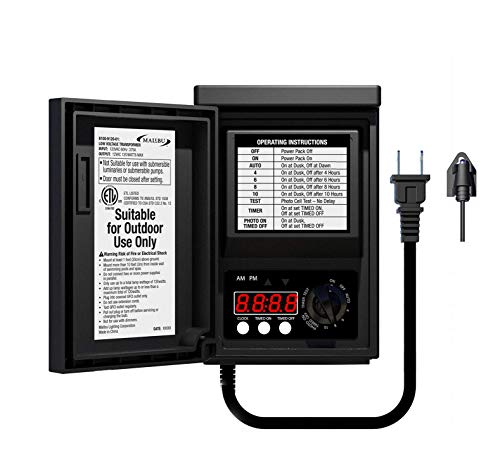
Malibu 120 Watt Landscape Power Pack with Sensor
$69.99A 120W transformer with a detachable photocell and 4/6/8/10-hour countdown; the maker recommends loading it to about 90W.
Best for: powering up to about 90W of LED fixtures
Check price on Amazon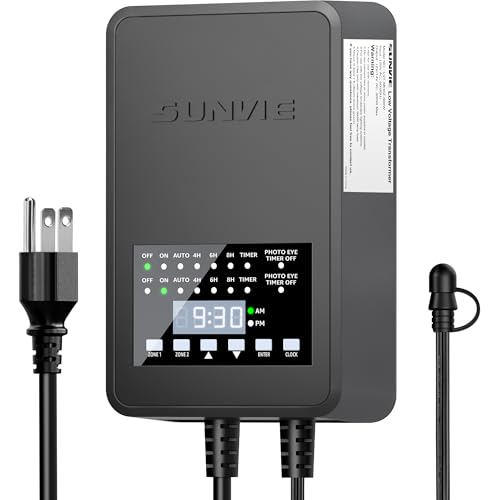
SUNVIE 300W Two-Zone Landscape Transformer with Timer
$119.99A 120V to 12/14V transformer with two independently controlled zones, photocell, timer and countdown modes, plus built-in circuit protection.
Best for: larger systems that need two lighting schedules
Check price on Amazon
Malibu 10-Light Low Voltage Landscape Kit with 150W Transformer
$259.99A complete metal kit of six 10W path lights and four 20W spotlights with a 150W transformer and 75 ft of wire, so nothing else is needed to start.
Best for: a first wired landscape lighting install
Check price on Amazon
Lumina Lighting 3W LED Low Voltage Path Lights (8-Pack)
$189.99Cast aluminum IP65 path lights with an 8 in. shade for glare-free downlight and replaceable G4 LED bulbs (transformer not included).
Best for: upgrading a walkway with durable LED fixtures
Check price on Amazon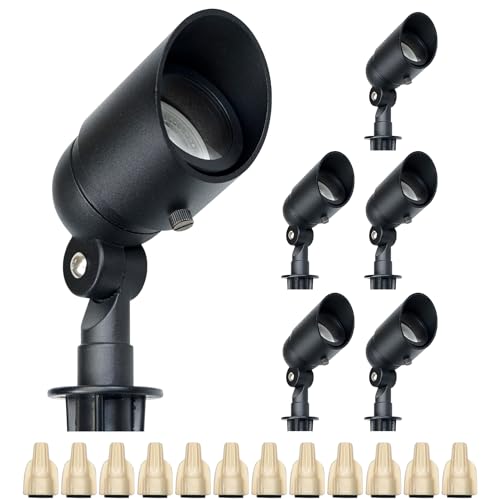
Lumina Lighting 4W LED Low Voltage Spotlights (6-Pack)
$128.99Cast aluminum IP65 spotlights with tempered glass lenses and a 160-degree adjustable knuckle for uplighting trees, walls and flags.
Best for: uplighting trees and the front of the house
Check price on Amazon
Mancra Solar Pathway Lights (8-Pack)
$39.99Glass-and-steel solar stakes with a warm 3000K filament-style LED, monocrystalline panels and an 800mAh battery, installed with no wiring.
Best for: lighting a path where running wire is impractical
Check price on Amazon
NYMPHY Solar Spotlights (4-Pack, Warm White)
$39.99IP68 solar spotlights with 56 LEDs each and three brightness modes that mount in the ground or on a wall.
Best for: accent lighting on shrubs without wiring
Check price on Amazon
Kasa EP40 Outdoor Smart Plug (2 Outlets)
$17.28Two independently controlled IP64 outlets rated 15A each with sunrise and sunset scheduling and up to 300 ft of Wi-Fi range.
Best for: putting string lights on a sunset schedule
Check price on AmazonOn this page
What size transformer do I need for landscape lighting?
| Total fixture watts | Current at 12V | Transformer (80 percent loading) |
|---|---|---|
| 30 W | 2.5 A | 60 W |
| 50 W | 4.2 A | 120 W |
| 75 W | 6.3 A | 120 W |
| 100 W | 8.3 A | 150 W |
| 150 W | 12.5 A | 200 W |
| 200 W | 16.7 A | 300 W |
| 300 W | 25 A | 600 W |
How much power do landscape light fixtures use?
| Fixture | Typical watts | Typical use |
|---|---|---|
| LED path light | 2 to 4 W | Every 6 to 10 ft along a path, staggered |
| LED spotlight or uplight | 4 to 7 W | One to three per tree or feature |
| LED well light | 4 to 8 W | In-ground uplighting |
| LED wall wash or flood | 8 to 15 W | House facades and large walls |
| Halogen path light (older) | 10 to 20 W | Replace with LED to cut load by 70 to 80 percent |
What wire gauge do I need for my run?
Maximum run length that keeps voltage drop to about 1.5 volts, worst case with all fixtures at the end of the run.
| Load on the run | 16 AWG | 14 AWG | 12 AWG | 10 AWG |
|---|---|---|---|---|
| 50 W (4.2 A) at the end of the run | 45 ft | 71 ft | 113 ft | 180 ft |
| 100 W (8.3 A) at the end of the run | 22 ft | 36 ft | 57 ft | 90 ft |
| 150 W (12.5 A) at the end of the run | 15 ft | 24 ft | 38 ft | 60 ft |
How are transformer size and voltage drop calculated?
- Total load = sum of fixture watts (use the LED fixture rating, not a halogen equivalent)
- Transformer = total load / 0.8, rounded up to a standard size
- Current on a run = run load in watts / 12 volts
- Voltage drop = 2 x run length in feet x current x wire resistance per foot; the factor of 2 counts both conductors
The worst case assumes all fixtures sit at the far end of the run. Real runs with fixtures spaced along the cable drop less, which is why the calculator reports worst case as a safe upper bound. Many LED fixtures operate over a wide input range, often from about 9 to 15 volts, so check your fixture specs; multi-tap transformers with 13, 14 and 15 volt taps let long runs start higher to finish near 12 volts.
Low voltage or solar landscape lights?
Low voltage systems give consistent brightness all night in every season, with a timer or photocell on the transformer such as the SUNVIE 300W Two-Zone Landscape Transformer with Timer or the Malibu 120 Watt Landscape Power Pack with Sensor. LED fixtures like the Lumina Lighting 3W LED Low Voltage Path Lights (8-Pack) and Lumina Lighting 4W LED Low Voltage Spotlights (6-Pack) keep the load small. Solar lights such as the Mancra Solar Pathway Lights (8-Pack) install in minutes with no wiring, but they depend on sun: shaded spots and short winter days mean dim or short-lived light. For a starter system in one box, the Malibu 10-Light Low Voltage Landscape Kit with 150W Transformer includes fixtures, cable and transformer. See solar vs low voltage landscape lights.
Frequently asked questions
How many lights can I put on a 120 watt transformer?
At 80 percent loading a 120 watt transformer supports about 96 watts of fixtures. That is roughly 32 LED path lights at 3 watts, 24 spotlights at 4 watts, or a mix such as 16 path lights and 12 spotlights. With older halogen fixtures of 10 to 20 watts, the same transformer supports only about 5 to 9 fixtures, which is why LED retrofits free up so much capacity.
What gauge wire should I use for landscape lighting?
12 gauge cable is the common choice for most residential runs up to about 100 feet with a 50 watt load. Use 10 gauge for longer or heavier runs, and reserve 14 or 16 gauge for short runs with a few low-watt LED fixtures. Keep voltage drop to about 1.5 volts on the far fixture, or use a higher transformer tap to compensate.
Why are my landscape lights dim at the end of the run?
Dim lights at the end of a run are usually voltage drop: the cable is too long or too thin for the load, so the last fixtures receive well under 12 volts. Fixes include splitting the run into two shorter runs, using heavier 10 or 12 gauge cable, moving to hub wiring, reducing load by switching to LED fixtures, or connecting that run to a 13 to 15 volt tap.
Should I get a bigger landscape lighting transformer than I need?
Yes, within reason. Sizing so fixtures use no more than 80 percent of the rating avoids overheating and nuisance trips, and extra headroom lets you add fixtures later without replacing the transformer. A 200 to 300 watt transformer is a practical choice for a typical front yard system, while small path-only projects are well served by 60 to 120 watts.
Do LED landscape lights need a special transformer?
Most LED landscape fixtures run on standard 12 volt AC magnetic or electronic landscape transformers. Some LED fixtures are sensitive to certain transformer types or require a minimum load, so check the fixture specifications. Multi-tap magnetic transformers are the most flexible choice for long runs, and many include timers, photocells or smart controls for scheduling.
Researched, not professional advice. This page is compiled from published specifications, manuals, labels and owner-review consensus, not hands-on testing. Follow the manufacturer's instructions and product label, and consult a qualified professional where safety, chemicals, fuel or structures are involved. As an Amazon Associate we earn from qualifying purchases.