Lighting and Exterior
Landscape Lighting Planning Guide: Fixtures, Spacing and Wiring
Quick answer
Plan landscape lighting around safety, security and accent: path lights every 6 to 10 feet staggered, one to three 4 to 7 watt LED spotlights per tree, warm 2700 to 3000K color, and a transformer loaded to no more than 80 percent. Fourteen LED fixtures at 48 watts run fine on the Malibu 120 Watt Landscape Power Pack with Sensor.
Low voltage landscape lighting is a system in which a transformer plugged into an outdoor outlet steps household 120 volt power down to about 12 volts, which runs along direct-burial cable to path lights, spotlights and other fixtures. Because 12 volt cable can be buried shallow and handled safely by homeowners, it is the standard do-it-yourself approach, while motion floodlights on the house run on line voltage and belong to an electrician.
Good lighting starts with a sketch, not a shopping cart. Decide what each light is for, pick fixtures and count watts, then size the transformer and cable runs with the landscape lighting transformer calculator. A two-zone transformer with a timer such as the SUNVIE 300W Two-Zone Landscape Transformer with Timer ($119.99) leaves room to grow, and the best landscape lighting ranks complete options.
On this page
- What should a landscape lighting plan accomplish?
- What types of landscape light fixtures are there?
- How far apart should landscape path lights be?
- What color temperature is best for landscape lighting?
- What size transformer do I need for landscape lighting?
- How do I prevent voltage drop in landscape lighting?
- Should I wire landscape lights daisy chain, T or hub?
- Are solar landscape lights as good as low voltage?
- How do I put landscape lights on a timer?
- How do I install low voltage landscape lighting step by step?
- What landscape lighting gear should I buy?
What should a landscape lighting plan accomplish?
Every fixture should serve one of three goals, and planning by goal keeps a yard from looking like an airport runway:
- Safety: light where feet go. Steps, path edges, grade changes, the driveway apron and the route from the car to the door. Low path lights and step lights put light on the ground without glare in the eyes.
- Security: remove dark hiding spots near doors, windows, side yards and the garage. Motion floodlights such as the Lithonia Lighting HomeGuard 2-Light LED Motion Flood Light or a camera floodlight like the Ring Floodlight Cam 4K Pro (Wired) do this job better than dim accent lights, and they are line voltage.
- Accent: show off a tree canopy, the texture of a stone wall, a flag or the house facade. Accent light is what makes a yard look designed, and less is usually more.
Walk the property at night with a flashlight before buying. Note where you trip, what you see from inside the house and the street, and where neighbors' windows are, so accent lights do not shine into bedrooms. Mark outlet locations: a transformer needs a GFCI-protected outdoor receptacle, and runs are shortest when the transformer sits near the middle of the lit areas.
What types of landscape light fixtures are there?
Wattages are typical LED ratings used for transformer sizing. Always add up the actual watts printed on your fixtures.
| Fixture | Typical LED watts | Where it goes | Example |
|---|---|---|---|
| Path light | 2 to 4 W | Every 6 to 10 ft along a path, staggered side to side | Lumina 3W path lights |
| Spotlight or uplight | 4 to 7 W | One to three per tree, wall feature, flag or sign | Lumina 4W spotlights |
| Well light | 4 to 8 W | In-ground uplighting where a stake light would be mowed or tripped over | LED well lights |
| Wall wash or flood | 8 to 15 W | House facades and large walls | wall wash lights |
| Step or hardscape light | About 1 to 3 W | Under stair treads, wall caps and retaining walls | hardscape lights |
| Downlight (moonlight) | 4 to 7 W | High in a tree, shining down through branches | tree-mounted downlights |
| Halogen path light (older kits) | 10 to 20 W | Replace with LED to cut load by 70 to 80 percent | Malibu 10-light kit |
How far apart should landscape path lights be?
Space path lights about 6 to 10 feet apart and stagger them from one side of the path to the other, so pools of light overlap slightly on the walking surface. Lining both sides at equal spacing creates the runway look. Set them a few inches back from the edge where mowers and shovels will not clip them. Tall shaded path lights such as the Lumina Lighting 3W LED Low Voltage Path Lights (8-Pack), which uses an 8 inch shade, cast light down and out rather than into the eyes.
- Trees: one spotlight lights a small ornamental; a large shade tree usually needs two or three from different sides so the canopy looks three-dimensional. Place uplights a short distance from the trunk, aimed up into the branches.
- Walls and facades: grazing, with the fixture close to a textured stone or brick wall, shows texture; washing, with the fixture set farther back, lights a smooth wall evenly.
- Steps: light every step or every other step on longer runs, from the side or under the tread.
- Driveways: mark edges and curves at wider spacing, and keep fixtures out of the snow-shovel and plow zone.
Aim spotlights so the bulb is hidden from the main viewing spots and does not shine into the street or a neighbor's windows.
What color temperature is best for landscape lighting?
| Color temperature | Look | Best for |
|---|---|---|
| 2200 to 2700K | Amber to warm candle | Traditional homes, patios and a soft, low-glare mood; some owners use it to reduce insect attraction |
| 2700 to 3000K | Warm white, the most common landscape choice | Paths, brick, stone, wood and most plantings; matches warm interior lighting. The Mancra solar path lights are 3000K |
| 4000K | Neutral to cool white | Silver and blue foliage, modern architecture and moonlighting from trees |
| 5000K | Daylight white | Security floodlights over driveways; the Lithonia HomeGuard switches between 3000, 4000 and 5000K |
Mixing color temperatures in one view looks patchy. Pick one warm temperature for accent and path lights and keep cooler light for security floods.
What size transformer do I need for landscape lighting?
Add the watts of every fixture on the transformer, then divide by 0.8 so the connected load is no more than 80 percent of the transformer rating. For example, 8 path lights at 3 watts plus 6 spotlights at 4 watts is 48 watts, which fits a 60 watt transformer exactly at 80 percent, so a 120 watt unit leaves room to add lights. Malibu recommends loading its Malibu 120 Watt Landscape Power Pack with Sensor to about 90 watts.
| Total fixture watts | Current at 12V | Smallest standard transformer |
|---|---|---|
| 30 W | 2.5 A | 60 W |
| 50 W | 4.2 A | 120 W |
| 75 W | 6.3 A | 120 W |
| 100 W | 8.3 A | 150 W |
| 150 W | 12.5 A | 200 W |
| 200 W | 16.7 A | 300 W, such as the SUNVIE 300W |
| 300 W | 25 A | 600 W, or split across two transformers |
Halogen kits add up fast: the Malibu 10-light kit lists six 10W path lights and four 20W spots, 140 watts on a 150 watt transformer, which is above 80 percent. LED replacement bulbs or fewer fixtures bring it back into range.
How do I prevent voltage drop in landscape lighting?
Voltage drop is the loss of voltage along a cable, and it is why the last lights on a long run look dim or yellow. It rises with run length and load and falls with heavier cable. Voltage drop equals 2 times run length in feet times amps times the wire's resistance per foot, and a common target is to keep it to about 1.5 volts.
| Load on the run | 16 AWG | 14 AWG | 12 AWG | 10 AWG |
|---|---|---|---|---|
| 50 W (4.2 A) | 45 ft | 71 ft | 113 ft | 180 ft |
| 100 W (8.3 A) | 22 ft | 36 ft | 57 ft | 90 ft |
| 150 W (12.5 A) | 15 ft | 24 ft | 38 ft | 60 ft |
Copper resistance per 1,000 ft: 16 AWG 4.02 ohms, 14 AWG 2.53, 12 AWG 1.59, 10 AWG 1.00. Fixtures spaced along a run drop less than this worst case.
Should I wire landscape lights daisy chain, T or hub?
How the cable runs matters as much as its gauge. The three common layouts:
- Daisy chain (series of taps): one cable leaves the transformer and each fixture taps into it along the way. It is the simplest and uses the least cable, and it works for short runs with a few LED fixtures, but the last fixture is always dimmest, so keep runs short or load light.
- T method: a lead cable with no fixtures runs from the transformer to the middle of a group of lights, then splits in a T in two directions. The fixtures see nearly equal voltage because no light is far from the split point. It suits a cluster of lights far from the transformer, such as a garden bed at the back of the yard.
- Hub (star): several cables of equal length run from one central junction to individual fixtures or small groups. It gives the most even brightness and is common in professional installs, at the cost of more cable and connections.
Two-zone transformers such as the SUNVIE 300W Two-Zone Landscape Transformer with Timer let the front and back yards run as separate circuits with their own schedules, which also shortens each run. Use cable rated for direct burial, and splice with waterproof connectors made for low voltage landscape lighting. Leave a small loop of slack at each fixture so it can be moved as plants grow.
Are solar landscape lights as good as low voltage?
Solar lights such as the Mancra Solar Pathway Lights (8-Pack) and NYMPHY Solar Spotlights (4-Pack, Warm White) install in minutes with no wiring, transformer or trenching, which makes them the right answer for renters, a few path markers, and spots far from any outlet. The trade-off is consistency: brightness and run time depend on how much direct sun each panel got that day, so shaded beds, north sides of houses, cloudy stretches and short winter days mean dim or short-lived light. Their batteries also wear out after a few seasons.
Low voltage lights give the same brightness all night in every season, aim precisely, and last longer, but need a transformer, cable and an afternoon of work. Many yards mix them: low voltage for the front walk and feature trees, solar for a far garden path. The details are in solar vs low voltage landscape lights and the best solar path lights.
How do I put landscape lights on a timer?
Most landscape transformers include a photocell (dusk sensor), a countdown timer or both. The Malibu 120 Watt Landscape Power Pack with Sensor has a detachable photocell with 4, 6, 8 or 10 hour countdown, so lights come on at dusk and shut off later in the evening. The SUNVIE 300W Two-Zone Landscape Transformer with Timer adds photocell, timer and countdown modes for each of its two zones.
For app control, plug a transformer set to always-on into an outdoor smart plug such as the Kasa EP40 Outdoor Smart Plug (2 Outlets), which has two separately controlled 15A outlets with sunrise and sunset scheduling. It also runs plug-in patio lights like the Brightech Ambience Pro LED String Lights (48 ft., 15 Bulbs). Keep the plug within Wi-Fi range and under an in-use cover. For patio string lighting ideas, see the best outdoor string lights.
How do I install low voltage landscape lighting step by step?
- Sketch the plan. Draw the house, paths, beds and trees, mark each fixture by goal, note the outlet location and measure each cable run.
- Size the system. Add fixture watts, divide by 0.8 to choose the transformer, and check each run length against the gauge table or the calculator.
- Call 811. Request utility locates a few business days before digging, and wait for the lines to be marked.
- Mount the transformer. Mount it near a GFCI outdoor outlet with an in-use cover, at least 12 inches above the ground per its instructions.
- Lay out cable and fixtures. Place fixtures on the surface, lay direct-burial cable in your chosen daisy chain, T or hub layout, and leave a slack loop at each fixture.
- Connect and test at night. Make connections with waterproof low voltage connectors, power up after dark, and adjust aim and spacing before anything is buried.
- Check voltage. If you have a multimeter, measure at the farthest fixture; move it to a higher transformer tap or shorten the run if it reads well under the fixture's range.
- Bury the cable. Slice a shallow trench along bed edges, commonly about 6 inches or as the cable instructions and local code specify, tuck the cable in and close it.
- Set the schedule. Set the photocell and timer, or a smart plug schedule, and recheck aim after plants leaf out.
What landscape lighting gear should I buy?
A good first system is a transformer with headroom plus LED path lights and spotlights, rather than a halogen kit you will outgrow. Add security lighting on the house separately.
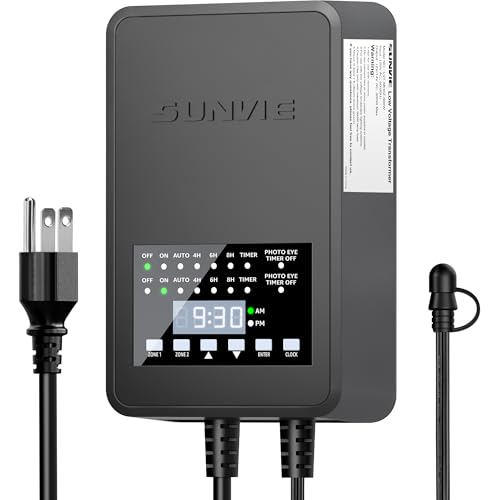
SUNVIE 300W Two-Zone Landscape Transformer with Timer
$119.99A 120V to 12/14V transformer with two independently controlled zones, photocell, timer and countdown modes, plus built-in circuit protection, supporting about 240 W at 80 percent.
Best for: front and back yard systems
Check price on Amazon
Lumina Lighting 3W LED Low Voltage Path Lights (8-Pack)
$189.99Cast aluminum IP65 path lights with an 8 in. shade for glare-free downlight and replaceable G4 LED bulbs, at 3 W each so eight add only 24 W.
Best for: walks and bed edges
Check price on Amazon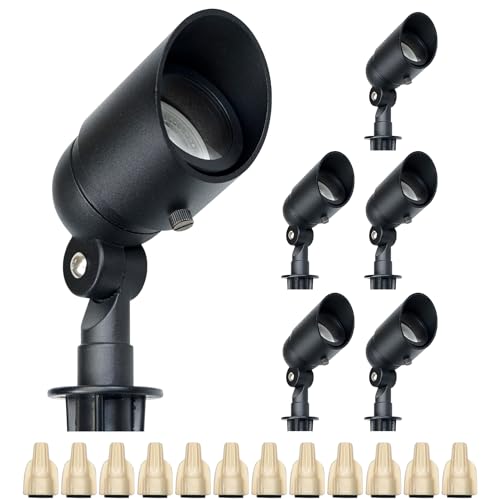
Lumina Lighting 4W LED Low Voltage Spotlights (6-Pack)
$128.99Cast aluminum IP65 spotlights with tempered glass lenses and a 160-degree adjustable knuckle for uplighting trees, walls and flags at 4 W each.
Best for: trees and facades
Check price on Amazon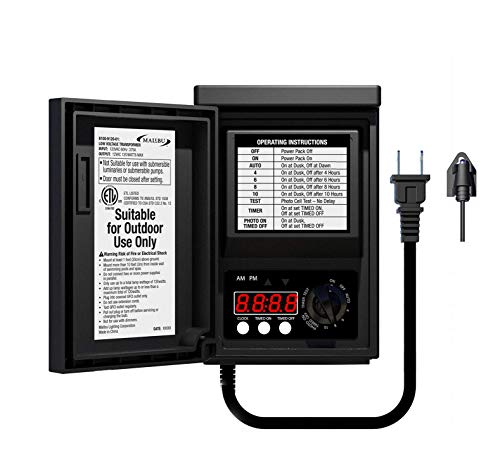
Malibu 120 Watt Landscape Power Pack with Sensor
$69.99A 120 W transformer with a detachable photocell and 4, 6, 8 or 10 hour countdown; the maker recommends loading it to about 90 W.
Best for: path-only projects
Check price on Amazon
Mancra Solar Pathway Lights (8-Pack)
$39.99Glass and steel solar stakes with a warm 3000K LED, monocrystalline panels and an 800mAh battery, for sunny spots far from an outlet.
Best for: renters and sunny paths
Check price on Amazon
Ring Floodlight Cam 4K Pro (Wired)
$279.992,000 lumen motion floodlights with a 4K camera, 3D motion detection, two-way talk and an 85 dB siren; hardwired, so plan for an electrician.
Best for: driveways and side yards
Check price on AmazonHow we chose
We did not test these products in person. Picks are researched from manufacturer specifications and owner manuals, engine and safety certifications where they apply, warranty terms, public recall records, and the recurring themes in verified owner reviews. We favor established brands with large review counts and parts support, match each pick to a real yard size or task, and place it in the tier where its price and capability actually belong.
Frequently asked questions
How many landscape lights can I put on one transformer?
Divide 80 percent of the transformer rating by the watts per fixture. A 120 watt transformer supports about 96 watts, or roughly 32 LED path lights at 3 watts. The SUNVIE 300W Two-Zone Landscape Transformer with Timer supports about 240 watts, around 60 LED spotlights at 4 watts. Also check each cable run for voltage drop, since a big load on one long thin run dims the last fixtures.
How deep should landscape lighting cable be buried?
Low voltage landscape cable is typically buried shallow, commonly about 6 inches, following the cable and fixture instructions and local code. Bury it along bed edges where aerators and edgers will not cut it, and leave slack at fixtures. Call 811 before digging even a shallow trench, because gas, electric and communication lines can sit close to the surface.
Do I need an electrician for landscape lighting?
Not for a plug-in low voltage system connected to an existing GFCI outdoor outlet with an in-use cover. You do need a licensed electrician to add a new outdoor receptacle, hardwire a transformer, or install line voltage fixtures such as motion floodlights and camera floodlights like the Ring Floodlight Cam 4K Pro (Wired). Local codes and permit rules vary.
What wattage LED landscape lights should I use?
Most LED path lights draw 2 to 4 watts, spotlights and uplights 4 to 7 watts, and wall washes or floods 8 to 15 watts. The Lumina Lighting 3W LED Low Voltage Path Lights (8-Pack) are 3 watts and the Lumina Lighting 4W LED Low Voltage Spotlights (6-Pack) are 4 watts. Brightness also depends on beam angle and lumens, so compare lumens when fixtures list them, and use the printed wattage for transformer sizing.
Why do my landscape lights flicker or go dim?
Dim lights at the end of a run usually mean voltage drop from a long or thin cable, or too much load on one run. Flickering often points to a corroded or loose connection, a failing bulb, or a photocell confused by nearby light. Check connections first, split long runs, move to heavier 12 or 10 gauge cable, or use a higher transformer tap if yours has one.
Is warm white or cool white better for landscape lighting?
Warm white, about 2700 to 3000K, is the most common choice for paths, trees, stone and brick, because it looks natural and matches indoor lighting. Cooler 4000K suits silver or blue foliage and moonlighting effects, and 5000K is typical for security floodlights. Keep one color temperature for accent lighting across the yard so it looks consistent.
Researched, not professional advice. This page is compiled from published specifications, manuals, labels and owner-review consensus, not hands-on testing. Follow the manufacturer's instructions and product label, and consult a qualified professional where safety, chemicals, fuel or structures are involved. As an Amazon Associate we earn from qualifying purchases.