Watering and Irrigation
Sprinkler Zone Calculator: How Many Sprinkler Heads Per Zone
Quick answer
Time how long a 5 gallon bucket takes to fill at the spigot, divide 300 by the seconds to get GPM, and plan each zone on about 75 percent of that. At 10 GPM you have about 7.5 usable GPM: roughly 3 gear rotors at 2.5 GPM or 4 full-circle spray heads at 1.8 GPM per zone. Never mix sprays and rotors on one zone.
A sprinkler zone is a group of heads that run together from one valve, and the number of heads a zone can carry is limited by the water your home supply delivers. Put too many heads on a zone and pressure drops, spray patterns shrink and dry spots appear. Enter your bucket test, water pressure and head type, and the calculator tells you heads per zone, zones needed for the heads you plan, and how long each zone should run for an inch of water a week. If you water from a hose instead, the hose pressure loss calculator shows how much pressure reaches the sprinkler.
Sprinkler zone calculator
Heads per zone
Controllers and heads for your zones
Top matches update when you calculate.

Rachio 3 Smart Sprinkler Controller, 8 Zone
$199.00An app-run 8 zone controller whose Weather Intelligence skips watering for rain, wind and freeze, installing in about 30 minutes on most existing systems.
Best for: replacing a dial timer on a typical home system
Check price on Amazon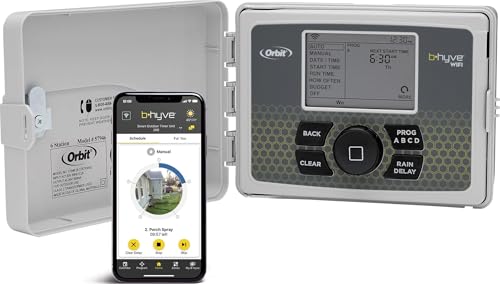
Orbit B-hyve Smart Indoor/Outdoor Sprinkler Controller, 12 Zone
$138.00A 12 zone app-controlled controller in a weatherproof case for garage or exterior walls, at a lower price than most smart controllers of the same zone count.
Best for: budget smart upgrade with outdoor mounting
Check price on Amazon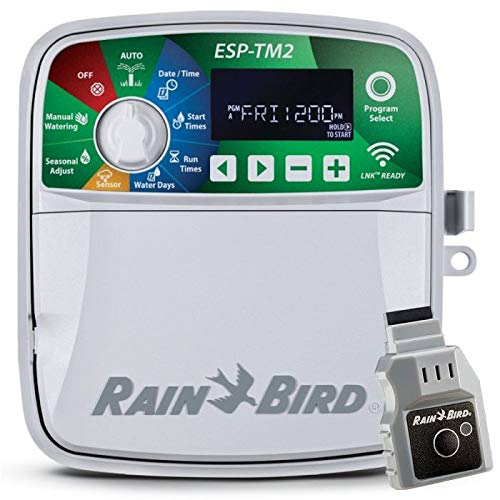
Rain Bird ESP-TM2 12 Zone Controller with LNK WiFi Module
$355.16A 12 zone indoor or outdoor controller with a backlit LCD and pre-wired power cord, bundled with the LNK module for app control and automatic weather adjustments.
Best for: people who want physical buttons plus app control
Check price on Amazon
Hunter PRO-HC WiFi Sprinkler Controller, 12 Zone
$354.90A contractor-grade Hydrawise controller with predictive weather scheduling, color touchscreen, sensor inputs, master valve output, wire fault detection and optional flow meter leak alerts.
Best for: larger systems that want flow monitoring
Check price on Amazon
Rachio Smart Hose Timer Bundle, 2 Valves plus WiFi Hub
$149.00Two app-controlled faucet valves and a hub (expandable to 8 valves) with rain skips, flow monitoring alerts and a manual quick-run button.
Best for: automating hose sprinklers without in-ground pipes
Check price on Amazon
Orbit B-hyve XD 4-Port Smart Hose Timer with Wi-Fi Hub
$124.05A battery-powered 4 outlet faucet timer with WeatherSense scheduling, controlled over Bluetooth or through the included Wi-Fi hub when away.
Best for: four hose zones from one spigot
Check price on Amazon
Melnor AquaTimer 4-Zone Programmable Digital Hose Timer
$69.99A non-WiFi 4 valve timer with independent schedules from hourly to weekly, 1 minute to 6 hour runs, a manual override and a 7-year limited warranty.
Best for: simple multi-zone hose watering without an app
Check price on Amazon
Rain Bird 5000 Rotor 20-Pack with Nozzle Trees and Tools
$207.95Twenty top-adjustable 5000 rotors with Rain Curtain nozzles, 40 to 360 degree arcs and 25 to 50 ft throw at 25 to 65 psi, enough heads for a typical front and back yard.
Best for: building or rebuilding an in-ground system
Check price on Amazon
Hunter PGP Ultra Rotor Sprinkler Heads, 4-Pack
$65.94A four-pack of the widely installed Hunter PGP Ultra gear rotor with the adjustment tool included, a common like-for-like replacement in existing Hunter systems.
Best for: replacing heads in a Hunter system
Check price on Amazon
Rain Bird 32ETI DIY In-Ground Automatic Sprinkler Kit
$126.49A faucet-connected kit with retracting heads that Rain Bird says installs in an afternoon and covers 1,000 to 3,000 sq ft at 45 to 75 psi.
Best for: small lawns that want pop-up heads without a plumber
Check price on Amazon
Nelson Rain Train Traveling Sprinkler, 13,500 sq ft
$77.75A cast iron tractor that follows the laid-out hose up to 200 ft with three speeds and automatic shut-off, covering up to 13,500 sq ft in one run.
Best for: big lawns without in-ground irrigation
Check price on Amazon
Melnor XT Oscillating Sprinkler, 4,500 sq ft
$32.99Twenty nozzles with width and range controls plus zoom flow control let one sprinkler cover a 4,500 sq ft rectangle or a small seeded patch.
Best for: rectangular lawns and new seed
Check price on AmazonOn this page
How many sprinkler heads per zone can I have?
Bucket test with a 5 gallon bucket at the spigot nearest the water meter, all other water off.
| Bucket fill time | Available flow | Usable (75 percent) | Rotors at 2.5 GPM | Full spray heads at 1.8 GPM |
|---|---|---|---|---|
| 15 sec | 20.0 GPM | 15.0 GPM | 6 | 8 |
| 20 sec | 15.0 GPM | 11.3 GPM | 4 | 6 |
| 25 sec | 12.0 GPM | 9.0 GPM | 3 | 5 |
| 30 sec | 10.0 GPM | 7.5 GPM | 3 | 4 |
| 40 sec | 7.5 GPM | 5.6 GPM | 2 | 3 |
| 60 sec | 5.0 GPM | 3.8 GPM | 1 | 2 |
How much water does each sprinkler head use?
| Head type | Typical flow | Precipitation rate | Minutes for 1 inch, about |
|---|---|---|---|
| Fixed spray head, full circle (about 15 ft) | 1.8 GPM | 1.5 to 2.0 in/hr | 34 min |
| Fixed spray head, half circle | 0.9 GPM | 1.5 to 2.0 in/hr | 34 min |
| Fixed spray head, quarter circle | 0.45 GPM | 1.5 to 2.0 in/hr | 34 min |
| Gear rotor (25 to 45 ft) | 2.5 GPM | 0.4 to 0.7 in/hr | 109 min |
| Multi-stream rotary nozzle, full circle | 0.6 GPM | 0.4 to 0.6 in/hr | 120 min |
| Impact sprinkler (hose or pop-up) | 3.5 GPM | 0.3 to 0.6 in/hr | 133 min |
How is the sprinkler zone calculation done?
- Available flow (GPM) = 5 gallons x 60 / seconds to fill the bucket
- Usable flow = available flow x 0.75, leaving margin for pressure loss in pipe, valves and backflow preventers
- Heads per zone = usable flow / GPM per head, rounded down
- Zones needed = total head flow for an area / usable flow, rounded up
- Runtime = weekly water target in inches / precipitation rate in inches per hour
Pressure matters too. Spray heads generally perform best around 30 psi at the nozzle and rotors around 40 psi or more, and static pressure at the spigot drops once water flows. A simple pressure gauge on a hose bib reads static pressure; if it is under about 40 psi, plan fewer heads per zone. Many lawns need roughly an inch of water a week in active growth, including rain, but grass type, soil and climate change that, so follow local extension guidance.
Do I need a smart sprinkler controller?
Not required, but it pays back in water and attention. Smart controllers adjust schedules for rain, temperature and season, and many let you run zones from a phone while you check coverage. The Rachio 3 Smart Sprinkler Controller, 8 Zone ($199.00) is a common 8 zone choice, the Orbit B-hyve Smart Indoor/Outdoor Sprinkler Controller, 12 Zone covers 12 zones for less, and contractor-grade options such as the Hunter PRO-HC WiFi Sprinkler Controller, 12 Zone add sensor inputs and flow monitoring. For hose-fed watering, smart hose timers such as the Orbit B-hyve XD 4-Port Smart Hose Timer with Wi-Fi Hub bring scheduling to spigots. See the best smart sprinkler controllers and Rachio vs Orbit B-hyve.
Sprinkler system or hose sprinklers?
An in-ground system with zones waters evenly on a schedule and suits lawns you intend to keep green through dry spells. Hose-end sprinklers cost far less and work well for small lawns, new seed and occasional deep watering: an oscillating model like the Melnor XT Oscillating Sprinkler, 4,500 sq ft covers a rectangle up to 4,500 square feet, and a traveling sprinkler such as the Nelson Rain Train Traveling Sprinkler, 13,500 sq ft follows a hose across up to 13,500 square feet. Faucet-fed kits like the Rain Bird 32ETI DIY In-Ground Automatic Sprinkler Kit sit in between. Shrub and flower beds are usually better served by drip, which is compared in drip irrigation vs sprinklers.
Frequently asked questions
How many sprinkler heads can be on one zone?
It depends on your water flow and the heads. Measure available flow with a bucket test, use about 75 percent of it, and divide by each head's flow. At 10 GPM available, a zone can typically carry about 3 gear rotors at 2.5 GPM each or 4 full-circle spray heads at 1.8 GPM. Half and quarter circle heads use less, so more of them fit.
How do I measure my water flow for sprinklers?
Turn off all water in the house, open the spigot nearest the water meter fully and time how many seconds it takes to fill a 5 gallon bucket. Divide 300 by the seconds for gallons per minute: 30 seconds is 10 GPM, 20 seconds is 15 GPM. Repeat twice and average. A pressure gauge on the spigot also tells you static pressure.
Can I put rotors and spray heads on the same zone?
No. Spray heads apply water at roughly 1.5 to 2 inches per hour, while rotors apply about 0.4 to 0.7 inches per hour. On the same zone, spray areas would be overwatered long before rotor areas get enough. Keep sprays and rotors on separate zones, and ideally match precipitation rates within each zone for even watering.
How long should each sprinkler zone run?
Divide the water you want to apply by the head precipitation rate. For about an inch a week, spray zones need roughly 30 to 40 minutes a week and rotor zones 1.5 to 2.5 hours, split into two or three sessions so water soaks in instead of running off. Early morning watering reduces evaporation and disease. Adjust for rain, soil and local restrictions.
How many zones does a sprinkler system need?
Add up the flow of all the heads needed to cover each area, keeping sprays and rotors separate, and divide by your usable flow per zone. A typical suburban front and back yard often ends up with 4 to 8 zones. Sunny and shaded areas, lawn and beds, and slopes are also good reasons to split zones even when flow would allow fewer.
Researched, not professional advice. This page is compiled from published specifications, manuals, labels and owner-review consensus, not hands-on testing. Follow the manufacturer's instructions and product label, and consult a qualified professional where safety, chemicals, fuel or structures are involved. As an Amazon Associate we earn from qualifying purchases.