Watering and Irrigation
Best Lawn Sprinklers: Oscillating, Impact, Traveling and Rotors (2026)
Quick answer
The best lawn sprinkler depends on yard shape: the Melnor XT oscillating covers rectangles up to 4,500 sq ft, the Nelson Rain Train waters up to 13,500 sq ft per run, and for permanent coverage the Rain Bird 5000 rotor 20-pack anchors an in-ground system on a smart controller.
Sprinklers differ in the shape they water, how far they throw, and how fast they put water down. Oscillating sprinklers sweep a rectangle, impact sprinklers throw a long circle or arc, traveling sprinklers crawl along a hose covering a strip, and in-ground gear rotors pop up on a timer. Picking the wrong type for your yard is why so many lawns have a green center and brown corners.
Our top pick is the Rain Bird 5000 rotor 20-pack ($207.95) because a permanent rotor system run by a smart sprinkler controller waters more evenly, with less effort and less waste, than anything you move by hand. If in-ground is not in the plans, the hose-end picks below cover every yard shape. Plan zones with the sprinkler zone calculator, and check how much pressure a long hose costs you with the hose pressure loss calculator.
On this page
- Oscillating vs impact vs traveling vs in-ground rotor: which sprinkler is best?
- How much water pressure and flow do I have for sprinklers?
- Beginner picks: oscillating sprinklers for rectangular lawns and new seed
- Intermediate picks: traveling, tripod impact and a faucet pop-up kit
- Expert picks: gear rotors and pop-up impacts for permanent systems
- How do the sprinkler picks compare?
- How long should I run a sprinkler to water my lawn?
- Can I automate hose-end sprinklers?
- What about shrub and flower beds?
Oscillating vs impact vs traveling vs in-ground rotor: which sprinkler is best?
Match the sprinkler to the shape of the area and to how much you are willing to move hoses. Oscillating sprinklers are best for rectangular lawns and new seed because their gentle, adjustable pattern fits a rectangle. Impact sprinklers throw a long, low stream that resists wind and suits large or irregular areas. Traveling sprinklers cover long, narrow strips and big lawns in a single unattended run. In-ground rotors are best for anyone who waters regularly, because they run on a timer with heads spaced to overlap.
| Type | Pattern | Coverage or throw (catalog picks) | Best for | Weakness |
|---|---|---|---|---|
| Oscillating | Rectangle | Up to 3,600 to 4,500 sq ft | Rectangular lawns, new seed | Wind drift; high arc evaporates |
| Impact (tripod or pop-up) | Circle or arc | 24 to 45 ft radius (AG-5) | Large, irregular areas; dirty water | Uneven close in; needs moving |
| Traveling tractor | Strip along the hose | Up to 13,500 sq ft, 15 to 55 ft wide | Big lawns without irrigation | Needs a laid-out hose path |
| Gear rotor (in-ground) | Adjustable arc | 25 to 50 ft throw (Rain Bird 5000) | Medium to large permanent systems | Install cost and time |
| Faucet-fed pop-up kit | Multiple small circles | 1,000 to 3,000 sq ft (Rain Bird 32ETI) | Small lawns without trenching to the main | Limited by faucet flow |
| Drip | Point source | Plant by plant | Shrub and flower beds | Not for turf |
How much water pressure and flow do I have for sprinklers?
Sprinklers need both pressure (psi) and flow (gallons per minute). Pressure you can read with an inexpensive hose-thread gauge on the spigot; Rain Bird lists 25 to 65 psi for the 5000 rotor and 45 to 75 psi for the 32ETI kit. Flow you measure with a bucket: time how long a 5 gallon bucket takes to fill from the spigot with the valve wide open. Flow sets how many sprinklers or heads can run at once, and a long, narrow hose eats into both numbers.
| Seconds to fill 5 gal | Flow (GPM) | What it can run |
|---|---|---|
| 20 | 15 | Several rotors per zone; any hose-end sprinkler |
| 30 | 10 | A traveling or impact sprinkler easily; 3 to 4 rotors per zone |
| 40 | 7.5 | One large hose-end sprinkler at a time |
| 60 | 5 | One oscillating or small impact sprinkler; long hoses will hurt |
| 75 | 4 | Small sprinklers only; use a 3/4 in hose for any distance |
Flow = 300 divided by seconds. Rotor flow per head depends on the nozzle; check the nozzle chart before designing zones.
Beginner picks: oscillating sprinklers for rectangular lawns and new seed
Cheap, adjustable and easy to aim. Most homeowners should own one even with an in-ground system, for new seed and dry corners.

Melnor XT Oscillating Sprinkler, 4,500 sq ft
$32.99Twenty nozzles with TwinTouch width and range controls and a Zoom control that shrinks the pattern for a small patch of new seed or opens it to 4,500 sq ft. Width indicators help you repeat settings, and Melnor backs it with a limited lifetime warranty.
Best for: rectangular lawns and new seed
Check price on Amazon
Gilmour Metal Sled Base Oscillating Sprinkler, 3,600 sq ft
$53.71A metal sled-base oscillating sprinkler rated for 3,600 sq ft. The metal base sits heavier on the lawn and tolerates being dragged by the hose better than all-plastic sprinklers.
Best for: mid-size rectangular lawns
Check price on AmazonIntermediate picks: traveling, tripod impact and a faucet pop-up kit
For larger lawns watered with hoses, or small lawns ready for pop-up heads without a plumber.

Nelson Rain Train Traveling Sprinkler, 13,500 sq ft
$77.75A 19.4 lb cast iron tractor that follows the hose up to 200 ft, covering up to 13,500 sq ft in one run with adjustable arms spraying 15 to 55 ft wide. Three speeds set how much water goes down, and a ramp trips the automatic shut-off at the end.
Best for: big lawns without in-ground irrigation
Check price on Amazon
Orbit 58308Z Brass Impact Sprinkler on Tripod
$59.39A heavy-duty brass impact head on a tripod that lifts the stream over tall grass and beds, with up to 360 degree rotation for long-range watering of irregular yards.
Best for: large, irregular yards watered by hose
Check price on Amazon
Rain Bird 32ETI DIY In-Ground Automatic Sprinkler Kit
$126.49A faucet-connected kit with retracting heads that Rain Bird says installs in an afternoon and covers 1,000 to 3,000 sq ft at 45 to 75 psi. Heads retract for mowing, and it ends hose dragging on small lawns.
Best for: small lawns that want pop-up heads
Check price on AmazonExpert picks: gear rotors and pop-up impacts for permanent systems
For building, expanding or repairing an in-ground system that runs on a controller.

Rain Bird 5000 Rotor 20-Pack with Nozzle Trees and Tools
$207.95Twenty 5000 rotors with Rain Curtain nozzles that throw larger, wind-resistant droplets, top adjustment of arc and distance with a flat-blade screwdriver, a closed case that resists debris, a stainless retract spring and a 3/4 inch NPT inlet.
Best for: building or rebuilding an in-ground system
Check price on Amazon
Hunter PGP Ultra Rotor Sprinkler Heads, 4-Pack
$65.94A four-pack of the widely installed Hunter PGP Ultra gear rotor with the adjustment tool included. Matching the existing brand keeps precipitation rates consistent within a zone.
Best for: replacing heads in a Hunter system
Check price on Amazon
Rain Bird AG-5 Pop-Up Impact Sprinkler, 24 to 45 ft
$19.98A 3 inch pop-up impact head with 5 color-coded nozzles, 24 to 45 ft throw and 20 to 360 degree arcs, built for hard, dirty or reclaimed water that clogs gear rotors.
Best for: in-ground systems on well water
Check price on AmazonWho should not buy this tier: Skip in-ground heads if you rent, if your lawn is under about 2,000 sq ft (an oscillating sprinkler and a hose timer cost far less), or if you are not prepared to trench, glue pipe, add a backflow preventer and pull any permit your town requires. Skip mixing rotors and spray heads on one zone: their precipitation rates differ severalfold and one area will flood while the other stays dry.
How do the sprinkler picks compare?
| Model | Price | Type | Coverage |
|---|---|---|---|
| Rain Bird 5000 Rotor 20-Pack with Nozzle Trees and Tools | $207.95 | in ground gear rotor | - |
| Hunter PGP Ultra Rotor Sprinkler Heads, 4-Pack | $65.94 | in ground gear rotor | - |
| Rain Bird AG-5 Pop-Up Impact Sprinkler, 24 to 45 ft | $19.98 | pop up impact | - |
| Nelson Rain Train Traveling Sprinkler, 13,500 sq ft | $77.75 | traveling tractor | 13,500 sq ft |
| Orbit 58308Z Brass Impact Sprinkler on Tripod | $59.39 | tripod impact | - |
| Rain Bird 32ETI DIY In-Ground Automatic Sprinkler Kit | $126.49 | faucet fed in ground kit | 3,000 sq ft |
| Melnor XT Oscillating Sprinkler, 4,500 sq ft | $32.99 | oscillating | 4,500 sq ft |
| Gilmour Metal Sled Base Oscillating Sprinkler, 3,600 sq ft | $53.71 | oscillating | 3,600 sq ft |
How long should I run a sprinkler to water my lawn?
Most established lawns need about 1 inch of water per week including rain, delivered in one or two deep waterings rather than daily sips. Deep, infrequent watering grows deeper roots. Water early in the morning, when wind and evaporation are low and leaves dry quickly, which reduces disease. New seed is the exception: keep the top half inch of soil moist with short, frequent runs until seedlings are established.
To find your runtime, set out five or six straight-sided cans across the pattern, run the sprinkler 30 minutes, and average the depth. If the cans hold a quarter inch, you need about two hours per week in that spot. If water puddles or runs off before an inch soaks in, split the time into two or three shorter cycles an hour apart. Rotor systems space heads so each throw reaches the next head, called head-to-head coverage, which evens out the dry rings you get with a single hose-end sprinkler.
Can I automate hose-end sprinklers?
Yes. A smart hose timer such as the Rachio Smart Hose Timer or the Orbit B-hyve XD 4-port turns a Rain Train or Melnor into a scheduled, rain-skipping zone. Run sprinklers far from the spigot on a 3/4 inch hose to limit pressure loss; see best garden hoses and store it on a cart from best hose reels. For in-ground rotors, the best smart sprinkler controllers page covers Rachio, B-hyve, Rain Bird and Hunter.
What about shrub and flower beds?
Beds and turf need different water, so give beds their own drip line or zone. See drip irrigation vs sprinklers.
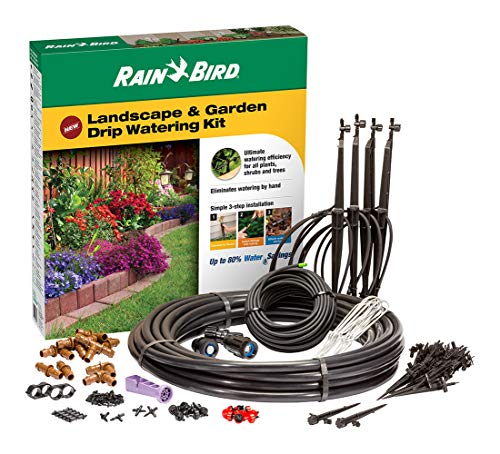
Rain Bird LNDDRIPKIT Landscape Drip Irrigation Kit
$62.83A 108-piece faucet-connected kit with pressure-compensating drippers, micro-bubblers and micro sprays, so each shrub gets the same water. Rain Bird claims up to 80 percent water savings compared with watering by hand.
Best for: shrub and flower beds around the lawn
Check price on Amazon
Raindrip SDFSTH1P Automatic Drip Kit with Timer
$71.99A timer, pressure regulator and filter, 50 ft of half-inch tubing and ten 2 GPH drippers in one box, for automating water to up to 10 shrubs or trees.
Best for: new shrubs and trees
Check price on AmazonHow we chose
We did not test these products in person. Picks are researched from manufacturer specifications and owner manuals, engine and safety certifications where they apply, warranty terms, public recall records, and the recurring themes in verified owner reviews. We favor established brands with large review counts and parts support, match each pick to a real yard size or task, and place it in the tier where its price and capability actually belong.
Frequently asked questions
What is the best sprinkler for a large lawn?
Without in-ground irrigation, a traveling sprinkler such as the Nelson Rain Train is the best hose-end option for large lawns, following up to 200 ft of hose and covering up to 13,500 sq ft in one run. An impact sprinkler on a tripod suits irregular shapes. For regular watering of a large lawn, an in-ground gear rotor system on a smart controller waters most evenly.
Is an oscillating or impact sprinkler better?
Oscillating sprinklers are better for rectangular lawns and new seed because they water a gentle, adjustable rectangle. Impact sprinklers are better for large or irregular areas and windy sites, because their low, heavy stream throws farther and drifts less. Many homeowners keep one of each: the oscillating model for seed and small rectangles, the impact model for the back of a large yard.
How many square feet does a sprinkler cover?
Coverage varies widely by type. The Melnor XT oscillating covers up to 4,500 sq ft and the Gilmour metal sled 3,600 sq ft. An impact head throwing 45 ft covers a circle of about 6,360 sq ft at full rotation. The Nelson Rain Train covers up to 13,500 sq ft per run. In-ground rotors are spaced head to head, so each covers roughly its spacing squared.
How long should I water my lawn with a sprinkler?
Aim for about 1 inch of water per week including rain, applied in one or two deep sessions early in the morning. Measure your sprinkler by setting out straight-sided cans for 30 minutes and averaging the depth, then scale up. If water runs off before soaking in, split runtime into shorter cycles. New seed needs light, frequent watering to keep the surface moist.
Are in-ground sprinklers worth it?
For homeowners who water most weeks of the growing season on a lawn of a few thousand square feet or more, in-ground systems usually pay off in time saved and more even coverage, especially paired with a smart controller that skips rain days. For small lawns, rentals, or yards watered only in drought, hose-end sprinklers with a smart hose timer are far cheaper.
What water pressure do sprinklers need?
Most residential sprinklers work between roughly 30 and 70 psi. Rain Bird lists 25 to 65 psi for the 5000 rotor and 45 to 75 psi for its 32ETI faucet kit. Flow matters as much as pressure: time a 5 gallon bucket at the spigot and divide 300 by the seconds to get gallons per minute. Long, small-diameter hoses reduce both at the sprinkler.
Researched, not professional advice. This page is compiled from published specifications, manuals, labels and owner-review consensus, not hands-on testing. Follow the manufacturer's instructions and product label, and consult a qualified professional where safety, chemicals, fuel or structures are involved. As an Amazon Associate we earn from qualifying purchases.