Watering and Irrigation
Drip Irrigation vs Sprinkler System: Which Should You Use?
Quick answer
Use sprinklers for lawns and drip irrigation for shrubs, trees, flower beds and containers. Drip emitters are rated in gallons per hour and deliver water at the roots, losing far less to evaporation, wind and runoff; EPA WaterSense says drip can use 20 to 50 percent less water than conventional in-ground sprinklers. Turf needs even overhead coverage, which sprinklers provide.
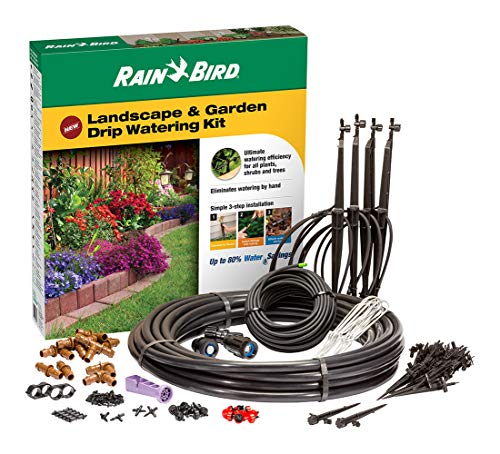
Rain Bird LNDDRIPKIT Landscape Drip Irrigation Kit
$62.83A 108-piece faucet-connected kit with pressure-compensating drippers, bubblers and micro sprays.
Best for: watering landscape beds separately from turf
Check price on Amazon
Rain Bird 5000 Rotor 20-Pack with Nozzle Trees and Tools
$207.95Twenty in-ground gear rotors with 25 to 50 ft throw and adjustable arcs.
Best for: building or rebuilding an in-ground system
Check price on AmazonDrip irrigation runs low-pressure tubing to emitters that release water slowly at the base of each plant, measured in gallons per hour (GPH). A sprinkler system sprays water over an area through spray heads or rotors, measured in gallons per minute (GPM). That difference of sixty times in flow units tells you what each is for: drip for individual plants in beds, sprinklers for a continuous surface like a lawn.
The best systems use both on separate zones. A drip kit such as the Rain Bird LNDDRIPKIT ($62.83) connects to a faucet for foundation shrubs and flower beds, while rotors like the Rain Bird 5000 20-pack ($207.95) cover turf. Plan zones with the sprinkler zone calculator. For vegetable gardens and greenhouses, see GreenhouseSetup.
On this page
- How does drip irrigation compare with sprinklers?
- Which should you choose, drip or sprinklers?
- Drip irrigation vs sprinkler system: which uses less water?
- Can you use drip irrigation on a lawn?
- What does each cost to install and run?
- Can you put drip and sprinklers on the same zone?
- Drip kits, sprinklers and controllers to consider
How does drip irrigation compare with sprinklers?
| Factor | Drip irrigation | Sprinklers |
|---|---|---|
| Flow rating | Gallons per hour; Raindrip kit drippers are 2 GPH | Gallons per minute per head |
| Where water goes | Soil at the root zone | Sprayed over the whole area |
| Best for | Shrubs, trees, flower beds, containers | Lawns and large groundcover areas |
| Water lost to evaporation, wind and runoff | Far less | More, especially midday and in wind |
| Operating pressure | Low; kits include or need a pressure regulator | 25 to 65 psi (Rain Bird 5000 rotors); 45 to 75 psi (Rain Bird 32ETI kit) |
| Foliage | Stays dry, which discourages some leaf diseases | Gets wet |
| Weeds | Dry soil between plants germinates fewer weeds | Waters weeds too |
| DIY install | Faucet kit, tubing on the surface under mulch | Trenching, valves, controller and backflow protection |
| Upkeep | Clean filter, check for clogged emitters and chewed tubing | Adjust arcs, clear nozzles, replace broken heads |
| Catalog price | $62.83 to $71.99 per kit | $207.95 for 20 rotors, plus pipe, valves and a controller |
Pressures and parts from Rain Bird and Raindrip listings. Rain Bird claims up to 80 percent water savings for its drip kit; that is a maker claim.
Which should you choose, drip or sprinklers?
Choose drip irrigation if:
- You are watering foundation shrubs, new trees, perennial beds or containers.
- You have slopes or clay where sprinkler water runs off.
- Your area has watering restrictions; many allow drip on days sprinklers are banned, so check local rules.
- You want leaves kept dry and fewer weeds between plants.
Choose sprinklers if:
- You are watering turf, which needs even coverage across every square foot.
- You are establishing new grass seed or sod.
- You want to water large open areas quickly.
- You already have an in-ground system and are refitting heads or adding a smart controller.
Drip irrigation vs sprinkler system: which uses less water?
Drip, by a wide margin, for the plants it suits. EPA's WaterSense program says drip irrigation can use 20 to 50 percent less water than conventional in-ground sprinkler systems, because water goes straight into the soil instead of into the air, onto sidewalks and down gutters. Sprinklers can be made far more efficient too: run them in early morning when wind and evaporation are low, use rotors or rotary nozzles that apply water slowly enough for the soil to absorb it, fix overspray onto pavement and add a smart controller that skips watering after rain, such as the Rachio 3.
Measure before you cut back. Most lawns need roughly 1 in of water per week in the growing season, including rain, though needs vary by grass, soil and heat. Set a few straight-sided cans across a zone, run it for 15 minutes and measure the depth to learn how long your system takes to apply an inch.
Can you use drip irrigation on a lawn?
Technically yes, practically rarely. Subsurface drip tubing buried in a grid under turf exists and can save water, but it is expensive to install, hard to repair when a line is cut by aeration or edging, and uneven wetting can show as striped growth, particularly while establishing seed. Aeration tines and edgers are a constant threat to shallow tubing. For most homeowners, efficient sprinklers on the lawn plus drip in the beds is the better system.
What does each cost to install and run?
A faucet drip kit costs little: the Rain Bird LNDDRIPKIT and the Raindrip SDFSTH1P, which adds a timer, pressure regulator and 50 ft of tubing for up to 10 plants, list at $62.83 and $71.99. An in-ground sprinkler system costs far more: rotors, pipe, valves, a controller, a backflow preventer and trenching, and many areas require a permit or licensed installer for the backflow connection. Faucet-fed options sit between; the Rain Bird 32ETI covers 1,000 to 3,000 sq ft with pop-up heads, and hose sprinklers plus a B-hyve XD hose timer automate a lawn without digging. The hose pressure loss calculator shows what long hose runs cost you in pressure.
Can you put drip and sprinklers on the same zone?
No. A spray head applies water many times faster than a drip emitter, so any run time that suits one will flood or starve the other. Give drip its own valve with a filter and pressure regulator, and schedule it separately, usually longer and less often. Most controllers, including the Rachio 3 and Orbit B-hyve, let you set zone types so the schedule fits.
Drip kits, sprinklers and controllers to consider
More options in the best lawn sprinklers and best smart sprinkler controllers.
Rain Bird LNDDRIPKIT Landscape Drip Irrigation Kit
$62.83A 108-piece faucet kit with pressure-compensating drippers, micro-bubblers and micro sprays, installed in three steps with no digging.
Best for: shrub and flower beds
Check price on Amazon
Raindrip SDFSTH1P Automatic Drip Kit with Timer
$71.99A timer, pressure regulator and filter, 50 ft of 1/2 in tubing and ten 2 GPH drippers for up to 10 shrubs or trees.
Best for: new trees and foundation plantings
Check price on Amazon Rain Bird 5000 Rotor 20-Pack with Nozzle Trees and Tools
$207.95Twenty top-adjustable rotors with 40 to 360 degree arcs and 25 to 50 ft throw at 25 to 65 psi, with nozzle trees and tools.
Best for: building or rebuilding a lawn system
Check price on Amazon
Rachio 3 Smart Sprinkler Controller, 8 Zone
$199.00An app-run 8 zone controller whose Weather Intelligence skips watering for rain, wind and freeze, with an install Rachio puts at about 30 minutes.
Best for: running drip and lawn zones efficiently
Check price on AmazonHow we chose
We did not test these products in person. Picks are researched from manufacturer specifications and owner manuals, engine and safety certifications where they apply, warranty terms, public recall records, and the recurring themes in verified owner reviews. We favor established brands with large review counts and parts support, match each pick to a real yard size or task, and place it in the tier where its price and capability actually belong.
Frequently asked questions
Is drip irrigation better than sprinklers?
For shrubs, trees and flower beds, yes: drip puts water at the roots, keeps leaves dry and loses far less to evaporation and runoff. EPA WaterSense says drip can use 20 to 50 percent less water than conventional sprinklers. For lawns, sprinklers are better because turf needs even coverage everywhere. The most efficient yards use sprinklers on turf and drip in beds, on separate zones.
How long should I run drip irrigation?
Work from emitter flow. A 2 GPH dripper delivers 1 gallon in 30 minutes, so a shrub with two 2 GPH emitters gets 2 gallons in 30 minutes. New plantings typically need more frequent watering than established ones, and sandy soil drains faster than clay. Run long enough to wet the root zone, then let the soil dry slightly before the next cycle. Check moisture with a trowel.
Can drip irrigation water a lawn?
It can with buried subsurface drip grids, but that approach is costly, hard to repair and easily damaged by aerating and edging, and uneven wetting can show in the grass. Most homeowners get better results with efficient sprinklers on the lawn, run early in the morning and controlled by a weather-aware controller, and drip only in beds and around trees.
Do I need a pressure regulator for drip irrigation?
Usually, yes. Household water pressure is often higher than drip fittings and emitters are designed for, which can pop fittings apart and make emitters spray. Many kits include one; the Raindrip SDFSTH1P comes with a pressure regulator and filter. Pressure-compensating emitters, like those in the Rain Bird LNDDRIPKIT, keep output even along the line.
How much water does a lawn need per week?
A common guideline is about 1 in per week during the growing season, including rain, applied in one or two deep waterings rather than daily sprinkles. Needs vary with grass type, soil, heat and shade. To know your run time, set cans across the lawn, run the sprinklers for 15 minutes and measure the water collected, then scale the time to reach an inch.
Researched, not professional advice. This page is compiled from published specifications, manuals, labels and owner-review consensus, not hands-on testing. Follow the manufacturer's instructions and product label, and consult a qualified professional where safety, chemicals, fuel or structures are involved. As an Amazon Associate we earn from qualifying purchases.