Patio Heat and Fire Pits
Electric vs Propane Patio Heater: Cost Per Hour, Heat and Safety
Quick answer
Propane heaters make far more heat: the Fire Sense 61130 burns 48,000 BTU for about $1.85 an hour. Electric infrared heaters make less heat but aim it at people and cost less per hour: the 1500 W Fire Sense 02117 uses about 26 cents an hour. Under a covered patio, electric is the safer fit.
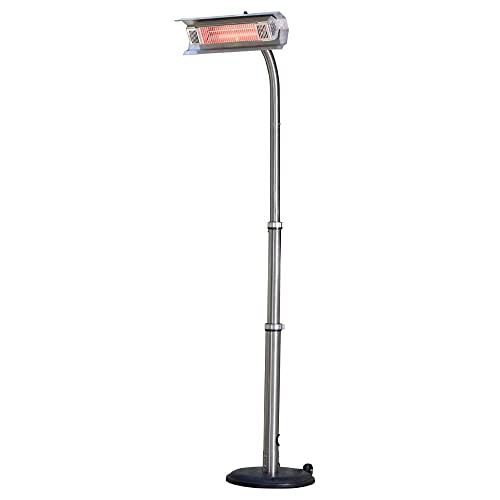
Fire Sense 02117 Offset Pole Electric Infrared Patio Heater
$210.001500 W infrared that plugs into a household circuit.
Best for: plug-in heat with no propane
Check price on Amazon
Fire Sense 61130 Standing Propane Patio Heater, 48,000 BTU
$131.2448,000 BTU mushroom heater on a 20 lb tank.
Best for: warming a dining set outdoors
Check price on AmazonA propane patio heater burns gas under a reflector and warms a wide open-air circle. An electric infrared heater turns electricity into infrared radiation that heats people and surfaces directly, the way sunlight does, rather than heating the air. That difference explains most of the trade-offs: propane wins on raw output and needs no wiring; electric wins on running cost, wind resistance and where you can safely mount it.
The two examples here cost about the same up front: $210.00 for the Fire Sense 02117 Offset Pole Electric Infrared Patio Heater and $131.24 for the Fire Sense 61130 Standing Propane Patio Heater, 48,000 BTU. Work out how much heat your space needs with the patio heater BTU calculator.
On this page
- How do electric and propane patio heaters compare?
- Which should you choose, electric or propane?
- Is an electric or propane patio heater cheaper to run?
- Do electric patio heaters need an electrician?
- Can you use a propane patio heater under a covered patio?
- Which electric and propane heaters are worth buying?
How do electric and propane patio heaters compare?
| Factor | Electric infrared | Propane |
|---|---|---|
| Example | Fire Sense 02117, $210.00 | Fire Sense 61130, $131.24 |
| Output | 1500 W, about 5,100 BTU per hour | 48,000 BTU per hour input |
| How it heats | Infrared aimed at people and objects | Radiant heat from a reflector over an open-air circle |
| Listed coverage | 9 ft blanket of heat, not affected by wind | Up to 18 ft diameter |
| Cost per hour | About $0.26 at 17 cents per kWh | About $1.85 at $3.50 per gallon |
| Cost per 10,000 BTU | About $0.50 | About $0.38 |
| Power or fuel | Dedicated 15 A, 1800 W circuit; 6 ft cord | 20 lb tank, about 10 hours per tank (listed) |
| Where it can go | Listed for indoor and outdoor use | Outdoors only, never enclosed |
| Build | Telescoping pole 72 to 93 in., wheels, 52 lb | 86 in. tall, wheels, 40 lb |
| Safety features | Tip-over protection | Tilt shutoff valve, ETL approved |
| Bigger versions | Dr. Infrared 3000 W (240 V), Bromic 4000 W (240 V) | Hiland pyramid, 40,000 BTU |
One watt is 3.412 BTU per hour. Electricity at $0.17 per kWh and propane at $3.50 per gallon are example rates; use your own.
Which should you choose, electric or propane?
Choose an electric patio heater if
- Your patio is covered, screened on some sides or close to the house.
- You want to flip a switch with no tanks to buy, swap or store.
- You heat a defined seating area of a couple of people to a small table, often in wind.
- You will have an electrician add a 240 V circuit for a mounted unit like the Bromic Tungsten Smart-Heat 4000W Electric Patio Heater.
Choose a propane patio heater if
- You need to warm a large, open patio or a group of eight or more.
- There is no outlet or circuit where the heater needs to stand.
- You want the most heat for the lowest purchase price.
- You move heat around the yard for parties.
Is an electric or propane patio heater cheaper to run?
Per hour, electric is cheaper; per unit of heat, propane is cheaper. A 1500 W heater uses 1.5 kWh an hour, about 26 cents at 17 cents per kWh. A 48,000 BTU propane heater burns about 2.2 lb of propane an hour (propane holds 21,548 BTU per pound), about $1.85 at $3.50 per gallon. But the propane heater makes roughly nine times more heat. Measured per 10,000 BTU, electricity costs about 50 cents and propane about 38 cents at those rates.
Why does electric still feel like good value? Infrared puts its heat directly on people instead of warming air that wind carries away, so a small infrared heater aimed at a seating area can feel warmer than its BTU number suggests. For a whole open patio, propane's raw output wins; for two to four people in a defined spot, electric usually costs less to stay comfortable. Plug in your own rates with the patio heater BTU calculator.
Do electric patio heaters need an electrician?
It depends on the heater. A 1500 W plug-in model like the Fire Sense 02117 Offset Pole Electric Infrared Patio Heater runs on a standard 120 V household outlet, but Fire Sense specifies a dedicated 15 amp circuit so it does not trip breakers; outdoors that outlet should be GFCI protected and weather-rated. Larger heaters are a different category. The Dr. Infrared Heater DR-239 3000W Wall or Ceiling Patio Heater runs on 220 to 240 V with a NEMA 6-15 plug, and the Bromic Tungsten Smart-Heat 4000W Electric Patio Heater draws about 16.6 amps at 240 V and lists minimum mounting clearances of 72 inches on a wall and 96 inches on a ceiling. Any new 240 V circuit or hardwired heater should be installed by a licensed electrician, with a permit where required.
Can you use a propane patio heater under a covered patio?
Only where the heater's manual explicitly allows it and every overhead and side clearance is met, and never in an enclosed or mostly enclosed space. Propane heaters release combustion gases including carbon monoxide and put intense heat into the space above the reflector, which can scorch or ignite ceilings, awnings and umbrellas. Many covered patios simply do not have the height or airflow. If your patio has a roof, walls on two or more sides or a screen, choose a mounted electric infrared heater instead. The propane safety guide covers clearances in more detail.
Which electric and propane heaters are worth buying?
Both examples compared here and a mounted electric step-up at two price points.
Fire Sense 02117 Offset Pole Electric Infrared Patio Heater
$210.00A 1500 W telescoping offset infrared heater that runs on a household circuit, adjusts from 72 to 93 inches and has tip-over protection.
Best for: plug-in heat for a seating area
Check price on Amazon Fire Sense 61130 Standing Propane Patio Heater, 48,000 BTU
$131.24A 48,000 BTU mushroom heater listed for an 18 ft heat diameter with a tilt shutoff valve, wheels and roughly 10 hours per 20 lb tank.
Best for: large open patios
Check price on Amazon
Dr. Infrared Heater DR-239 3000W Wall or Ceiling Patio Heater
$293.20A 3000 W, 240 V carbon infrared heater with an IP55 rating, wall and ceiling brackets, remote control and ETL listing.
Best for: covered patios with a 240 V circuit
Check price on Amazon
Bromic Tungsten Smart-Heat 4000W Electric Patio Heater
$693.70A dual-element 4000 W stainless infrared heater rated for 130 sq ft, with IPX4 protection and smart-control dimming compatibility.
Best for: high-end outdoor rooms
Check price on AmazonHow we chose
We did not test these products in person. Picks are researched from manufacturer specifications and owner manuals, engine and safety certifications where they apply, warranty terms, public recall records, and the recurring themes in verified owner reviews. We favor established brands with large review counts and parts support, match each pick to a real yard size or task, and place it in the tier where its price and capability actually belong.
Frequently asked questions
Is it cheaper to run an electric or propane patio heater?
Per hour, an electric heater is usually cheaper: a 1500 W heater costs about 26 cents an hour at 17 cents per kWh, while a 48,000 BTU propane heater costs about $1.85 at $3.50 per gallon. Per unit of heat, propane is cheaper, because the propane heater produces far more BTU. For warming a few people in one spot, electric infrared usually costs less overall.
How much area does a 1500 watt patio heater warm?
A 1500 W heater produces about 5,100 BTU per hour, which suits a couple of chairs or a small table rather than a whole patio. Fire Sense lists a 9 ft blanket of heat for its 02117 infrared pole heater. Infrared warms the people it is aimed at, so position it close to seating. For larger areas, use several heaters or a 240 V mounted unit.
Can I plug an electric patio heater into an extension cord?
Avoid it. A 1500 W heater draws about 12.5 amps continuously, and light or long extension cords can overheat and create a fire risk. Fire Sense specifies a dedicated 15 amp circuit for its 1500 W heater. Plug directly into a GFCI-protected outdoor outlet; if the heater's cord will not reach, have a licensed electrician add an outlet rather than stretching a cord across the patio.
Are electric patio heaters safe under a covered patio?
Electric infrared heaters are the usual choice for covered patios because they produce no combustion gases. Safety still depends on installation: mount at the clearances the manual lists, such as Bromic's 72 inches on walls and 96 inches on ceilings, use a heater with a suitable water-ingress rating for the location, and put it on a correctly sized circuit installed by a licensed electrician.
How long does a 20 lb propane tank last on a patio heater?
A 20 lb tank holds about 431,000 BTU. A 48,000 BTU heater on high uses it in about 9 hours, and Fire Sense lists about 10 hours for the 61130. A 40,000 BTU heater lasts about 11 hours. Lower settings stretch tank life. Exchange tanks are often filled to about 15 lb, so they run out sooner than a refilled 20 lb tank.
Researched, not professional advice. This page is compiled from published specifications, manuals, labels and owner-review consensus, not hands-on testing. Follow the manufacturer's instructions and product label, and consult a qualified professional where safety, chemicals, fuel or structures are involved. As an Amazon Associate we earn from qualifying purchases.