Grills and Griddles
Propane vs Natural Gas Grill: Cost Per Hour, Hookup and Conversion
Quick answer
Choose natural gas if a gas line already reaches your patio and you grill often: at example rates it costs about 40 percent as much per hour and never runs out. Choose propane if there is no gas line, you want to move the grill, or you grill occasionally. The Weber Spirit E-325 comes in both fuels.

Weber Spirit E-325 Gas Grill (Propane)
$499.00Runs from a 20 lb tank and goes anywhere on the patio.
Best for: weeknight grilling for a family of four
Check price on Amazon
Weber Spirit E-325 Gas Grill (Natural Gas)
$549.00The same grill built for a home gas line.
Best for: homes with a natural gas stub on the patio
Check price on AmazonMost grills come in two factory versions, propane (LP) and natural gas (NG), with different orifices and regulators matched to each fuel. Cooking results are essentially the same when each runs on the fuel it was built for. What differs is cost per hour, installation, mobility and whether you ever run out mid-cook.
The Weber Spirit E-325 Gas Grill (Propane) is $499.00 and the Weber Spirit E-325 Gas Grill (Natural Gas) is $549.00. The fuel savings are real but modest for light use, so the gas line is the deciding cost. Estimate tank life for any grill with the propane tank runtime calculator.
On this page
- How do propane and natural gas grills compare?
- Which should you choose, propane or natural gas?
- Is natural gas cheaper than propane for grilling?
- Can you convert a propane grill to natural gas?
- What does a natural gas grill hookup involve?
- Do natural gas grills get as hot as propane grills?
- Which grills come in natural gas versions?
How do propane and natural gas grills compare?
| Factor | Propane (LP) | Natural gas (NG) |
|---|---|---|
| Example grill | Weber Spirit E-325 LP, $499.00 | Weber Spirit E-325 NG, $549.00 |
| Supply | 20 lb refillable tank | Home gas line, unlimited |
| Energy content | 21,548 BTU per lb; about 431,000 BTU in a 20 lb tank | About 1,000 BTU per cubic foot; 100,000 BTU per therm |
| Example fuel price | $3.50 per gallon (about 83 cents per lb) | $1.50 per therm |
| Cost per 100,000 BTU | About $3.83 | About $1.50 |
| Cost per hour at 30,000 BTU | About $1.15 | About $0.45 |
| Installation | Connect tank, leak test | Licensed plumber or gas fitter, shutoff valve, quick-disconnect hose, permit where required |
| Mobility | Anywhere that meets manual clearances | Limited by hose length from the gas outlet |
| Running out | Yes; keep a spare or a tank scale | Never |
| Burner orifices | Smaller, for higher-pressure propane | Larger, for lower-pressure natural gas |
| Converting | Only with the maker's approved kit for that model, where one exists | Same rule in reverse |
Fuel prices are examples only and vary widely by region and season; use your own utility rate and propane price.
Which should you choose, propane or natural gas?
Choose propane if
- No gas line runs to your patio, or the run would be long or cross a finished yard.
- You want to move the grill for the seasons, parties or a future house.
- You grill a few times a month, where the fuel savings are small.
- You rent and cannot add a gas outlet.
Choose natural gas if
- A gas stub or outlet already exists near the patio.
- You grill several times a week or run long indirect cooks.
- You never want to swap or haul a tank again.
- You are building an outdoor kitchen, where a hard-piped built-in like the Napoleon Built-In 500 Series 32 in. Grill Head (Natural Gas) makes sense.
Is natural gas cheaper than propane for grilling?
Per unit of heat, usually yes. Propane holds 21,548 BTU per pound and about 4.24 pounds per gallon, so at $3.50 per gallon, 100,000 BTU of propane costs about $3.83. Natural gas is sold by the therm, which is 100,000 BTU, so at $1.50 per therm the same heat costs $1.50. A grill averaging 30,000 BTU per hour costs about $1.15 an hour on propane and about $0.45 on natural gas.
Now scale it to real use. 100 hours of grilling a year at that rate is about $115 in propane versus $45 in natural gas, a $70 difference. If you need a new gas line, compare your plumber's quote to that yearly savings: at light use, payback can take many years, while heavy users and outdoor kitchens recover it faster. Refill a tank rather than exchanging it when you can, because exchange tanks are commonly filled to about 15 lb instead of 20.
Can you convert a propane grill to natural gas?
Only with the manufacturer's approved conversion kit for your exact model, installed as the instructions require, and many cart grills have no approved kit at all. Conversion is more than a new hose: natural gas needs larger burner orifices, a different regulator setup and sometimes different valves, because it is delivered at lower pressure and carries less energy per cubic foot. Never connect a propane grill to a natural gas line, or the reverse, without that kit; the result can be weak, unstable flames or dangerous oversized flames.
If a kit exists, it is sold by model number; search for natural gas conversion kits and match the part to your grill's manual before buying. If none exists, buy the grill in the fuel you have. Broil King, Weber and Napoleon all sell factory natural gas models, such as the Broil King Regal S 420 Pro Gas Grill (Natural Gas).
What does a natural gas grill hookup involve?
A typical hookup has a gas line run from the house supply to an exterior outlet with a shutoff valve, sized for the total BTU load and the length of the run, then a quick-disconnect hose to the grill. The line should be installed and pressure tested by a licensed plumber or gas fitter, and many jurisdictions require a permit and inspection. If the line runs underground, call 811 before anyone digs so buried utilities are marked. An undersized line is a common reason natural gas grills never get hot, especially if a patio heater or fire pit shares the same run.
Do natural gas grills get as hot as propane grills?
A grill built for natural gas is designed to deliver its rated heat on natural gas, so a factory NG model should cook like its propane twin. Propane carries about two and a half times more energy per cubic foot, which is why its orifices are smaller, not why it cooks hotter. Where natural gas grills fall short, the cause is almost always the supply: a line too small for the load, a long run, low pressure or a kinked hose. If yours struggles to reach temperature, have a gas fitter check pressure at the grill before blaming the burners.
Which grills come in natural gas versions?
Factory natural gas models from our catalog, plus the propane twin for comparison.
Weber Spirit E-325 Gas Grill (Natural Gas)
$549.00The three-burner Spirit E-325 with Boost Burners and cast-iron grates, built from the factory for a home gas line.
Best for: homes with a gas stub on the patio
Check price on Amazon Weber Spirit E-325 Gas Grill (Propane)
$499.00The same Spirit E-325 running from a 20 lb tank, with a cast-aluminum cook box and a 10-year limited warranty.
Best for: patios without a gas line
Check price on Amazon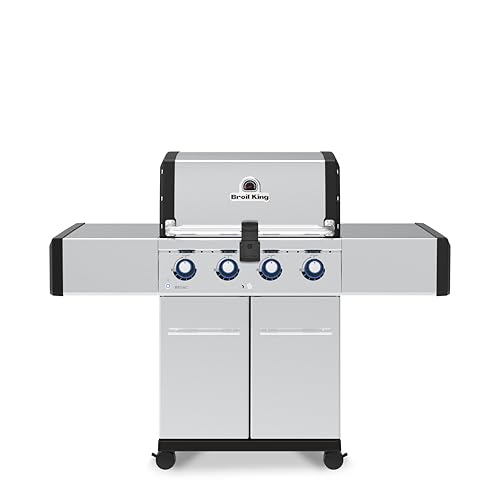
Broil King Regal S 420 Pro Gas Grill (Natural Gas)
$1,359.00Four stainless Dual-Tube burners at 50,000 BTU, reversible stainless grids and a 15-year top-to-bottom warranty.
Best for: a long-lasting natural gas cart grill
Check price on Amazon
Napoleon Built-In 500 Series 32 in. Grill Head (Natural Gas)
$1,679.00A 32 inch built-in head with four stainless burners at 48,000 BTU, 531 sq in and 7.5 mm stainless grids.
Best for: an outdoor kitchen island on a gas line
Check price on AmazonHow we chose
We did not test these products in person. Picks are researched from manufacturer specifications and owner manuals, engine and safety certifications where they apply, warranty terms, public recall records, and the recurring themes in verified owner reviews. We favor established brands with large review counts and parts support, match each pick to a real yard size or task, and place it in the tier where its price and capability actually belong.
Frequently asked questions
Is natural gas or propane better for grilling?
Neither cooks better when the grill is built for its fuel. Natural gas is cheaper per hour at typical rates and never runs out, which suits frequent grillers with a gas line. Propane is portable and needs no plumbing, which suits most patios. The Weber Spirit E-325 is sold in both versions, so the choice comes down to your gas supply.
Can I use a propane grill on natural gas?
Not without the manufacturer's approved conversion kit for that exact model. Propane and natural gas need different orifice sizes and pressure settings, so hooking a propane grill to a natural gas line gives weak or unstable flames, and the reverse can cause dangerous oversized flames. Many cart grills have no approved kit, so the safe choice is buying the factory natural gas version.
How much does it cost to run a natural gas grill per hour?
Multiply the BTU you burn per hour by your utility rate per therm, where one therm is 100,000 BTU. A grill averaging 30,000 BTU per hour at $1.50 per therm costs about 45 cents an hour. The same grill on propane at $3.50 per gallon costs about $1.15 an hour. Check your gas bill for your actual therm price, including delivery charges.
Do I need a permit for a natural gas grill line?
Many jurisdictions require a permit and inspection for new gas piping, including an exterior line to a grill outlet. A licensed plumber or gas fitter will know the local rules, size the line for your grill and any other gas appliances, and pressure test it. If the line is buried, call 811 before digging. Do not run gas piping yourself unless local code allows homeowner work.
Why is my natural gas grill not getting hot?
The usual causes are supply problems: a gas line too small for the total BTU load, a very long run, low pressure, a kinked or overly long hose, or a partly closed shutoff valve. A grill converted with the wrong parts will also underperform. Clean the burner ports first, then have a licensed gas fitter measure pressure at the grill connection rather than adjusting anything yourself.
Researched, not professional advice. This page is compiled from published specifications, manuals, labels and owner-review consensus, not hands-on testing. Follow the manufacturer's instructions and product label, and consult a qualified professional where safety, chemicals, fuel or structures are involved. As an Amazon Associate we earn from qualifying purchases.