Mowers
How to Mow Slopes Safely: Slope Limits, Mower Types and Direction
Quick answer
Measure the slope first: 15 degrees is a 27 percent grade, rising about 2.7 feet every 10 feet. Stay within your operator manual's limit, mow up and down with riding mowers and across with walk-behinds, never mow wet slopes, and use a string trimmer or a steep-rated robot mower on banks too steep to ride.
Slopes turn an ordinary chore into the most dangerous part of yard work. Riding mowers can slide or roll over, zero-turns can lose steering and braking at the same moment, and a walk-behind operator who slips can end up with a foot under the deck. The U.S. Consumer Product Safety Commission (CPSC) and the Outdoor Power Equipment Institute (OPEI) both put slopes, along with children, at the top of their mower safety guidance.
This guide shows how to measure a slope, what the percent and degree numbers mean, what the manual limits are, which mower type fits which grade, which direction to mow, and when to stop mowing a bank altogether. If hills are why you are shopping, the best mowers for hills and best robot mowers for hills cover the machines built for them.
On this page
- Why is mowing on a slope dangerous?
- How do I measure the slope of my yard?
- How do slope percent and degrees compare?
- What is the maximum slope for a riding mower or zero-turn?
- Which type of mower is best for slopes?
- Should you mow up and down or across a slope?
- Why do zero-turn mowers slide on hills?
- Is it safe to mow wet grass on a slope?
- Do turf tires or wheel weights help a mower on hills?
- When should I stop mowing a bank and use a string trimmer instead?
- Can a robot mower handle a steep yard?
- What mowers and tools are built for hilly yards?
- How do I mow a slope safely step by step?
Why is mowing on a slope dangerous?
Slope, or grade, is the rise divided by the run. A lawn that rises 2 feet over a 10-foot horizontal distance is a 20 percent slope, which is 11.3 degrees. As a slope steepens, more of a mower's weight shifts onto the downhill wheels, the uphill wheels lose grip, and the machine becomes easier to slide or tip.
Three things make it worse: wet grass, which cuts tire traction sharply; sudden turns, stops or speed changes, which shift weight abruptly; and edges such as ditches, retaining walls, ponds and drop-offs, where a slide becomes a rollover. Riding mowers carry the added risk of the machine landing on the operator, and walk-behinds the risk of slipping into the blade path.
How do I measure the slope of my yard?
Measure the steepest section you would mow, not the average across the yard. Three easy methods:
- Level and board: lay a straight 4-foot board on the slope with its uphill end on the grass, set a level on top, and lift the downhill end until it reads level. Measure the gap in inches, divide by 48 and multiply by 100 for percent. A 9.6-inch gap is a 20 percent slope.
- Phone inclinometer: set the phone on the same straight board (not directly on bumpy grass) and read the angle in degrees.
- String and line level: stake a string at the top, run it 10 feet downhill, level it with a line level, and measure from the string down to the ground. A 24-inch drop over 10 feet is a 20 percent slope.
Many riding mower manuals include a printed slope gauge you can fold and sight along a tree or pole. Use it; it is set to that manual's limit.
How do slope percent and degrees compare?
Mower manuals usually give slope limits in degrees, while robot mower makers usually rate slopes in percent. The two are not the same: a 45 percent slope is only about 24 degrees.
| Slope (percent) | Slope (degrees) | Rise per 10 ft of run | What it means for mowing |
|---|---|---|---|
| 5% | 2.9 | 6 in | Gentle; any mower within its manual |
| 10% | 5.7 | 12 in | Noticeable; slow down on riders, watch wet grass |
| 15% | 8.5 | 18 in | Moderate; check your manual before riding it |
| 17.6% | 10.0 | 21 in | At or past the limit in some riding and zero-turn manuals |
| 20% | 11.3 | 24 in | Steep for riders; walk-behinds across with good footing |
| 26.8% | 15.0 | 32 in | Past the limit in most riding mower manuals |
| 30% | 16.7 | 36 in | Walk-behind or robot territory, if its manual allows |
| 36.4% | 20.0 | 44 in | Hard to stand on when wet; consider a trimmer |
| 45% | 24.2 | 54 in | Rated limit of Husqvarna Automower iQ and Segway Navimow i210 |
| 50% | 26.6 | 60 in | Steep bank; no riding or walk-behind mowing |
| 80% | 38.7 | 96 in | Rated limit of Mammotion LUBA 2 AWD and LUBA 3 AWD |
| 84% | 40.0 | 101 in | Rated limit of WORX Landroid Vision WR342 |
| 100% | 45.0 | 120 in | Rise equals run; trimmer, ground cover or a pro |
Degrees = arctangent of (percent / 100). Robot mower ratings are manufacturer figures for dry, firm turf.
What is the maximum slope for a riding mower or zero-turn?
The maximum is whatever your operator manual says, and it applies to dry, firm turf. Many riding mower and zero-turn manuals set the limit somewhere between 10 and 15 degrees (roughly 18 to 27 percent), some are lower, and most reduce it further when you tow an attachment, carry a bagger or mow wet grass. A zero-turn's limit is often at the low end because of how it steers.
Do not treat the number as a target. Uneven ground, soft spots, a rut or a hidden hole can make a slope within the rating behave like a steeper one, and a mower that feels stable going straight can tip in a turn. If you cannot find the manual, download it from the manufacturer by model number before you mow a grade.
Which type of mower is best for slopes?
| Steepest slope | Riding mower or zero-turn | Walk-behind | Robot mower | Best tool |
|---|---|---|---|---|
| Under 10% (under 5.7 degrees) | Any type, within the manual | Any, mowing across | Any model | Whatever fits your acreage |
| 10 to 17.6% (5.7 to 10 degrees) | Lawn tractor preferred; zero-turn only if the manual allows, dry grass only | Rear-wheel-drive self-propelled, across | Any model rated 45% | Lawn tractor or RWD walk-behind |
| 17.6 to 26.8% (10 to 15 degrees) | Only if your manual allows; many zero-turn limits are lower | Across, with good footing | Models rated 45% | RWD walk-behind or robot mower |
| 26.8 to 45% (15 to 24 degrees) | No | Only if the manual allows and footing is secure | Models rated 45% at their limit; AWD models preferred | Robot mower or string trimmer |
| 45 to 84% (24 to 40 degrees) | No | No | AWD models rated 80 to 84% | Steep-rated robot or string trimmer |
| Over 84% (over 40 degrees) | No | No | No | Ground cover, trimmer from secure footing, or a pro |
The operator manual for your machine overrides this table. Wet, soft or uneven ground lowers every limit.
Should you mow up and down or across a slope?
Riding mowers, including lawn tractors and zero-turns: up and down, never across. This is the direction in CPSC and OPEI guidance and in most riding mower manuals. Driving across a slope puts the uphill wheels light and lets the mower roll sideways, the most common rollover scenario. Driving straight up and down keeps the weight between the wheels. Go slowly, avoid sudden stops, starts and turns, and make turns on level ground at the top or bottom rather than on the face of the slope.
Walk-behind mowers: across, never up and down. If you slip while mowing across, you fall beside the mower rather than into it. Mowing downhill, the mower can run away from you; mowing uphill, it can roll back onto your feet. Never pull a walk-behind backward toward you on a slope, and wear shoes with real tread.
Robot mowers: follow the maker's setup for slopes, which may include zone settings, slower speed or a specific mowing direction on steep sections.
Why do zero-turn mowers slide on hills?
A zero-turn steers and brakes through its two rear drive tires. The front wheels are free-swiveling casters that do not steer at all. When those rear tires lose grip on wet grass or a steep grade, you lose steering and braking at the same instant, and pulling back on the lap bars does not stop the slide. Heading downhill, weight shifts forward onto the casters and away from the drive tires, which makes it worse.
That is why zero-turn manuals set conservative slope limits and why lawn tractors, which steer with the front wheels and brake through the transmission, generally handle grades better. Some electric models are designed with slopes in mind, such as the wide frame on the EGO POWER+ Z6 ZT4214L 42 in. Electric Zero Turn Mower, and some larger zero-turns such as the Husqvarna MZ61 61 in. Zero Turn Mower with ROPS come with a rollover protection structure (ROPS). Where ROPS is fitted, keep it raised and wear the seat belt. Neither feature raises the manual's slope limit.
Is it safe to mow wet grass on a slope?
No. Wet grass is the single biggest traction killer on slopes, and a grade you mow comfortably when dry can become unsafe after rain, heavy dew or an irrigation cycle. Riding mowers slide, zero-turns lose steering, and walk-behind operators slip.
Wait until the grass is dry to the touch, usually late morning or afternoon after dew, and turn off sprinklers the night before you mow a bank. If the soil is soft enough for tires to leave ruts, it is also soft enough for a wheel to sink and tip the mower. On a lawn that is always damp, mow slopes with a string trimmer or a robot mower rated for the grade.
Do turf tires or wheel weights help a mower on hills?
They improve traction, but they do not change the slope limit in your manual. Turf tires with a deeper tread pattern grip better than worn or smooth tires, and correct, equal tire pressure on both sides keeps the mower from pulling. Some manufacturers specify wheel weights or counterweights for certain attachments; the EGO POWER+ ABK4200 Bagger Kit for 42 in. Z6 Zero Turn for the EGO ZT4204L, for example, includes counterweights to balance the bagger. Add weights only as your manual directs, since weight in the wrong place can make a mower less stable.
A differential lock, like the one on the Husqvarna TS 375XD 54 in. Lawn Tractor, helps a lawn tractor keep driving when one wheel slips on damp ground. Again, it is a traction aid, not a license to mow steeper grades.
When should I stop mowing a bank and use a string trimmer instead?
Stop mowing and switch tools when any of these are true:
- The slope is steeper than your manual allows.
- You cannot stand comfortably on it, or your feet slip when it is dry.
- The slope ends at a drop-off, ditch, retaining wall, road or water. Keep riding mowers well away from edges, at least the distance the manual specifies.
- The ground is rough, rutted or soft.
A string trimmer lets you cut a bank from secure footing at the top or bottom. A battery model such as the EGO Power+ ST1623T 16 in. String Trimmer Kit with 4.0Ah Battery is light enough to swing for a long bank, and the gas ECHO SRM-2620T 25.4cc High Torque Gas String Trimmer handles thick, tall growth. Wear eye protection, long pants and boots. For a bank you fight every week, consider replacing the grass with a low ground cover or mulched plantings, which removes the hazard for good. See the best string trimmers.
Can a robot mower handle a steep yard?
Robot mowers are often the best answer for slopes, because no one is on or behind the machine. Check the rated slope in percent against the steepest section you measured:
- Husqvarna Automower 410iQ Robot Mower, Husqvarna Automower 420iQ Robot Mower and Husqvarna Automower 440iQ Robot Mower: 45 percent (about 24 degrees).
- Segway Navimow i210 AWD Robot Mower: 45 percent with all-wheel drive, for about a quarter acre.
- Mammotion LUBA 2 AWD 3000X Robot Mower and Mammotion LUBA 3 AWD 5000 Robot Mower: 80 percent (about 39 degrees) with four-wheel drive.
- WORX Landroid Vision Cloud WR342 4WD Robot Mower: 84 percent (40 degrees) with 4WD, for about half an acre.
Leave margin below the rating, because wet grass affects robots too. Keep children and pets off the lawn while a robot mower runs. The robot mower size for steep yards page matches models to grade and area.
What mowers and tools are built for hilly yards?
For slopes, the safest upgrade is often a different type of machine rather than a bigger one: a lawn tractor with a differential lock, a rear-wheel-drive walk-behind, a robot rated for the grade, or a trimmer for the steepest bank.

Mammotion LUBA 3 AWD 5000 Robot Mower
$3,299.00Four-motor drive rated for 80 percent slopes, with LiDAR, network RTK and dual-camera vision, sized for up to 1.25 acres.
Best for: steep or complex lawns up to 1.25 acres
Check price on Amazon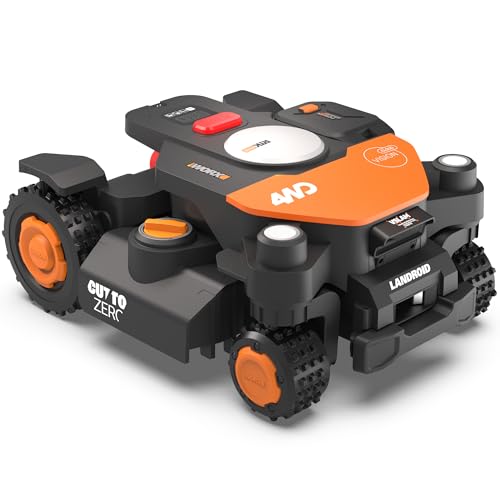
WORX Landroid Vision Cloud WR342 4WD Robot Mower
$2,069.99Rated for 84 percent slopes with 4WD, using cloud RTK with no local antenna, for hilly lawns of about half an acre.
Best for: very steep half-acre yards
Check price on Amazon
Husqvarna TS 375XD 54 in. Lawn Tractor
$5,199.00A 24 HP Kawasaki V-twin, fabricated 54-inch deck and a differential lock for traction on damp or sloped ground, within its manual limit.
Best for: large properties with moderate slopes
Check price on Amazon
SENIX 22 in. Variable Speed RWD Self-Propelled Gas Mower, 201cc
$509.99Variable-speed rear-wheel drive puts traction where the weight is when mowing across a slope, on a 22-inch 201cc 3-in-1 deck.
Best for: sloped lawns under half an acre
Check price on Amazon
EGO Power+ ST1623T 16 in. String Trimmer Kit with 4.0Ah Battery
$299.00A 16-inch battery string trimmer kit with a 4.0Ah battery, light enough to cut a bank from secure footing where no mower should go.
Best for: banks, ditches and edges past any mower limit
Check price on AmazonHow do I mow a slope safely step by step?
- Measure the steepest section. Use a 4-foot board and level, a phone inclinometer or a string line to find the grade in percent and degrees.
- Check the manual limit. Compare the reading with your operator manual, including any lower limit for baggers, attachments or towing.
- Wait for dry grass. Mow only when the grass and soil are dry and firm, never after rain, dew or irrigation.
- Clear the area. Pick up sticks and rocks, mark holes and soft spots, and make sure children and pets are indoors.
- Pick the direction. Drive riding mowers straight up and down the slope; push walk-behinds across it.
- Go slow and steady. Use a low speed, avoid sudden stops, starts and turns, and turn only on level ground.
- Stay off the edges. Keep well back from drop-offs, ditches, walls and water, and trim those strips with a string trimmer.
- Stop when in doubt. If the mower slips or feels light on one side, stop mowing that section and switch to a trimmer or robot mower.
How we chose
We did not test these products in person. Picks are researched from manufacturer specifications and owner manuals, engine and safety certifications where they apply, warranty terms, public recall records, and the recurring themes in verified owner reviews. We favor established brands with large review counts and parts support, match each pick to a real yard size or task, and place it in the tier where its price and capability actually belong.
Frequently asked questions
What slope is too steep to mow with a riding mower?
Any slope steeper than the limit in your operator manual is too steep. Many riding mower and zero-turn manuals set that limit between 10 and 15 degrees, roughly 18 to 27 percent, and some are lower. The limit applies to dry, firm grass and usually drops when towing or bagging. Past the limit, use a walk-behind across the slope, a steep-rated robot mower or a string trimmer.
Is it safer to mow a hill up and down or side to side?
It depends on the mower. With a riding mower or zero-turn, mow up and down, never across, because crossing a slope can let the machine roll sideways. With a walk-behind mower, mow across the slope so a slip puts you beside the mower instead of under or behind it. This split is consistent across CPSC guidance, OPEI guidance and most manuals.
How do I convert slope percent to degrees?
Divide the percent by 100 and take the arctangent. A 20 percent slope is 11.3 degrees, 27 percent is about 15 degrees, 45 percent is about 24 degrees, and 100 percent is 45 degrees. Mower manuals usually give limits in degrees and robot mower makers usually rate slopes in percent, so convert before comparing a robot rating with a riding mower limit.
Can a zero turn mower be used on hills?
Only on gentle grades within its manual limit, and only when the grass is dry. Zero-turns steer and brake through their rear drive tires, so if those tires lose traction on a wet or steep slope, you lose steering and braking together. For hilly properties, a lawn tractor rated for the grade, a rear-wheel-drive walk-behind or a steep-rated robot mower is usually the safer choice.
What is the best mower for a steep backyard?
For slopes beyond what a riding mower manual allows, a robot mower rated for the grade is often safest because no one is operating it on the slope. The Mammotion LUBA 3 AWD is rated for 80 percent slopes and the WORX Landroid Vision WR342 for 84 percent. For moderate grades under half an acre, a rear-wheel-drive self-propelled mower pushed across the slope works well.
How far from a ditch or drop-off should I mow?
Keep riding mowers well back from ditches, drop-offs, retaining walls and water, at least the distance your operator manual specifies, because a wheel over the edge can roll the mower. Trim the strip closest to the edge with a string trimmer while standing on secure, level footing. If the edge is also on a slope, leave a wider margin, and never mow near it when the grass is wet.
Researched, not professional advice. This page is compiled from published specifications, manuals, labels and owner-review consensus, not hands-on testing. Follow the manufacturer's instructions and product label, and consult a qualified professional where safety, chemicals, fuel or structures are involved. As an Amazon Associate we earn from qualifying purchases.