Robot Mowers
Robot Mower for Steep Yards: Slope Ratings Explained
Quick answer
For a steep yard, choose a robot mower whose slope rating beats your steepest grade with margin. Most are rated for 45 percent, about 24 degrees. All-wheel-drive models go further: the Mammotion LUBA 3 AWD 5000 and LUBA 2 AWD 3000X handle 80 percent (39 degrees) and the WORX WR342 84 percent (40 degrees).
Steep yards are where robot mowers make the strongest case for themselves. A slope that is risky on a riding mower and exhausting behind a push mower is routine for an all-wheel-drive robot, which weighs little, never tires and stops if it tips. The key is reading slope ratings correctly: makers quote them in percent, not degrees, and 80 percent is far less than vertical.
Our top pick is the Mammotion LUBA 3 AWD 5000 Robot Mower at $3,299.00: four-motor drive for 80 percent slopes, LiDAR, network RTK and dual-camera vision, rated for 1.25 acres. For smaller hillsides, the WORX WR342 ($2,069.99) has the highest slope rating in our catalog. Enter your slope in the robot mower calculator.
On this page
What slope can a robot mower handle?
Between 45 and 84 percent for the rated models in our catalog. Slope percent is rise over run times 100: a 45 percent slope climbs 4.5 feet for every 10 feet across, which is about 24 degrees. Standard two-wheel-drive designs from Husqvarna and Segway's i-series are rated for 45 percent. All-wheel-drive designs from Mammotion and WORX reach 80 to 84 percent, or 39 to 40 degrees.
Choose a rating at least 10 percentage points above the steepest part of your lawn, our rule of thumb, because wet grass, soft soil and turning on a slope all cost traction. Ratings also apply to the slope inside the lawn; many makers recommend gentler grades near the boundary edge, so check the manual.
How do slope percent and degrees compare?
Robot makers quote percent; phone inclinometer apps and riding mower manuals often quote degrees. This table converts between them.
| Slope percent | Degrees | Rise over 10 ft | What it looks like | Catalog robots rated for it |
|---|---|---|---|---|
| 15% | 8.5 | 1.5 ft | Gentle yard grade | All models with a published rating |
| 25% | 14.0 | 2.5 ft | Clearly sloped lawn | All models with a published rating |
| 35% | 19.3 | 3.5 ft | Steep front bank | All models with a published rating |
| 45% | 24.2 | 4.5 ft | Hard to walk up with a mower | All rated models (Husqvarna, Navimow i-series at their limit) |
| 60% | 31.0 | 6 ft | Hillside you lean into to climb | LUBA 2 AWD 3000X, LUBA 3 AWD 5000, WR342 |
| 80% | 38.7 | 8 ft | Very steep embankment | LUBA 2 AWD 3000X and LUBA 3 AWD 5000 at their limit, WR342 |
| 84% | 40.0 | 8.4 ft | Near the limit of a mowed lawn | WR342 at its limit |
| 100% | 45.0 | 10 ft | One foot up for every foot across | None |
Degrees = arctangent of (percent / 100). Ratings from manufacturer specifications; the GOAT A3000 and Navimow i105N do not publish one.
Which robot mowers are rated for steep slopes?
Each rated catalog robot with its slope rating and the largest lawn it covers at 75 percent loading.
| Model | Slope rating | Degrees | Drive | Largest lawn at 75% loading | Price |
|---|---|---|---|---|---|
| WORX Landroid WR342 | 84% | 40.0 | 4WD | 16,335 sq ft (0.38 acre) | $2,069.99 |
| Mammotion LUBA 3 AWD 5000 | 80% | 38.7 | Four-motor drive | 40,838 sq ft (0.94 acre) | $3,299.00 |
| Mammotion LUBA 2 AWD 3000X | 80% | 38.7 | Four-wheel drive | 24,503 sq ft (0.56 acre) | $1,998.00 |
| Segway Navimow i210 AWD | 45% | 24.2 | AWD with stability control | 8,168 sq ft (0.19 acre) | $1,299.00 |
| Husqvarna Automower 440iQ | 45% | 24.2 | Not listed | 65,340 sq ft (1.5 acres) | $2,649.99 |
| Husqvarna Automower 420iQ | 45% | 24.2 | Not listed | 32,670 sq ft (0.75 acre) | $1,841.66 |
| Husqvarna Automower 430X | 45% | 24.2 | Not listed | 26,136 sq ft (0.6 acre) | $2,167.79 |
| Segway Navimow i215 LiDAR | 45% | 24.2 | Not listed | 12,088 sq ft (0.28 acre) | $1,599.00 |
Largest lawn = rated area x 0.75. The 410iQ and 520H EPOS are also rated for 45 percent.
Best robot mowers for steep yards
Chosen by slope rating first, then by the lawn size each covers with headroom.

Mammotion LUBA 3 AWD 5000 Robot Mower
$3,299.00Four-motor drive for 80 percent slopes with LiDAR, network RTK and dual cameras, covering a steep lawn of up to about 40,800 square feet at 75 percent loading.
Best for: large, steep or complex yards
Check price on Amazon
Mammotion LUBA 2 AWD 3000X Robot Mower
$1,998.00Four-wheel drive for 80 percent slopes, RTK plus AI vision and a 15.8-inch dual-blade disc, covering up to about 24,500 square feet of steep lawn with headroom.
Best for: hilly half-acre yards
Check price on Amazon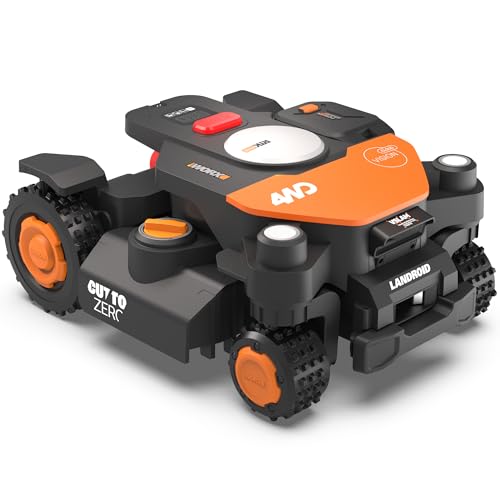
WORX Landroid Vision Cloud WR342 4WD Robot Mower
$2,069.99Rated for 84 percent slopes, the steepest in our catalog, with 4WD, cloud RTK that needs no local antenna and a cut-to-edge blade offset. Best on steep lawns up to about 16,300 square feet.
Best for: small, very steep yards
Check price on Amazon
Segway Navimow i210 AWD Robot Mower
$1,299.00All-wheel drive with electronic stability control for 45 percent slopes and wire-free RTK plus vision, sized for sloped lawns up to about 8,200 square feet at 75 percent loading.
Best for: compact yards with moderate slopes
Check price on Amazon
Husqvarna Automower 440iQ Robot Mower
$2,649.99Rated for 45 percent slopes over up to 2 acres, so it suits big lawns whose steepest grade stays well under 35 percent, with EPOS positioning and a 4-year warranty.
Best for: large lawns with rolling, not steep, terrain
Check price on AmazonHow do I measure the slope of my yard?
- Find the steepest spot. Walk the lawn and pick the steepest stretch the mower will cross, not the average grade.
- Level a straight board. Rest one end of a straight 4-foot board on the slope, pointing downhill, and lift the low end until a level on top reads flat.
- Measure the rise. Measure from the ground to the bottom of the raised end in inches.
- Convert to percent. Divide the inches by 48 and multiply by 100. A 12-inch rise over 4 feet is 25 percent, about 14 degrees. A phone inclinometer app laid on the board gives degrees directly.
- Add margin. Choose a robot rated at least 10 percentage points above your steepest reading, because wet grass reduces traction.
Is a robot mower safer than a riding mower on a steep yard?
For the person, generally yes, because nobody rides it. Riding mower operator manuals set their own maximum slopes, often far below robot ratings, and zero-turns can lose steering on wet or steep grass. The standard rule for people is to mow across a slope with a walk-behind and up and down with a riding mower, never across, always within the manual's limit. On a half acre with hills, a walk-behind takes about 1 hour 25 minutes per mow, roughly 37 hours a season, and a 42-inch tractor about 28 minutes, roughly 12 hours, if the slope is within its limit. See mowing on slopes safely and best mowers for hills.
| Mower | Type | Price | Time per mow | Hours per season |
|---|---|---|---|---|
| LUBA 2 AWD 3000X | AWD robot, 80% slopes | $1,998.00 | Unattended | About 0, plus trimming |
| SENIX 22 in RWD 201cc | RWD self-propelled walk-behind | $509.99 | About 1 hr 25 min | About 37 hr |
| Husqvarna TS 120 42 in | Lawn tractor, within manual slope limit | $2,799.00 | About 28 min | About 12 hr |
Hilly times use 65 percent efficiency, 3 mph walk-behind and 4.5 mph tractor speeds, and 26 weekly mows. The walk-behind time is for a 21-inch deck.
How we chose
We did not test these products in person. Picks are researched from manufacturer specifications and owner manuals, engine and safety certifications where they apply, warranty terms, public recall records, and the recurring themes in verified owner reviews. We favor established brands with large review counts and parts support, match each pick to a real yard size or task, and place it in the tier where its price and capability actually belong.
Frequently asked questions
What does a 45 percent slope rating mean on a robot mower?
It means the mower is rated to climb a grade that rises 45 feet for every 100 feet of horizontal distance, or 4.5 feet over 10 feet. That is about 24 degrees, not 45 degrees. Most Husqvarna Automowers and Segway Navimow i-series models are rated for 45 percent. All-wheel-drive models from Mammotion and WORX are rated for 80 to 84 percent, about 39 to 40 degrees.
What is the best robot mower for steep hills?
An all-wheel-drive model sized for your lawn. The Mammotion LUBA 3 AWD 5000 handles 80 percent slopes and covers up to about 40,800 square feet with headroom. The LUBA 2 AWD 3000X handles the same slopes on lawns up to about 24,500 square feet. The WORX WR342 has the highest rating in our catalog, 84 percent, for lawns up to about 16,300 square feet.
How do I convert slope percent to degrees?
Divide the percent by 100 and take the arctangent. A 25 percent slope is about 14 degrees, 45 percent is about 24 degrees, 80 percent is about 39 degrees, and 100 percent is exactly 45 degrees. A quick field method: lay a level on a straight 4-foot board, measure the rise in inches, divide by 48 and multiply by 100 for percent.
Can a robot mower work on a slope near the boundary?
Usually with limits. Many makers recommend a gentler grade along the boundary edge than in the middle of the lawn, because a mower turning at the edge of a slope can slide past the line. Check your model's installation manual, map a buffer strip inside steep edges, and keep the boundary away from drop-offs, retaining walls and water.
Are robot mowers safe on wet slopes?
Traction drops on wet grass for every mower. All-wheel-drive robots cope better than two-wheel-drive ones, and most robots have rain sensors or scheduling options to pause in wet weather. Choose a slope rating well above your steepest grade, at least 10 percentage points, and let the mower skip mowing right after heavy rain on the steepest areas.
Researched, not professional advice. This page is compiled from published specifications, manuals, labels and owner-review consensus, not hands-on testing. Follow the manufacturer's instructions and product label, and consult a qualified professional where safety, chemicals, fuel or structures are involved. As an Amazon Associate we earn from qualifying purchases.