Pressure Washing
Electric vs Gas Pressure Washer: Which Should You Buy?
Quick answer
Buy an electric pressure washer for cars, patio furniture, decks and siding; a 2.0 GPM model like the Greenworks 3000 PSI is quiet and nearly maintenance-free. Buy gas for large concrete driveways and heavy grime: the Simpson 3400 PSI, 2.5 GPM delivers about 8,500 cleaning units and finishes big flat areas far faster.

Greenworks 3000 PSI 2.0 GPM Brushless Electric Pressure Washer
$349.993000 PSI at 2.0 GPM (3300 cleaning units) from a brushless motor, lab-verified per Greenworks.
Best for: driveways and siding without the upkeep of a gas engine
Check price on Amazon
Simpson Clean Machine 3400 PSI 2.5 GPM Gas Pressure Washer
$329.993400 PSI at 2.5 GPM (8500 cleaning units) from a 208cc engine.
Best for: homeowners stepping up to gas for driveways and decks
Check price on AmazonAn electric pressure washer uses a plug-in motor to drive a small pump, usually at 1.2 to 2.0 GPM. A gas pressure washer uses a small engine, usually at 2.3 to 4.0 GPM. Pressure (PSI) gets the headlines, but flow (GPM) decides how fast you clean, because water volume rinses away what pressure loosens. A common way to compare is cleaning units: PSI multiplied by GPM.
By that measure, the Greenworks 3000 PSI electric ($349.99) rates 3,300 cleaning units, while the Simpson Clean Machine 3400 ($329.99) rates about 8,500. Most homeowners do not need the gas machine: siding, cars and wood decks all want low pressure anyway. Look up the right pressure for your surfaces with the pressure washer PSI calculator.
On this page
How do electric and gas pressure washers compare?
| Factor | Electric: {{p:greenworks-3000psi-brushless-electric|Greenworks 3000 PSI}} | Gas: {{p:simpson-clean-machine-3400|Simpson Clean Machine 3400}} |
|---|---|---|
| Rated pressure | 3000 PSI | 3400 PSI |
| Rated flow | 2.0 GPM | 2.5 GPM |
| Cleaning units (PSI x GPM) | 3,300 (Greenworks rating) | About 8,500 |
| Power source | 14 amp brushless motor on a household outlet | 208cc CRX engine with low-oil shutdown |
| Pump | Electric pump, stops when trigger released | Axial cam pump with thermal relief |
| Noise | Quiet between sprays | Engine runs the whole time |
| Engine upkeep | None | Oil changes, fuel stabilizer, air filter, spark plug |
| Where it can run | Outdoors on a GFCI outlet, within cord reach | Outdoors only, away from doors, windows and garages |
| Nozzles | 15, 25 and 40 degree, soap and turbo | 0, 15 and 40 degree plus soap |
| Hose | 25 ft kink-resistant | 25 ft MorFlex |
| Catalog price | $349.99 | $329.99 |
Specs from Greenworks and Simpson listings. Simpson lists this model as 49-state compliant and not for sale in California.
Which should you choose, electric or gas?
Choose an electric pressure washer if:
- You wash cars, patio furniture, grills, fences, vinyl siding and wood decks.
- You clean a few times a year and want it ready without fuel or oil.
- Noise matters to you or your neighbors.
- You store it in a small space; the Westinghouse ePX3500 is 19 lb.
Choose a gas pressure washer if:
- You clean a large concrete driveway, pool deck or long sidewalks, especially with a surface cleaner.
- You strip stains and grime from concrete or prep surfaces for paint.
- You work away from outlets: fences at the back of acreage, farm equipment, a barn.
- You clean often enough that time saved matters, or you run a side business.
Is a gas pressure washer better than electric?
Better at volume, not at everything. The advantage of gas is flow: 2.5 to 4.0 GPM moves loosened dirt away faster, so a driveway that takes an electric an afternoon takes a gas unit far less time. Electrics are better for delicate work, and most of what homeowners wash needs modest pressure anyway. As general guidance, cars take about 1,200 to 1,900 PSI, vinyl siding 1,300 to 1,600, soft wood decks 500 to 800, and bare concrete 2,500 to 3,000 or more.
A high PSI number on a cheap electric can mislead. The Sun Joe SPX3000 lists 2500 max PSI but 2030 PSI working pressure at 1.2 GPM, and the Westinghouse ePX3500 lists 2500 max PSI and 2000 rated PSI. Compare rated or working numbers, not maximums. See surface-by-surface detail for concrete driveways, vinyl siding and wood decks.
| Model | Type | PSI | GPM | Cleaning units |
|---|---|---|---|---|
| Sun Joe SPX3000 | Electric | 2,030 working | 1.2 | 2,436 |
| Karcher K 5 Premium | Electric | 2,000 | 1.4 | 2,800 |
| Greenworks 3000 PSI | Electric | 3,000 | 2.0 | 3,300 (maker rating) |
| Champion 2800 PSI | Gas | 2,800 | 2.1 | 5,880 |
| Simpson Clean Machine 3400 | Gas | 3,400 | 2.5 | 8,500 |
| Westinghouse WPX3400 | Gas | 3,400 | 2.6 | 8,840 |
| Simpson PowerShot 4400 | Gas | 4,400 | 4.0 | 17,600 |
Calculated from listed ratings except where the maker publishes its own figure. Greenworks rates its unit at 3,300, below the simple product, likely because max pressure and max flow do not occur at the same time.
What does each cost over 5 years?
An electric washer has almost no running cost beyond water and electricity. The main risks are pump wear and freezing damage if water is left inside over winter. A gas washer adds engine oil changes, fuel stabilizer or fresh fuel each season, air filters and spark plugs, and the pump may need a pump saver or antifreeze in cold climates. Budget for a 15 in surface cleaner ($39.99) with either if you clean concrete; owners commonly report that surface cleaners on 1.2 to 1.4 GPM electrics are slow and leave swirl marks, while they work well on 2.5 GPM gas units.
If you would use a gas washer once a year for a driveway, renting one and owning an electric for everything else is often the cheaper path.
Which pressure washer is easier to maintain and store?
Electric wins clearly. Coil the hose, drain the water and store it indoors where it will not freeze. The Karcher K 5 Premium adds an onboard hose reel and a water-cooled induction motor designed for long life. Gas units need the fuel handled before storage, an oil check before each use, and floor space; the Simpson Clean Machine measures 37 by 30 by 21 in and weighs 64 lb. Carbon monoxide is the storage rule people break: never start a gas unit inside a garage, even with the door open.
Electric and gas pressure washers to consider
Full lineups in the best electric pressure washers and best gas pressure washers roundups.
Greenworks 3000 PSI 2.0 GPM Brushless Electric Pressure Washer
$349.99A 14 amp brushless motor with 3000 PSI and 2.0 GPM that Greenworks says an independent lab verified, a metal gun and a 25 ft kink-resistant hose.
Best for: siding, decks and driveways without gas
Check price on Amazon
Kärcher K 5 Premium Electric Pressure Washer with Hose Reel
$386.01A water-cooled induction motor and non-corrosive pump with Vario Power and Dirt Blaster wands and an onboard hose reel.
Best for: frequent light and medium cleaning
Check price on Amazon Simpson Clean Machine 3400 PSI 2.5 GPM Gas Pressure Washer
$329.99A 208cc CRX engine with low-oil shutdown driving a maintenance-free axial cam pump at 3400 PSI and 2.5 GPM, on 10 in pneumatic tires.
Best for: large driveways and heavy grime
Check price on Amazon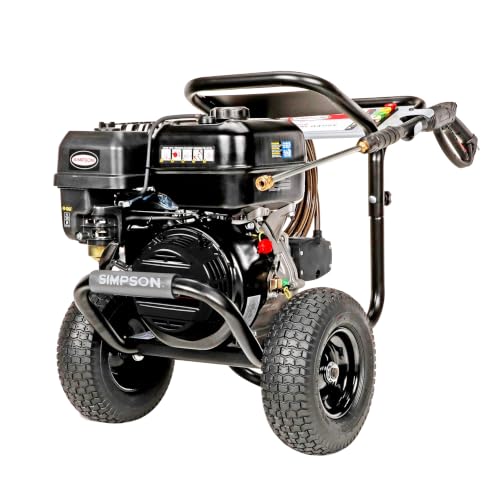
Simpson PowerShot 4400 PSI 4.0 GPM Gas Pressure Washer
$899.99A 420cc engine and AAA triplex plunger pump at 4400 PSI and 4.0 GPM with a 50 ft 3/8 in hose.
Best for: big concrete areas and side jobs
Check price on AmazonHow we chose
We did not test these products in person. Picks are researched from manufacturer specifications and owner manuals, engine and safety certifications where they apply, warranty terms, public recall records, and the recurring themes in verified owner reviews. We favor established brands with large review counts and parts support, match each pick to a real yard size or task, and place it in the tier where its price and capability actually belong.
Frequently asked questions
Is an electric pressure washer strong enough to clean a driveway?
Yes, but slowly. A 2.0 GPM electric such as the Greenworks 3000 PSI cleans concrete with a 15 or 25 degree tip or a surface cleaner, but it moves less water than a gas unit and takes longer. A 1.2 GPM electric will get there on light grime but is tedious on a large driveway. For big or heavily stained concrete, a 2.5 GPM gas washer is much faster.
What PSI do I need for a house?
Less than most people think. Vinyl siding cleans at roughly 1,300 to 1,600 PSI with a 25 or 40 degree tip and detergent, and many exterior cleaners work best as a soft wash with low pressure. Soft wood decks need about 500 to 800 PSI. A 2,000 PSI electric covers all of it. The how to pressure wash a house guide walks through the process.
Do gas pressure washers need a lot of maintenance?
More than electric. Expect oil changes per the engine manual, fresh or stabilized fuel, an air filter and spark plug check each season, and draining or protecting the pump before freezing weather. The Simpson Clean Machine uses a maintenance-free axial cam pump, while triplex pumps like the one on the PowerShot 4400 need pump oil changes but last longer.
What are cleaning units on a pressure washer?
Cleaning units are pressure multiplied by flow: PSI times GPM. They give a single number for how much cleaning work a washer does, because pressure loosens dirt and flow carries it away. A 3,400 PSI, 2.5 GPM gas washer rates about 8,500 cleaning units, while a 2,000 PSI, 1.2 GPM electric rates 2,400. Higher cleaning units generally mean faster cleaning, not safer cleaning.
Can I use an extension cord with an electric pressure washer?
Check your manual first, because many makers advise against extension cords or allow only a short, heavy-gauge outdoor cord. Long, thin cords cause voltage drop that strains the motor and can trip breakers. The usual advice is to plug directly into a GFCI outlet and add a longer high-pressure or garden hose instead of a longer cord. Keep all plug connections off wet ground.
Researched, not professional advice. This page is compiled from published specifications, manuals, labels and owner-review consensus, not hands-on testing. Follow the manufacturer's instructions and product label, and consult a qualified professional where safety, chemicals, fuel or structures are involved. As an Amazon Associate we earn from qualifying purchases.