Pressure Washing
Pressure Washer PSI Chart: Safe PSI by Surface
Quick answer
Concrete driveways take 2,500 to 3,000 PSI, vinyl siding only 1,300 to 1,600, and wood decks 500 to 1,200 with a 40 degree tip. Roofs should never be pressure washed: soft wash them at under 500 PSI or hire a professional.
Pressure washer damage is almost always a nozzle and distance problem, not a machine problem. The same 3,000 PSI washer that cleans concrete will carve wood and drive water behind siding if you use the wrong tip at the wrong distance.
The table below is the site's single source for surface pressures, shared with the pressure washer PSI calculator and every surface page. Equipment manuals and the surface maker's care instructions always govern. Our top pick for a homeowner who cleans concrete is the Simpson Clean Machine 3400 at $329.99.
On this page
What PSI should I use on each surface?
| Surface | PSI | Minimum GPM | Nozzle | Distance (in) |
|---|---|---|---|---|
| Concrete driveway | 2,500 to 3,000 | 2.3 | 15 or 25 degree, or a surface cleaner | 8 to 12 |
| Pavers | 1,500 to 2,500 | 2.0 | 25 degree or a surface cleaner | 12 |
| Brick | 1,500 to 2,500 | 1.8 | 25 degree | 12 |
| Vinyl siding | 1,300 to 1,600 | 1.5 | 25 or 40 degree, soap tip for detergent | 12 to 24 |
| Stucco | 1,200 to 1,500 | 1.5 | 40 degree | 18 to 24 |
| Wood deck | 500 to 1,200 | 1.2 | 40 degree, 25 only at distance on hardwoods | 12 to 18 |
| Composite deck | 1,000 to 1,500 | 1.2 | 40 degree fan | 8 to 12 |
| Wood fence | 500 to 1,200 | 1.2 | 40 degree | 12 to 18 |
| Cars and trucks | 1,200 to 1,900 | 1.2 | 40 degree, foam cannon for soap | 12 to 24 |
| Patio furniture | 500 to 1,500 | 1.2 | 40 degree | 12 to 24 |
| Windows | Up to 1,200 | 1.2 | 40 degree, at a distance | 24 or more |
| Roof | Up to 500, soft wash only | 1.2 | Soft wash with a roof cleaning solution | From the ground or by a professional |
Compiled from pressure washer operator manuals and surface makers care instructions. Start at the low end, at a distance, and test an inconspicuous spot first.
What do the pressure washer nozzle colors mean?
| Tip | Color | Use |
|---|---|---|
| 0 degree | Red | Pinpoint blast for stubborn spots on metal or concrete at a distance. Never on wood, siding, vehicles, skin or anything near people and pets. |
| 15 degree | Yellow | Stripping and heavy stains on concrete and masonry. Too aggressive for wood and siding. |
| 25 degree | Green | General cleaning of driveways, brick, pavers, fences and outdoor equipment. |
| 40 degree | White | Gentle wide fan for siding, vehicles, windows, softwood decks and patio furniture. |
| 65 degree or soap | Black | Low-pressure tip that lets the pump draw detergent. Applies soap; does not clean on its own. |
The tip changes effective pressure at the surface as much as the machine setting does. Most homeowners should leave the red 0 degree tip in the box.
How do PSI and GPM compare across pressure washers?
| Model | PSI | GPM | Cleaning units | Power |
|---|---|---|---|---|
| Greenworks 2000 PSI | 2,000 | 1.2 | 2,400 | Electric |
| Karcher K 5 Premium | 2,000 | 1.4 | 2,800 | Electric |
| Sun Joe SPX3000 | 2,500 | 1.2 | 3,000 | Electric |
| RYOBI 2500 PSI | 2,500 | 1.2 | 3,000 | Electric |
| Westinghouse ePX3500 | 2,500 | 1.76 | 4,400 | Electric |
| Champion 2800 PSI | 2,800 | 2.1 | 5,880 | Gas |
| Greenworks 3000 PSI brushless | 3,000 | 2.0 | 6,000 | Electric |
| DEWALT DXPW3300-S | 3,300 | 2.4 | 7,920 | Gas |
| Simpson PowerShot PS3228 | 3,300 | 2.5 | 8,250 | Gas |
| Simpson Clean Machine 3400 | 3,400 | 2.5 | 8,500 | Gas |
| Westinghouse WPX3400 | 3,400 | 2.6 | 8,840 | Gas |
| Simpson PowerShot 4400 | 4,400 | 4.0 | 17,600 | Gas |
Cleaning units are PSI multiplied by GPM, the standard way to compare machines. Flow, not pressure, is what rinses debris away and drives a surface cleaner.
Is PSI or GPM more important?
PSI breaks the bond between dirt and the surface. GPM carries the dirt away and covers ground. For most homeowner jobs, flow is the number people underrate: a 2,500 PSI machine at 1.2 GPM and a 2,500 PSI machine at 2.0 GPM clean the same stain, but the second one finishes a driveway in far less time.
Multiply them for cleaning units, which is how the industry compares machines. A surface cleaner attachment such as the Westinghouse 15 in surface cleaner at $39.99 needs flow to spin properly, which is why it is paired with 2.3 GPM or more on concrete. The full comparison is in pressure washer PSI vs GPM.
How long does pressure washing take?
Time scales with flow. As a planning figure, wand cleaning covers roughly 3 square feet per minute per GPM on concrete, 4 on siding and 5 on vehicles, so a 2.5 GPM machine cleans about 7.5 square feet of concrete a minute, or a 600 square foot driveway in roughly 80 minutes with a wand.
A rotary surface cleaner changes that maths completely on flat concrete: it cleans several times faster than a wand and avoids the zebra striping that wand passes leave. Treat oil stains with a degreaser first, because pressure alone does not lift them. Surface-by-surface detail is on concrete driveways, vinyl siding and wood decks.
Which pressure washer should I buy for my surfaces?
Match the machine to the surface you clean most. Electric covers cars, furniture, decks and siding; gas earns its keep on concrete and large areas. See electric vs gas pressure washers.

Simpson Clean Machine 3400 PSI 2.5 GPM Gas Pressure Washer
$329.99At 3,400 PSI and 2.5 GPM it has the flow to drive a 15 inch surface cleaner, which is the difference between an afternoon and a morning on a driveway.
Best for: driveways, patios and large flatwork
Check price on Amazon
Greenworks 3000 PSI 2.0 GPM Brushless Electric Pressure Washer
$349.99At 3,000 PSI and 2.0 GPM this covers concrete with a surface cleaner while still being safe on siding with a 40 degree tip at distance.
Best for: homeowners who want one machine for everything
Check price on Amazon
Kärcher K 5 Premium Electric Pressure Washer with Hose Reel
$386.01At 2,000 PSI and 1.4 GPM it sits right in the safe band for vehicles at 1,200 to 1,900 PSI and for vinyl siding at 1,300 to 1,600.
Best for: cars, furniture and siding
Check price on Amazon
Sun Joe SPX3000 Electric Pressure Washer
$169.00A 2,500 PSI, 1.2 GPM electric that handles decks, furniture, fences and light concrete at the lowest price in the category.
Best for: first pressure washer
Check price on Amazon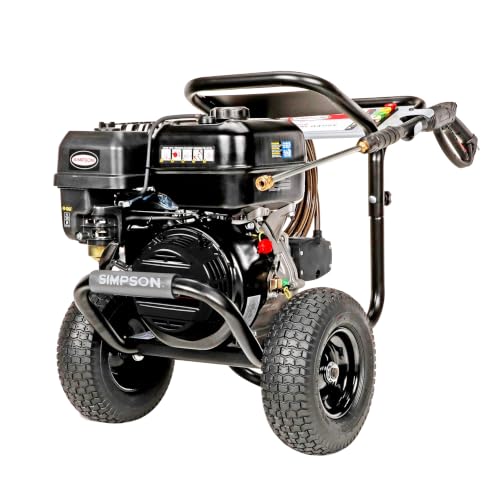
Simpson PowerShot 4400 PSI 4.0 GPM Gas Pressure Washer
$899.99At 4,400 PSI and 4.0 GPM this is a professional-class machine, far more pressure than any siding or wood surface can take.
Best for: large properties and commercial flatwork
Check price on Amazon
Westinghouse 15 in. Pressure Washer Surface Cleaner
$39.99A 15 inch rotary surface cleaner cleans flat concrete several times faster than a wand and avoids striping, rated for machines up to 3,400 PSI.
Best for: anyone cleaning a driveway
Check price on AmazonHow we chose
We did not test these products in person. Picks are researched from manufacturer specifications and owner manuals, engine and safety certifications where they apply, warranty terms, public recall records, and the recurring themes in verified owner reviews. We favor established brands with large review counts and parts support, match each pick to a real yard size or task, and place it in the tier where its price and capability actually belong.
Frequently asked questions
What PSI is safe for vinyl siding?
Use 1,300 to 1,600 PSI with a 25 or 40 degree tip at 12 to 24 inches. Spray level or downward, never up under the laps, which drives water behind the siding and into the wall. A soap tip with a cleaning solution does most of the work, and the rinse should be gentle. Always check the siding maker care instructions first.
What PSI do I need to clean a concrete driveway?
Concrete takes 2,500 to 3,000 PSI with a 15 or 25 degree tip at 8 to 12 inches, and at least 2.3 GPM if you want to run a rotary surface cleaner. The surface cleaner is the real time saver, because it covers flat concrete several times faster than a wand and leaves no zebra striping. Degrease oil stains before washing.
Can I pressure wash a wood deck?
Yes, carefully. Softwoods such as pine and cedar need 500 to 800 PSI and dense hardwoods tolerate a little more, up to about 1,200, always with a 40 degree tip at 12 to 18 inches. Keep the wand moving with the grain to avoid gouges and raised fibers. Let the wood dry for a couple of days before staining or sealing.
What does the red 0 degree nozzle do?
It concentrates the entire flow into a pinpoint jet for stubborn spots on metal or concrete at a distance. It is also the tip that causes most damage and most injuries: it will carve wood, crack siding, strip paint and cut skin. Most homeowners never need it, and it should never be used on wood, siding, vehicles or anywhere near people and pets.
Is more PSI always better?
No. Above the range a surface tolerates, extra pressure only causes damage: stripped wood fibers, cracked stucco, blown-out window seals and water driven behind siding. Beyond about 3,000 PSI you are buying capability for concrete and commercial work, not better results on a house. Flow in GPM does more for speed than extra pressure does.
Researched, not professional advice. This page is compiled from published specifications, manuals, labels and owner-review consensus, not hands-on testing. Follow the manufacturer's instructions and product label, and consult a qualified professional where safety, chemicals, fuel or structures are involved. As an Amazon Associate we earn from qualifying purchases.