Pressure Washing
Pressure Washer PSI Calculator: PSI, GPM and Nozzle by Surface
Quick answer
Use about 2,500 to 3,000 PSI and at least 2.3 GPM for concrete driveways, 1,500 to 2,500 PSI for brick and pavers, 1,300 to 1,600 PSI for vinyl siding, 1,200 to 1,900 PSI for cars, and only 500 to 1,200 PSI for wood decks and fences. Roofs should be soft washed, not pressure washed.
Pressure is only half of cleaning power. PSI, pounds per square inch, is how hard the water hits; GPM, gallons per minute, is how much water rinses the dirt away. Too much PSI etches wood and strips paver sand; too little GPM makes a driveway an all-afternoon job. Choose the surface, enter the area and your washer's ratings if you own one, and the calculator gives the PSI range, minimum GPM, nozzle tip, working distance and an estimated cleaning time. Every surface has its own page under pressure washer PSI by surface.
Pressure washer PSI calculator
Recommended pressure
Pressure washers for this job
Top matches update when you calculate.

Greenworks 2000 PSI 1.2 GPM Electric Pressure Washer
$194.99PWMA-rated 2000 PSI and 1.2 GPM from a 14 amp motor with auto stop and an onboard soap tank.
Best for: medium-duty cleaning of walkways, grills and vehicles
Check price on Amazon
Sun Joe SPX3000 Electric Pressure Washer
$169.00Sun Joe lists 2500 max PSI (2030 PSI working) at 1.2 GPM, with five quick-connect tips, dual detergent tanks and a 20 ft hose.
Best for: cars, patio furniture and light deck cleaning
Check price on Amazon
Kärcher K 5 Premium Electric Pressure Washer with Hose Reel
$386.01Water-cooled induction motor with a non-corrosive pump, Vario Power and Dirt Blaster wands, an onboard hose reel and a 25 ft hose.
Best for: frequent use where motor life and tidy storage matter
Check price on Amazon
RYOBI 2500 PSI 1.2 GPM Electric Pressure Washer
$327.91High performance cold water electric unit rated at 2500 PSI and 1.2 GPM for decks, fences, siding and vehicles.
Best for: homeowners who want more pressure than entry electrics
Check price on Amazon
Westinghouse ePX3500 Electric Pressure Washer
$169.002500 max PSI and 1.76 max GPM (2000 PSI and 1.2 GPM rated) in a 19 lb anti-tip body with a 25 ft braided hose and 3-year coverage.
Best for: compact storage and all-around home cleaning
Check price on Amazon
Greenworks 3000 PSI 2.0 GPM Brushless Electric Pressure Washer
$349.99TruBrushless 14 amp motor with 3000 PSI and 2.0 GPM (3300 cleaning units) that Greenworks says an independent lab verified, a metal gun and 25 ft kink-resistant hose.
Best for: driveways and siding without the upkeep of a gas engine
Check price on Amazon
Champion 2800 PSI 2.1 GPM Low Profile Gas Pressure Washer
$499.99196cc Champion OHV engine with an Annovi Reverberi axial cam pump at 2800 PSI and 2.1 GPM, plus onboard storage and a detergent tank.
Best for: gas cleaning power in a compact footprint
Check price on Amazon
DEWALT DXPW3300-S 3300 PSI 2.4 GPM Gas Pressure Washer
$382.99208cc engine and axial cam pump at 3300 PSI and 2.4 GPM, with thermal relief, a welded steel frame and 10 in. pneumatic tires.
Best for: residential exterior prep and deck cleaning
Check price on Amazon
Simpson Clean Machine 3400 PSI 2.5 GPM Gas Pressure Washer
$329.99208cc CRX engine with low-oil shutdown driving a maintenance-free axial cam pump at 3400 PSI and 2.5 GPM, on 10 in. pneumatic tires.
Best for: homeowners stepping up to gas for driveways and decks
Check price on Amazon
Westinghouse WPX3400 3400 PSI 2.6 GPM Gas Pressure Washer
$349.00212cc OHV engine at 3400 PSI and 2.6 GPM with a half gallon soap tank, never-flat wheels and 3-year coverage.
Best for: driveways, siding and fences on a mid-range budget
Check price on Amazon
Simpson PowerShot PS3228 3300 PSI Honda GX200 Gas Pressure Washer
$659.00Honda GX200 engine and AAA triplex plunger pump at 3300 PSI and 2.5 GPM, a contractor build designed for long service life.
Best for: heavy regular use, paint prep and side-business cleaning
Check price on Amazon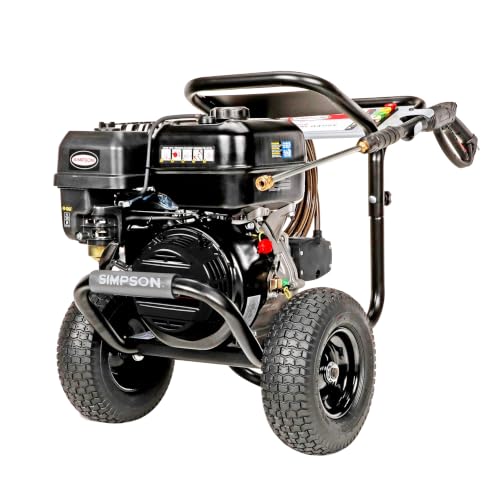
Simpson PowerShot 4400 PSI 4.0 GPM Gas Pressure Washer
$899.99420cc CRX engine and AAA industrial triplex pump at 4400 PSI and 4.0 GPM with a 50 ft 3/8 in. hose, aimed at deck restoration and paint prep.
Best for: large concrete areas and professional-level jobs
Check price on Amazon
Westinghouse 15 in. Pressure Washer Surface Cleaner
$39.99A 4 lb, 15 in. surface cleaner that concentrates up to 3400 PSI across driveways, patios and decks.
Best for: even results on large flat concrete
Check price on AmazonOn this page
What PSI do I need for each surface?
| Surface | PSI | GPM | Nozzle | Distance |
|---|---|---|---|---|
| Concrete driveway | 2,500 to 3,000 | 2.3+ | 15 or 25 degree, or a surface cleaner | 8 to 12 in |
| Pavers | 1,500 to 2,500 | 2+ | 25 degree or a surface cleaner | 12 in |
| Brick | 1,500 to 2,500 | 1.8+ | 25 degree | 12 in |
| Vinyl siding | 1,300 to 1,600 | 1.5+ | 25 or 40 degree, soap tip for detergent | 12 to 24 in |
| Stucco | 1,200 to 1,500 | 1.5+ | 40 degree | 18 to 24 in |
| Wood deck | 500 to 1,200 | 1.2+ | 40 degree (25 degree only at distance on hardwoods) | 12 to 18 in |
| Composite deck | 1,000 to 1,500 | 1.2+ | 40 degree fan | 8 to 12 in |
| Wood fence | 500 to 1,200 | 1.2+ | 40 degree | 12 to 18 in |
| Cars and trucks | 1,200 to 1,900 | 1.2+ | 40 degree, foam cannon for soap | 12 to 24 in |
| Patio furniture | 500 to 1,500 | 1.2+ | 40 degree | 12 to 24 in |
| Windows | Soft wash, under 1200 | 1.2+ | 40 degree, at a distance | 24 or more in |
| Roof | Soft wash, under 500 | 1.2+ | Soft wash only (low pressure with a roof cleaning solution) | from the ground or by a professional |
What do the pressure washer nozzle colors mean?
| Tip | Color | Use |
|---|---|---|
| 0 degree | Red | Pinpoint blast for stubborn spots on metal or concrete at a distance. Never on wood, siding, vehicles, skin or anything near people and pets. |
| 15 degree | Yellow | Stripping and heavy stains on concrete and masonry. Too aggressive for wood and siding. |
| 25 degree | Green | General cleaning of driveways, brick, pavers, fences and outdoor equipment. |
| 40 degree | White | Gentle, wide fan for siding, vehicles, windows, softwood decks and patio furniture. |
| 65 degree or soap | Black | Low-pressure tip that lets the pump draw detergent. Applies soap; does not clean on its own. |
Is PSI or GPM more important?
Both, but for large flat areas GPM matters more than people expect. PSI loosens dirt; GPM carries it away and determines how quickly you cover ground. Multiplying the two gives cleaning units, a rough measure of cleaning power: a 2,000 PSI, 1.2 GPM electric washer produces 2,400 cleaning units, while a 3,400 PSI, 2.6 GPM gas washer produces 8,840, more than three times the work per minute. That is why a gas washer such as the Westinghouse WPX3400 3400 PSI 2.6 GPM Gas Pressure Washer or the Simpson Clean Machine 3400 PSI 2.5 GPM Gas Pressure Washer is the practical choice for driveways and whole-house washing, while a compact electric like the Sun Joe SPX3000 Electric Pressure Washer suits cars, furniture and small decks. The full trade-off is in pressure washer PSI vs GPM.
| Class | PSI | GPM | Cleaning units | Best for |
|---|---|---|---|---|
| Compact electric | 1,800 to 2,000 | 1.1 to 1.4 | 2,000 to 2,800 | Cars, furniture, small decks |
| Full-size electric | 2,300 to 3,000 | 1.2 to 2.0 | 2,800 to 6,000 | Siding, decks, small patios |
| Residential gas | 2,800 to 3,400 | 2.3 to 2.6 | 6,400 to 8,800 | Driveways, whole-house washing |
| Heavy-duty gas | 3,600 to 4,400 | 2.8 to 4.0 | 10,000 to 17,600 | Large concrete areas, surface cleaners |
How does the calculator estimate cleaning time?
Cleaning time here is a rough planning estimate: square feet per minute = GPM x a surface factor, about 3 for concrete with a wand, 4 for siding and 5 for vehicles, reflecting how much scrubbing each surface needs. A rotary surface cleaner is estimated at about four times the wand rate on flat concrete and pavers. A 2.5 GPM gas washer with a wand covers roughly 7.5 square feet a minute of driveway, so a 600 square foot driveway takes about 80 minutes with a wand and about 20 minutes with a surface cleaner such as the Westinghouse 15 in. Pressure Washer Surface Cleaner. Heavy staining, mildew and detergent dwell time add to any estimate.
Should I buy an electric or gas pressure washer?
Choose electric for cars, patio furniture, decks and occasional siding: electric washers are quiet, start instantly, need no engine maintenance and their 1,200 to 2,000 PSI is safer on soft surfaces. The Greenworks 3000 PSI 2.0 GPM Brushless Electric Pressure Washer pushes electric into 2.0 GPM territory. Choose gas for concrete, large patios, long fences and whole-house washing, where 2.5 GPM or more and a surface cleaner save hours; the Simpson PowerShot 4400 PSI 4.0 GPM Gas Pressure Washer at 4.0 GPM is the heavy-duty end. Compare in electric vs gas pressure washers, and see tiered picks in the best pressure washers.
Frequently asked questions
What PSI is best for washing a house?
For vinyl siding, about 1,300 to 1,600 PSI with a 25 or 40 degree tip, used 12 to 24 inches from the surface, is the common guidance. Apply house wash detergent through the soap tip first, let it dwell, then rinse working level or downward so water does not get forced up under the siding laps. Stucco and painted wood need even lower pressure or soft washing.
Is 2000 PSI enough to clean concrete?
It will clean concrete, but slowly, especially with the low 1.1 to 1.4 GPM typical of 2,000 PSI electric washers. For driveways, 2,500 to 3,000 PSI with 2.3 GPM or more and a rotary surface cleaner is far faster and more even. If you only clean a small patio occasionally, a 2,000 PSI electric with a small surface cleaner attachment can be enough.
What PSI should I use on a wood deck?
Use about 500 to 800 PSI on softwoods such as pine and cedar and up to about 1,200 PSI on dense hardwoods, with a 40 degree tip held 12 to 18 inches away and moved with the grain. Too much pressure or too close a tip gouges wood and raises fibers that then need sanding. Composite decks follow their maker's care guide, and some makers restrict pressure washing.
Can you pressure wash a roof?
Pressure washing asphalt shingle roofs is widely discouraged because high pressure strips the protective granules, can shorten shingle life and may void warranties. Roofs are cleaned by soft washing, which uses low pressure and a roof cleaning solution. Working on a roof or ladder with a pressure washer is dangerous, so roof cleaning is a job for a professional service.
How many GPM do I need in a pressure washer?
For cars, furniture and small decks, 1.2 to 1.5 GPM is enough. For siding and larger decks, 1.5 to 2.0 GPM makes rinsing faster. For concrete driveways, patios and surface cleaners, look for 2.3 GPM or more; most surface cleaners list a minimum flow. Higher GPM also needs a water supply that can keep up, so check your spigot flow with a bucket and a timer.
Researched, not professional advice. This page is compiled from published specifications, manuals, labels and owner-review consensus, not hands-on testing. Follow the manufacturer's instructions and product label, and consult a qualified professional where safety, chemicals, fuel or structures are involved. As an Amazon Associate we earn from qualifying purchases.