Lawn Care
How to Test Soil pH for Your Lawn: Sampling, Results and Lime Rates
Quick answer
To test lawn soil pH, mix 10 to 15 cores 3 to 4 inches deep in a clean plastic bucket and send 2 cups to an extension or mail-in lab. Most grasses grow best at pH 6.0 to 7.0. Raising loam one unit takes about 70 lb of lime per 1,000 sq ft, in splits of 50 lb or less.
Soil pH is a measure of how acidic or alkaline soil is, on a scale from 0 to 14 where 7 is neutral, lower is acidic and higher is alkaline. It matters because pH controls how available nutrients are to grass roots. In strongly acidic soil, phosphorus, calcium and magnesium become harder for grass to use; in alkaline soil, iron and manganese do, and grass turns yellow even when it is fed. A lawn with the wrong pH wastes much of the fertilizer you put down.
The fix, usually lime for acidic soil, only works at the right rate, and the right rate depends on a soil test. This guide covers choosing a test, taking a proper sample, reading the report and turning it into a lime or sulfur plan. When you have a result, the lime calculator converts it into pounds and bags for your lawn size.
On this page
- Why does soil pH matter for grass?
- Should I use a lab soil test or a home test kit?
- When is the best time to test soil pH?
- How do I take a soil sample for a pH test?
- How do I read my soil test results?
- What is buffer pH, and why do two soils with the same pH need different lime?
- How much lime do I need to raise soil pH?
- What kind of lime should I use on my lawn?
- How do I lower soil pH for grass?
- What soil pH does each type of grass prefer?
- How long does lime take to work, and how often should I retest soil pH?
- Which soil test kits and lime products should I buy?
Why does soil pH matter for grass?
The pH scale is logarithmic, so soil at pH 5.0 is ten times more acidic than soil at pH 6.0 and a hundred times more acidic than soil at 7.0. Small numbers represent big chemical differences. Most lawn grasses grow best between pH 6.0 and 7.0, where the widest range of nutrients is available and soil microbes that break down thatch and release nitrogen are most active.
- Below about 5.5: phosphorus, calcium and magnesium availability drops, aluminum and manganese can reach levels that injure roots, and fertilizer response is poor. Thin turf and moss often move in.
- 6.0 to 7.0: the target for most lawns.
- Above about 7.5: iron and manganese become less available, causing yellowing between leaf veins, and phosphorus can tie up again.
Some grasses prefer the edges of that range, which is covered in the grass table below.
Should I use a lab soil test or a home test kit?
Use a lab test when you plan to lime, fertilize a problem lawn or start a new one. Your state's land-grant university extension service runs or recommends a soil testing lab, with fees that are usually modest; check your state extension website for mailers and instructions. Home kits are fine for quick checks between lab tests, but most do not measure buffer pH, which is what a lime rate depends on.
| Option | What it measures | Gives a lime rate? | Best for | Limits |
|---|---|---|---|---|
| State extension soil lab | pH, buffer pH, P, K, often Ca, Mg and CEC | Yes, per 1,000 sq ft for lawns | Liming and fertilizer decisions | Turnaround and mailing vary by state |
| MySoil mail-in lab test | pH and 13 plant-available nutrients | Product and rate recommendations | Convenient prepaid lab testing | Results in 6 to 8 days per the listing |
| Luster Leaf Rapitest capsule kit | pH, nitrogen, phosphorus, potash by color chart | No | Cheap spot checks around the yard | Color matching is approximate |
| Analog probe pH meter | Estimated pH | No | Not recommended for decisions | Owners commonly report inconsistent readings |
| Calibrated digital pH pen with soil slurry | pH | No | Frequent checks by careful users | Needs calibration solutions and technique |
Details for catalog kits are from their listings. Ask for a lawn or turf recommendation when a lab form asks for the crop.
When is the best time to test soil pH?
You can sample any time the ground is not frozen or saturated, but late summer to fall is the most useful time for lawns. Results come back in time for fall liming, and lime then has winter freeze-thaw cycles and months of rain to start working before spring growth. Sample at about the same time of year each time you test so results are comparable, since pH drifts a little with season and moisture.
Wait several weeks after fertilizing and a few months after liming before sampling, so fresh granules do not skew the reading. Test a new lawn area before seeding or sodding, when you can still mix lime into the soil.
How do I take a soil sample for a pH test?
- Gather clean tools. Use a soil probe, trowel or spade and a clean plastic bucket. Avoid galvanized or brass buckets and tools that can contaminate micronutrient readings.
- Divide the property. Sample each area that is managed differently or looks different, such as front lawn, back lawn and a problem patch, as separate samples.
- Take 10 to 15 cores per area. Walk a zigzag pattern across the area and take a core at each stop. Skip spots near driveways, foundations, fertilizer spills, burn piles and dog spots.
- Sample 3 to 4 inches deep. For established lawns, take each core from the surface to 3 to 4 inches deep. For a new lawn that will be tilled, sample to about 6 inches.
- Remove grass and thatch. Trim off the green grass and thatch layer from the top of each core, and discard rocks and roots.
- Mix thoroughly. Crumble and mix all cores from one area together in the bucket so the sample represents the whole area.
- Air-dry about 2 cups. Spread the mixed soil on clean paper indoors to dry at room temperature. Do not dry it in an oven or microwave.
- Label and send. Put about 2 cups, or the amount the lab asks for, in the lab bag or box, label the area and fill in the form with lawn or turf as the crop and your grass type.
How do I read my soil test results?
A lab report typically lists several numbers. Here is what the ones that matter for lime and fertilizer mean:
- Soil pH (water pH): the current acidity. This tells you whether you need lime (below about 6.0 for most grasses), sulfur (well above 7.0 for most grasses) or nothing.
- Buffer pH (lime requirement index): measures the soil's reserve acidity. It tells the lab how much lime it takes to move the pH. It appears only when lime may be needed.
- CEC (cation exchange capacity): how much the soil holds onto nutrients. Low CEC usually means sandy soil that changes pH easily; high CEC means clay or organic soil that resists change.
- Phosphorus and potassium: usually reported as low, medium, optimum or high, with a fertilizer recommendation. If both are optimum, a zero-phosphorus maintenance fertilizer is the right buy; see how to read a fertilizer label.
- Calcium and magnesium: these help choose between dolomitic lime (adds magnesium) and calcitic lime (mostly calcium).
- Lime recommendation: most labs convert everything into pounds of ground limestone per 1,000 sq ft for lawns. Use that number over any general table.
What is buffer pH, and why do two soils with the same pH need different lime?
Two lawns can both test at pH 5.5 and need very different amounts of lime. Soil pH measures only the acidity in the soil water. Clay and organic matter hold a large reserve of acidity on their particle surfaces that releases as you neutralize the water, so they need much more lime to move one unit. Sandy soils hold little reserve and change quickly. Buffer pH captures that reserve. The lower the buffer pH, the more lime the soil needs.
This is why home kits that report only pH cannot tell you how much lime to apply, and why guessing often leads to either no visible change or overshooting. Without a lab buffer test, the conservative approach is to use the texture-based estimates below, apply no more than 50 lb per 1,000 sq ft at a time on established turf and retest before adding more.
How much lime do I need to raise soil pH?
These are general planning estimates for ground or pelletized agricultural limestone to raise the pH of the top few inches of lawn soil by one unit. Use your soil test's lime recommendation when you have one. On established turf, apply no more than about 50 lb per 1,000 sq ft per application and split larger amounts across seasons, commonly fall and spring. The lime rate chart covers more starting points.
| Soil texture | Lime per 1 pH unit (lb) | Max per application on established turf (lb) | Example plan: raise pH 5.5 to 6.5 | Bags of 50 lb pelletized lime per 5,000 sq ft |
|---|---|---|---|---|
| Sandy | 40 | 50 | 40 lb once | 4 |
| Loam | 70 | 50 | 50 lb in fall, 20 lb in spring | 7 |
| Clay | 100 | 50 | 50 lb in fall, 50 lb in spring | 10 |
Estimates assume ground or pelletized calcium carbonate equivalent. Bags column = lb per 1,000 sq ft x 5 / 50, total across applications. Lime reacts slowly; retest about a year after liming.
What kind of lime should I use on my lawn?
Pelletized limestone is ground limestone pressed into pellets with a binder, so it spreads cleanly through a lawn spreader without dust and dissolves into powder after rain or watering. The chemistry and rate by weight are essentially the same as powdered agricultural lime. Choose by your soil test's magnesium result:
- Dolomitic lime supplies calcium and magnesium. Use it when magnesium is low or medium. The Old Castle Pro Pelleted Dolomitic Limestone is a plain 50 lb bag meant for a standard spreader.
- Calcitic lime supplies mostly calcium. Use it when magnesium is already high.
- Soluble calcium products such as Jonathan Green Mag-I-Cal for acidic soil are applied at much lower rates; Jonathan Green says one bag has the pH-raising power of up to 15 bags of limestone. Follow the product label, not the limestone table.
- Gypsum does not raise pH. The Andersons NutraSoft pelletized gypsum is pH-neutral and is used for clay structure and salt damage instead.
Check your spreader: Chapin notes its 8401C push spreader is not recommended for pelletized lime. A tow-behind like the Brinly 40 in. combo aerator spreader can drop lime while it perforates the soil. More options are in best lawn spreaders.
How do I lower soil pH for grass?
Lowering pH is slower and harder than raising it. The usual tool is elemental sulfur, which soil bacteria convert to acid over weeks to months, fastest in warm, moist soil. Many extension services advise applying no more than about 5 lb of elemental sulfur per 1,000 sq ft at a time to established turf, in cool weather and watered in, because higher rates burn grass. Use an elemental sulfur product at its label rate, and retest before repeating.
- Fertilizers containing ammonium sulfate acidify soil gradually and can help hold pH down over years.
- Aluminum sulfate is not a good lawn choice; heavy use can build aluminum to levels that injure roots.
- Soils in arid regions that contain free calcium carbonate (they fizz when a drop of vinegar hits them) are impractical to acidify. Choose grasses adapted to alkaline soil and use iron products for color.
What soil pH does each type of grass prefer?
These are approximate preferred ranges drawn from common university extension guidance. Grasses survive outside them, but color, density and fertilizer response suffer. Centipedegrass is the notable exception to liming toward 7.0; see the centipedegrass page. Cool-season details are on the Kentucky bluegrass and tall fescue pages.
| Grass | Preferred pH | Notes |
|---|---|---|
| Tall fescue | 5.5 to 7.0 | Tolerates mild acidity better than bluegrass |
| Kentucky bluegrass | 6.0 to 7.0 | Thins and yields to moss in acidic soil |
| Perennial ryegrass | 6.0 to 7.0 | Responds well to liming acidic soil |
| Fine fescue | 5.5 to 6.5 | Tolerates acidic, low-fertility shade |
| Bermudagrass | 6.0 to 7.0 | Tolerates a wide range, from mildly acidic to slightly alkaline |
| Zoysiagrass | 6.0 to 7.0 | Slow to recover from pH-related thinning |
| St. Augustinegrass | 6.0 to 7.5 | Iron yellowing is common above about 7.5 |
| Centipedegrass | 5.0 to 6.0 | Do not lime above 6.0; high pH causes iron chlorosis |
| Bahiagrass | 5.0 to 6.5 | Well suited to acidic, sandy soils |
| Buffalograss | 6.5 to 8.0 | Adapted to alkaline soils of the Plains |
Ranges are approximate and vary by source; your soil test recommendation for your grass type takes priority.
How long does lime take to work, and how often should I retest soil pH?
Lime works slowly because it has to dissolve and react with the soil. Pelletized lime breaks down faster than coarse lime, but noticeable pH change in the top few inches of an established lawn commonly takes several months, and full effect can take a year or more. Surface-applied lime moves down slowly, which is why liming after core aeration helps. Soluble calcium products act faster, as their makers note, but still need time.
- While correcting pH: retest about a year after the first application, before applying more.
- Once pH is in range: retest every two to three years. Rain, irrigation and nitrogen fertilizer slowly acidify most lawn soils again.
- Anytime a problem appears: retest if the lawn yellows, thins or stops responding to fertilizer.
Which soil test kits and lime products should I buy?
A lab-quality test first, then the right amendment and a spreader that can handle it. More kits are in best soil test kits.

MySoil Soil Test Kit
$34.26A prepaid mail-in lab test that reports pH and 13 plant-available nutrients in 6 to 8 days with product and rate recommendations.
Best for: testing before liming or fertilizing
Check price on Amazon
Luster Leaf Rapitest Soil Test Kit, 40 Tests
$18.68A capsule and color-chart kit with 10 tests each for pH, nitrogen, phosphorus and potash. Useful for comparing areas, but it does not give a lime rate.
Best for: quick checks between lab tests
Check price on Amazon
Old Castle Pro Pelleted Dolomitic Limestone, 50 lb
$47.99A plain 50 lb bag of pelletized dolomitic lime that spreads through a standard spreader, applied at the rate a soil test calls for.
Best for: correcting acidic soil
Check price on Amazon
Jonathan Green Mag-I-Cal Soil Food for Acidic Soil, 15,000 sq ft
$61.20Soluble calcium carbonate with humates in a 54 lb bag covering 15,000 sq ft, applied at its own label rate rather than limestone rates.
Best for: lighter bags and quicker response
Check price on Amazon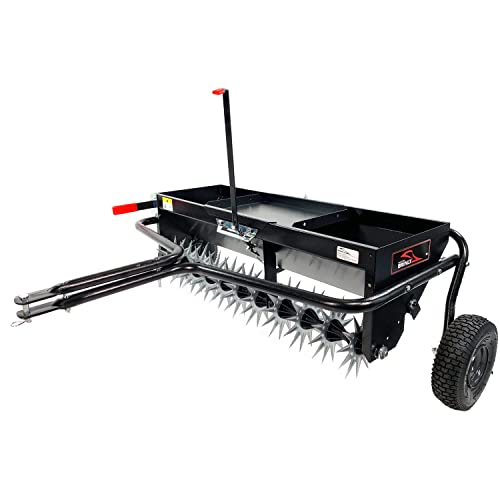
Brinly 40 in Tow-Behind Combination Aerator Spreader
$384.00Star tines perforate the soil while a 100 lb steel hopper drops lime, seed or fertilizer, putting lime into the holes in one pass.
Best for: liming large lawns with a riding mower
Check price on AmazonHow we chose
We did not test these products in person. Picks are researched from manufacturer specifications and owner manuals, engine and safety certifications where they apply, warranty terms, public recall records, and the recurring themes in verified owner reviews. We favor established brands with large review counts and parts support, match each pick to a real yard size or task, and place it in the tier where its price and capability actually belong.
Frequently asked questions
How accurate are home soil pH test kits?
Home capsule kits like the Luster Leaf Rapitest give a rough pH reading, usually close enough to tell acidic from neutral soil, but color matching is approximate. Cheap analog probe meters are commonly reported as unreliable. Neither measures buffer pH, so they cannot tell you how much lime to apply. Use a lab or mail-in test such as a state extension test or MySoil before liming.
How deep should I take a soil sample for a lawn?
Take lawn soil samples 3 to 4 inches deep, which is where most grass roots and surface-applied lime and fertilizer act. Remove the grass and thatch from the top of each core. For a new lawn that will be tilled before seeding, sample to about 6 inches. Take 10 to 15 cores per area and mix them into one sample so the result represents the whole lawn.
Can you put down too much lime on a lawn?
Yes. Overliming can push pH above 7.5, where iron and manganese become less available and grass yellows, and it is much harder to bring pH back down than to raise it. Centipedegrass is especially sensitive above pH 6.0. Apply lime only when a soil test calls for it, use no more than about 50 lb per 1,000 sq ft at a time on established turf and retest before repeating.
What time of year is best to lime a lawn?
Fall is generally the best time to lime a lawn, because rain and winter freeze-thaw cycles help work the lime into the soil before spring growth. Early spring works too. Lime can go down any time the ground is not frozen, and larger amounts are commonly split between fall and spring. Applying right after core aeration helps lime reach deeper soil.
Can I apply lime and fertilizer at the same time?
Many extension services suggest separating lime from urea or ammonium-based nitrogen fertilizers by a week or two, or watering each in promptly, because lime at the soil surface can increase nitrogen loss to the air as ammonia. Lime and a slow-release or zero-nitrogen product are less of a concern. Follow both product labels and never blend products in one spreader unless the labels allow it.
How often should I test my lawn soil pH?
Test every two to three years once pH is in the right range for your grass, and about a year after each lime or sulfur application while you are correcting it. Also retest whenever the lawn yellows, thins or stops responding to fertilizer. Sample at the same time of year each time so results are comparable, and wait several weeks after fertilizing before sampling.
Researched, not professional advice. This page is compiled from published specifications, manuals, labels and owner-review consensus, not hands-on testing. Follow the manufacturer's instructions and product label, and consult a qualified professional where safety, chemicals, fuel or structures are involved. As an Amazon Associate we earn from qualifying purchases.