Lawn Care
How to Aerate a Lawn: Core vs Spike, Timing, Soil Moisture and Aftercare
Quick answer
Core aerate cool-season lawns in early fall and warm-season lawns in late spring to early summer, when soil is moist but not soggy. Call 811 and flag sprinkler heads first, make two passes pulling 2 to 3 inch cores, leave the cores to break down, then overseed and fertilize. Research favors core over spike aeration.
Aerating a lawn means punching holes into the soil to relieve compaction so air, water and fertilizer can reach grass roots. Core aeration, the method university turf programs recommend, pulls out finger-sized plugs of soil and drops them on the surface. Spike aeration just pushes solid tines into the ground, which opens a hole but presses the surrounding soil tighter.
The job itself is simple. What decides whether it helps is timing, soil moisture, enough holes per square foot and what you do in the days afterward. This guide covers each step. Measure your lawn first with the lawn size calculator, because size decides whether to rent a walk-behind machine or buy a tow-behind aerator like the Agri-Fab 48 in Tow-Behind Plug Aerator ($319.98) for your riding mower.
On this page
- What does aerating a lawn actually do?
- Is core aeration or spike aeration better?
- When is the best time to aerate a lawn?
- How do I know if my lawn needs aeration?
- How wet should the soil be before aerating?
- Why should I call 811 and mark sprinkler heads before aerating?
- How do I aerate a lawn step by step?
- What pattern should I use, and how long does aerating take?
- What should I do after aerating my lawn?
- Should I rent a lawn aerator or buy a tow-behind aerator?
- Which lawn aerators are worth buying?
What does aerating a lawn actually do?
Foot traffic, mowing equipment, heavy rain and clay soil squeeze soil particles together until there is little pore space left. Compacted soil sheds water instead of absorbing it, starves roots of oxygen and resists root growth, so grass thins even when it is fed and watered. Core aeration removes plugs of soil, typically 2 to 3 inches long and about half an inch across, creating open channels that let water, air and nutrients move down and give roots room to expand.
Aeration also helps manage thatch, the layer of dead stems and roots between green grass and soil. Soil from the cores mixes into the thatch and speeds its breakdown. And the holes make an excellent seedbed: seed that falls into them germinates in a protected, moist pocket, which is why aerating and overseeding go together. For more on seeding, see how to overseed a lawn.
Is core aeration or spike aeration better?
Core aeration is better for compacted lawns, and turf research generally favors it. Removing a plug relieves pressure in the soil; pushing a solid spike in displaces soil sideways and can compact the walls of the hole, especially in clay. Spike tools still have a place for light jobs, such as opening the surface before watering in seed on a small lawn. The table compares the aerator types in the catalog. The full breakdown is on core vs spike aerator.
| Type | Catalog example | Depth | Best for | Limits |
|---|---|---|---|---|
| Manual core step tool | Yard Butler ID-6C | Shallow cores, two per push | Compacted paths and small patches | Exhausting beyond a few hundred sq ft |
| Manual spike step tool | Yard Butler IM-7C | 3 in tines | Opening soil on tiny areas | Does not remove soil |
| Walk-behind core (rental) | Rental store machine | Commonly 2 to 3 in | Small to mid lawns without a riding mower | Heavy to load and steer |
| Tow-behind plug, 48 in | Agri-Fab 48 in. plug aerator | Up to 3 in | Half acre and up with a lawn tractor | 32 knives; add weight for depth |
| Tow-behind plug, 42 in | Brinly PA-42BH-A | Up to 3 in | Uneven yards with a rider or zero-turn | Three sections limit tearing on turns |
| Tow spike plus spreader | Brinly 40 in. combo aerator spreader | Up to 2 in | Seeding or liming while perforating | Spikes do not pull cores |
Depths are from manufacturer listings. Real depth depends on soil moisture and how much weight is on the tray.
When is the best time to aerate a lawn?
Aerate when the grass is actively growing, so it can recover and fill the holes quickly:
- Cool-season lawns (tall fescue, Kentucky bluegrass, perennial ryegrass, fine fescue): early fall is best, ideally paired with overseeding while soil is still warm. Early spring is a second choice, but spring aeration can bring up weed seeds and should come before, not after, a pre-emergent.
- Warm-season lawns (bermudagrass, zoysiagrass, St. Augustinegrass, centipedegrass): late spring to early summer, after the lawn has fully greened up and is growing strongly.
Avoid aerating dormant, drought-stressed or heat-stressed grass, lawns seeded or sodded within about the last year, and soil that is frozen, bone dry or saturated. If you applied a pre-emergent this season, aerating afterward can disturb the barrier, so plan aeration for the other season; timing details are in when to apply pre-emergent. The lawn care calendar shows the window for your zone.
How do I know if my lawn needs aeration?
Look for these signs, then confirm with a simple screwdriver test: after a normal watering, push a long screwdriver into the lawn. If it is hard to push in more than 2 or 3 inches in moist soil, the soil is compacted.
- Water puddles or runs off instead of soaking in.
- Worn paths, play areas and spots where cars or equipment park stay thin.
- The lawn sits on heavy clay or on subsoil left behind after new-home construction.
- Thatch is thicker than about half an inch when you cut out a wedge of turf.
- Grass thins and struggles despite regular feeding and watering.
How often: many extension guides suggest once a year for clay soils and high-traffic lawns, and every one to three years for loam lawns with light use. Sandy soils rarely compact and seldom need it. If thatch is the main problem rather than compaction, a dethatcher may be the better tool; see dethatcher vs aerator.
How wet should the soil be before aerating?
Moist to a depth of 2 to 3 inches, but not muddy. Tines cannot penetrate dry, hard soil, so they bounce and pull short, shallow cores. Soaked soil smears, clogs the tines and leaves muddy plugs, and heavy machines rut it.
- Water about 1 inch one to two days before aerating, or aerate a day or two after a good soaking rain.
- Do the screwdriver test: it should slide in several inches with moderate pressure.
- Squeeze a handful of soil from 2 inches down. It should hold together and then crumble; if water drips out, wait.
An in-ground irrigation system makes this easy to schedule, and a hose-end sprinkler like the Melnor XT oscillating sprinkler works for smaller lawns.
Why should I call 811 and mark sprinkler heads before aerating?
Core aerator tines go 2 to 3 inches deep and some shallow lines are closer to the surface than you expect. Calling 811, the national call-before-you-dig number, is free and asks utilities to mark their buried lines, typically within a few business days depending on your state. Most utility lines are deeper than aerator tines, but shallow cable, fiber and some service lines are not always where records say, so call first.
811 marks public utility lines only. You have to find and flag your own private lines:
- Sprinkler heads, valve boxes and shallow irrigation or drip lines
- Invisible pet fence wire
- Low-voltage landscape lighting cable, often buried just a few inches deep
- Gas lines to grills, fire pits or pool heaters and electrical lines to sheds or lamp posts
- Septic tank lids, drain field lines and downspout drain pipes
Push marking flags next to each head and along known wire runs, then steer around them or lift the aerator as you pass. If you are planning lighting, the landscape lighting planning guide covers cable burial depth.
How do I aerate a lawn step by step?
- Pick the right window. Early fall for cool-season grass, late spring to early summer for warm-season grass, with the lawn actively growing.
- Call 811 and flag everything. Call 811 a few business days ahead. Flag sprinkler heads, valve boxes, pet fence wire, lighting cable and any other private lines.
- Mow first. Mow at your normal height, or a little lower if you plan to overseed, and remove clippings so tines reach the soil.
- Water 1 to 2 days before. Apply about 1 inch of water so soil is moist 2 to 3 inches down but not soggy on aeration day.
- Set up the aerator. For a tow-behind, attach it to the hitch, load the weight tray as the manual allows (the Agri-Fab and Brinly models list 175 lb trays) and check tine condition.
- Make the first pass. Aerate in straight lines across the lawn, overlapping slightly. Lift a tow aerator into transport position for sharp turns and to cross flags, driveways and paths.
- Make a second pass. Go over the lawn again at a right angle or diagonal to the first pass to double the number of holes, focusing extra passes on compacted areas.
- Leave the cores. Let the plugs dry and break down on the lawn over one to two weeks, or break them up by mowing over them once dry.
- Seed, feed and water. Overseed and apply fertilizer within a day or two while the holes are open, then water as the seeding schedule requires.
What pattern should I use, and how long does aerating take?
Two passes in different directions give far better coverage than one. Many extension services suggest aiming for roughly 20 to 40 holes per square foot on compacted lawns; a single pass of most machines leaves fewer, so add passes over high-traffic areas. Keep a steady pace, lift at turns and on slopes follow your tractor or mower manual's slope limits, driving up and down rather than across. The time estimates below assume a riding mower towing at a steady 3 mph with about 6 inches of overlap, excluding turns and refills.
| Lawn size | 48 in aerator, 1 pass | 48 in aerator, 2 passes | 42 in aerator, 1 pass | 42 in aerator, 2 passes |
|---|---|---|---|---|
| 1/4 acre (10,890 sq ft) | 12 | 24 | 14 | 28 |
| 1/2 acre (21,780 sq ft) | 24 | 47 | 27 | 55 |
| 1 acre (43,560 sq ft) | 47 | 94 | 55 | 110 |
| 2 acres (87,120 sq ft) | 94 | 189 | 110 | 220 |
Math: effective width (aerator width minus 6 in) x 15,840 ft per hour at 3 mph. Real times run longer with obstacles, turns and flags. Compare mowers that pull these tools in best riding lawn mowers and best zero-turn mowers.
What should I do after aerating my lawn?
The days right after aeration are the best time of the year to seed and feed, because the holes carry both straight to the root zone.
- Leave the cores. They return soil and microbes to the surface and dissolve in one to two weeks with rain, irrigation and mowing. Raking them up removes the benefit.
- Overseed within a day or two, at the overseeding rate for your grass type. A spreader like the Scotts EdgeGuard DLX or the tow-behind Brinly BS361BH-A puts seed down evenly.
- Fertilize. Use a starter fertilizer if you seeded, or your normal fall feeding if you did not. Follow the label rate.
- Lime if a soil test calls for it. Aeration holes help lime move into the soil; see how to test soil pH.
- Water. Keep seed moist, or water normally if you did not seed.
- Hold off on pre-emergent if you seeded, since most stop grass seed.
Should I rent a lawn aerator or buy a tow-behind aerator?
Rent if your lawn is under about a quarter acre, you do not own a riding mower or you aerate less than once a year. Walk-behind core aerators are commonly heavy enough that loading one needs a truck or trailer and two people, they pull hard on slopes, and rental periods are short, so check local rates, availability and weekend demand in fall. Lawn care companies also offer aeration as a service.
Buy a tow-behind if you have a half acre or more, a lawn tractor, riding mower or zero-turn, and plan to aerate every year. The Agri-Fab 48 in Tow-Behind Plug Aerator ($319.98) and Brinly PA-42BH-A 42 in Tow-Behind Plug Aerator ($379.00) both pull plugs up to 3 inches deep and hitch to most riders. A few years of rentals typically cover the cost, and you can aerate on the day soil moisture is right instead of the day the rental is free. Pair one with a riding lawn mower or zero-turn mower that is rated to tow.
Which lawn aerators are worth buying?
These catalog aerators cover everything from a compacted path to multiple acres. The full ranking is in best lawn aerators, and the Brinly is covered in depth in the Brinly PA-42BH-A review.
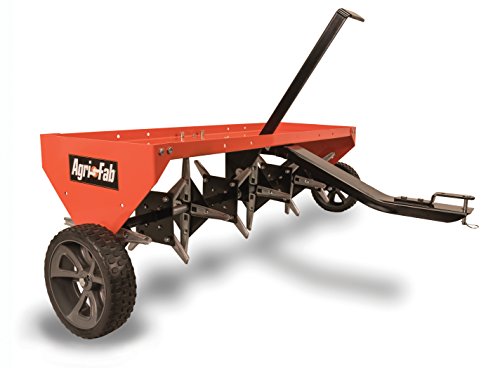
Agri-Fab 48 in Tow-Behind Plug Aerator
$319.98Thirty-two galvanized self-sharpening knives pull plugs up to 3 inches deep across 48 inches, with a 175 lb weight tray, flat-free tires and a seat-reachable transport handle.
Best for: core aerating an acre with a lawn tractor
Check price on Amazon
Brinly PA-42BH-A 42 in Tow-Behind Plug Aerator
$379.00Heat-treated 16-gauge spoons in three independently rotating sections pull 3 inch plugs and limit turf tearing on turns, with a 175 lb weight tray and folding tow bar.
Best for: rolling yards with a rider or ZTR
Check price on Amazon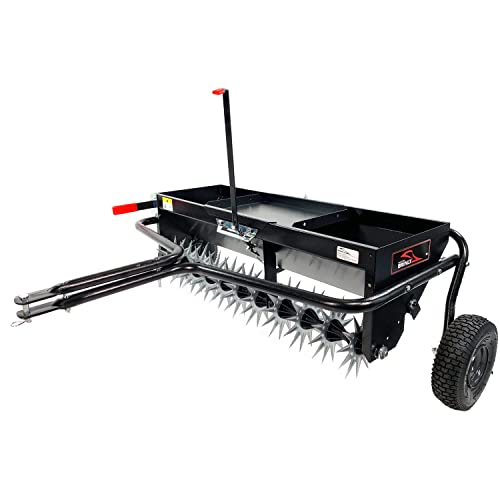
Brinly 40 in Tow-Behind Combination Aerator Spreader
$384.00Star tines perforate up to 2 inches while a 100 lb hopper drops seed, fertilizer or lime in the same pass. Spikes do not pull cores, so it is not a substitute for core aeration on compacted clay.
Best for: overseeding or liming in one trip
Check price on Amazon
Yard Butler ID-6C Manual Lawn Coring Aerator
$48.95A long-handled steel step aerator that pulls two cores per push for compacted paths, dog runs and small patches.
Best for: spot aeration
Check price on Amazon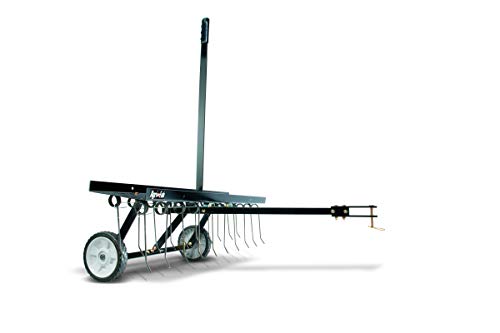
Agri-Fab 48 in Tow-Behind Lawn Dethatcher
$111.04Twenty-four spring-steel tines rake up thatch and debris across 48 inches before aerating and seeding, with a 70 lb weight tray.
Best for: lawns with thatch as well as compaction
Check price on AmazonHow we chose
We did not test these products in person. Picks are researched from manufacturer specifications and owner manuals, engine and safety certifications where they apply, warranty terms, public recall records, and the recurring themes in verified owner reviews. We favor established brands with large review counts and parts support, match each pick to a real yard size or task, and place it in the tier where its price and capability actually belong.
Frequently asked questions
How often should you aerate your lawn?
Aerate clay soils and high-traffic lawns about once a year, and loam lawns with light use every one to three years. Sandy soils rarely compact and seldom need aeration. A simple test is pushing a screwdriver into moist soil: if it will not go in more than 2 or 3 inches, the lawn is compacted and due for core aeration.
Should I pick up the plugs after aerating?
No. Leave the soil cores on the lawn to dry and break down, which usually takes one to two weeks with rain, irrigation and mowing. The cores return soil and microorganisms to the surface and help break down thatch. If they bother you, run a mower over them once they are dry. Raking them away removes much of the benefit of core aeration.
Are aerator spike shoes worth it?
Not for compacted lawns. Strap-on spike shoes push short solid spikes into the soil, which can press the surrounding soil tighter, and they rarely penetrate compacted clay. Turf research favors core aeration, which removes plugs of soil. For a small area, a manual core step tool like the Yard Butler ID-6C does more good, and larger lawns need a walk-behind or tow-behind core aerator.
Can you aerate a lawn in the spring?
Yes, but it is the second-best time for cool-season lawns and the right time for warm-season lawns. For tall fescue and bluegrass, early fall is better because it pairs with overseeding. If you aerate cool-season grass in spring, do it before applying a crabgrass preventer, since aerating afterward can disturb the barrier. Warm-season grasses should be aerated in late spring to early summer.
Should I aerate or dethatch first?
Dethatch first, then aerate, if your lawn needs both. Dethatching removes the mat of dead stems so the aerator tines reach soil and cores fall onto a clean surface, and it opens room for seed. Only dethatch when thatch is thicker than about half an inch. Both jobs stress the lawn, so do them during active growth and follow with overseeding and fertilizer.
Can I aerate a wet lawn?
Moist is ideal, wet is not. Saturated soil smears and clogs the tines, leaves muddy plugs and ruts under heavy machines. Wait until the soil is moist 2 to 3 inches deep but no water drips from a squeezed handful, usually a day or two after a soaking rain or about an inch of irrigation. Dry, hard soil is also a problem, because tines barely penetrate it.
Researched, not professional advice. This page is compiled from published specifications, manuals, labels and owner-review consensus, not hands-on testing. Follow the manufacturer's instructions and product label, and consult a qualified professional where safety, chemicals, fuel or structures are involved. As an Amazon Associate we earn from qualifying purchases.