Lawn Care
How to Overseed a Lawn: Timing, Seeding Rates and Watering Schedule
Quick answer
Overseed cool-season lawns in late summer to early fall, when soil is 50 to 65 F. Mow to about 2 inches, core aerate or dethatch, spread seed at half the new-lawn rate (3 to 4 lb per 1,000 sq ft for tall fescue), apply starter fertilizer, and keep the top half inch of soil moist until the seedlings are established.
Overseeding means spreading grass seed over an existing lawn to thicken thin turf, fill small bare areas and bring in improved grass varieties, without tearing out what is already there. Done at the right time, it is the cheapest way to get a denser lawn: a bag of good seed and a rented or tow-behind aerator usually cost less than a single season of weed control.
Timing and seed-to-soil contact decide whether it works. Seed thrown on top of thatch and dry grass mostly feeds birds; seed dropped into aeration holes or scratched-in soil and kept damp germinates. Start by measuring the area with the lawn size calculator, then get exact pounds of seed from the grass seed calculator. For large lawns, a tow-behind plug aerator such as the Agri-Fab 48 in Tow-Behind Plug Aerator ($319.98) pays for itself against repeated rentals.
On this page
- When is the best time to overseed a lawn?
- How much grass seed do I need to overseed a lawn?
- How low should I mow before overseeding?
- Should I aerate or dethatch before overseeding?
- How do I overseed a lawn step by step?
- How often should I water new grass seed after overseeding?
- Should I fertilize when overseeding?
- Can I use a pre-emergent and overseed at the same time?
- What is the best grass seed for overseeding?
- What equipment do I need to overseed a large lawn?
When is the best time to overseed a lawn?
Seed when soil temperature favors germination and the new grass has weeks of good growing weather ahead of it.
- Cool-season grasses (tall fescue, Kentucky bluegrass, perennial ryegrass, fine fescue): late summer to early fall, when soil temperatures are 50 to 65 F. Warm soil speeds germination, cooling air slows weeds and reduces heat stress, and seedlings get a full fall and the following spring to root before summer. University extension services consistently rank this window first.
- Spring is the second-best window for cool-season lawns. Seedlings face summer heat with shallow roots and compete with crabgrass, and a spring crabgrass preventer will usually stop the seed too.
- Warm-season grasses (bermudagrass, zoysiagrass, centipedegrass): late spring to early summer, once soil is consistently above about 65 F and the lawn is actively growing. Seeding late in summer leaves too little time before dormancy.
Use a soil thermometer at 2 to 4 inches deep or your state extension service's soil temperature data rather than a calendar. The lawn care calendar shows the window for each growing zone.
How much grass seed do I need to overseed a lawn?
Overseeding rates are about half of new-lawn rates, because you are filling gaps between existing plants rather than starting from bare soil. Use the low end for a lawn that is mostly full and the high end for a thin one. Bare patches larger than a few square feet should get the new-lawn rate. Rates below are per 1,000 sq ft of pure seed; seed-plus-fertilizer coated bags cover less ground per pound, so follow the bag's coverage when it is lower.
| Grass | New lawn (lb) | Overseed (lb) | Approx. germination (days) | Catalog seed and label overseed coverage |
|---|---|---|---|---|
| Tall fescue | 6 to 8 | 3 to 4 | 7 to 14 | Black Beauty Tall Fescue 25 lb (7,500 sq ft) |
| Kentucky bluegrass | 2 to 3 | 1 to 1.5 | 14 to 30 | Blue Panther KBG 25 lb (40,000 sq ft) |
| Perennial ryegrass | 5 to 7 | 3 to 4 | 7 to 12 | GreenView Perennial Ryegrass 20 lb (10,000 sq ft) |
| Fine fescue | 4 to 5 | 2 to 2.5 | 7 to 14 | Fine fescue seed |
| Sun and shade mix | 5 to 6 | 2.5 to 3 | 7 to 21 | Black Beauty Ultra 7 lb (2,800 sq ft) |
| Bermudagrass (hulled) | 1 to 2 | 0.5 to 1 | 7 to 14 in warm soil | Scotts Bermudagrass 4 lb (4,000 sq ft) |
| Zoysiagrass | 1 to 2 | 0.5 to 1 | 14 to 21 | Scotts Zoysia Seed and Mulch 5 lb (2,000 sq ft new) |
| Centipedegrass | 0.25 to 0.5 | 0.25 | 14 to 28 | Scotts Centipede Seed and Mulch 5 lb (2,000 sq ft) |
Rates are common extension planning figures; germination times are approximate and vary with soil temperature and moisture. Jonathan Green lists 21 to 28 days for Blue Panther KBG. St. Augustinegrass does not grow from seed; use plugs or sod.
How low should I mow before overseeding?
Mow about 1 to 1.5 inches lower than your normal height right before seeding, which takes most cool-season lawns to around 2 inches, and bag the clippings. A shorter canopy lets seed reach the soil and lets light reach seedlings. Do not scalp to dirt: that stresses the existing grass you are trying to thicken, and a sudden cut of more than about a third of the blade can brown a lawn for weeks. If your lawn is normally mowed at 3.5 inches, step it down over two mowings a week apart.
After seeding, do not mow until the new grass is about a third taller than your normal mowing height, then mow with a sharp blade when the soil is dry enough not to rut. The mowing height chart lists normal heights by grass type.
Should I aerate or dethatch before overseeding?
Yes, one or the other, because seed-to-soil contact is the single biggest factor in overseeding success.
- Core aerate if the soil is compacted, clay-heavy or gets foot traffic. A core aerator pulls plugs of soil 2 to 3 inches deep, and seed that falls into those holes germinates in protected, moist pockets. Make two passes in different directions for more holes. Tow-behind units like the Agri-Fab 48 in. plug aerator and Brinly PA-42BH-A cover large lawns with a riding mower. Full technique is in how to aerate a lawn.
- Dethatch if the thatch layer (the spongy mat of dead stems between grass and soil) is thicker than about half an inch. Power rake with a machine like the Greenworks 40V dethatcher or Sun Joe AJ805E, then rake up the debris.
- Slit seed by renting a slit seeder, which cuts grooves and drops seed into them in one pass, for thin lawns with many bare spots.
The trade-offs are covered in dethatcher vs aerator. Before core aerating, mark sprinkler heads and shallow lines, and call 811 so buried utilities are marked.
How do I overseed a lawn step by step?
- Test and check timing. Confirm soil is 50 to 65 F for cool-season grass or above about 65 F for warm-season grass. If you have not tested soil in 3 years, test pH first; see the soil pH guide.
- Kill weeds early. Treat broadleaf weeds at least several weeks before seeding, following the weed killer label's waiting period before seeding. Do not apply a crabgrass preventer before overseeding unless its label allows seeding.
- Mow low and bag. Mow to about 2 inches for cool-season lawns and bag or rake up the clippings.
- Aerate or dethatch. Core aerate in two directions, or dethatch and rake out the debris. Call 811 and flag sprinkler heads before aerating.
- Spread seed at half the new-lawn rate. Calibrate the spreader to the bag setting, split the seed in half and spread each half in perpendicular directions for even coverage. A Scotts EdgeGuard DLX handles lawns up to about a third of an acre.
- Apply starter fertilizer. Spread a starter fertilizer such as Scotts Turf Builder Starter Food at its label rate, where your state allows phosphorus for new seedings. Sweep granules off hard surfaces.
- Improve contact. Lightly rake bare spots so seed is covered by about 1/8 inch of soil, or roll the lawn. A thin topdressing of peat or compost holds moisture on bare patches.
- Water lightly and often. Keep the top half inch of soil constantly moist with short cycles 2 to 3 times a day until germination, then shift to deeper, less frequent watering.
- Stay off and mow carefully. Keep foot traffic off for 3 to 4 weeks. Make the first mowing when new grass is a third taller than your normal height, with a sharp blade on dry soil.
How often should I water new grass seed after overseeding?
Seed that dries out after it starts to germinate dies, so the first two to three weeks matter most. Short, frequent watering keeps the surface damp without washing seed away; deeper watering later trains roots down. Adjust for rain, wind and heat, and use a sprinkler that covers the seeded area evenly, such as the Melnor XT oscillating sprinkler on a Melnor AquaTimer hose timer.
| Stage | Goal | How often | How long per cycle |
|---|---|---|---|
| Seeding to germination (about days 1 to 14) | Top 1/2 in of soil stays damp | 2 to 3 times a day | 5 to 10 min, no puddles |
| Germination to first mow (about weeks 2 to 4) | Top 1 in stays moist | 1 to 2 times a day | 10 to 20 min |
| After first mow (about weeks 4 to 6) | Moist 2 to 3 in deep | Every 2 to 3 days | 20 to 30 min |
| Established (after about 6 to 8 weeks) | Deep roots | 1 to 2 times a week | About 1 in of water per week total, including rain |
Kentucky bluegrass takes longer to germinate, so extend the first stage to 3 to 4 weeks. Minutes depend on sprinkler output; measure with a tuna can or rain gauge.
Should I fertilize when overseeding?
Yes. Seedlings need phosphorus for root development and a modest amount of nitrogen. A starter fertilizer applied the same day as seeding is standard extension advice where soil tests do not show high phosphorus. The Scotts Turf Builder Starter Food for New Grass, 15 lb is a 24-25-4 formula labeled for new seed, sod, sprigs and plugs, with a 15 lb bag covering 5,000 sq ft.
Several states, including Minnesota, Wisconsin, Michigan, New York, New Jersey and Maryland, restrict phosphorus in lawn fertilizer, and most of those laws exempt new lawn establishment or soil-test-documented deficiency; check your state and local rules before buying. About six weeks after germination, a regular maintenance feeding helps the new grass thicken. Avoid weed-and-feed products such as Scotts Turf Builder Weed and Feed5 on new seedlings; their labels restrict use on newly seeded lawns. For bag math, see how to read a fertilizer label.
Can I use a pre-emergent and overseed at the same time?
Usually not. Most pre-emergent herbicides, including the common prodiamine, dithiopyr and pendimethalin classes, work by stopping seeds from developing roots, and they cannot tell crabgrass seed from grass seed. Their labels set waiting periods between application and seeding that can run several months. That is why you choose each season: fall overseeding means no fall pre-emergent, and spring overseeding usually means skipping the spring crabgrass preventer.
The main exception is mesotrione. The label for Syngenta Tenacity (mesotrione 40%) allows application at the time of seeding for a list of cool-season grasses, where it controls many broadleaf and grassy weeds as the new grass germinates. Read the label's grass list, rates and surfactant directions before using it, and note it can temporarily whiten some grasses. Broadleaf weed killers are a separate issue: most labels ask you to wait until new grass has been mowed several times. More on timing is in when to apply pre-emergent.
What is the best grass seed for overseeding?
Match the existing lawn's grass type and sunlight. These catalog seeds cover the most common cool-season overseeding jobs; more options are in best grass seed and best grass seed for shade.

Jonathan Green Black Beauty Ultra Grass Seed, 7 lb
$43.99A dark-green blend of tall fescue, Kentucky bluegrass and perennial ryegrass rated for 1,400 sq ft new or 2,800 sq ft overseeded.
Best for: thickening a mixed cool-season lawn
Check price on Amazon
Scotts Turf Builder Grass Seed Tall Fescue Mix, 16 lb
$58.00A 3-in-1 tall fescue seed, fertilizer and soil improver rated for 4,000 sq ft of overseeding, which keeps a fall reseed simple.
Best for: first-time overseeding of tall fescue
Check price on Amazon
GreenView Pure Grass Seed Perennial Ryegrass Blend, 20 lb
$86.98A 99.9 percent weed-free perennial ryegrass blend that starts germinating in 7 to 12 days and covers 10,000 sq ft overseeded.
Best for: high-traffic areas that need quick cover
Check price on AmazonWhat equipment do I need to overseed a large lawn?
For a quarter acre or less, a push spreader and a rented aerator are enough. For a half acre or more with a riding mower, tow-behind tools cut a weekend job to a few hours. Compare options in best lawn aerators and best lawn spreaders.
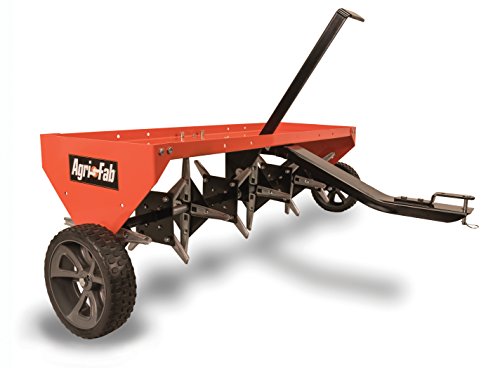
Agri-Fab 48 in Tow-Behind Plug Aerator
$319.98Thirty-two self-sharpening knives pull plugs up to 3 inches deep across 48 inches, with a 175 lb weight tray and flat-free tires.
Best for: core aerating an acre with a lawn tractor
Check price on Amazon
Brinly PA-42BH-A 42 in Tow-Behind Plug Aerator
$379.00Heat-treated spoons in three independently rotating sections pull 3 inch plugs while limiting turf tearing on turns.
Best for: aerating uneven yards with a rider or ZTR
Check price on Amazon
Brinly BS361BH-A Deluxe 175 lb Tow-Behind Broadcast Spreader
$439.00A 175 lb hopper with stainless hardware and directional spread control that spreads seed and starter fertilizer evenly on acreage.
Best for: lawns of 1 acre or more
Check price on Amazon
Scotts Turf Builder EdgeGuard DLX Broadcast Spreader
$94.97Pre-calibrated, holds up to 15,000 sq ft of product and has an edge shield that keeps seed and fertilizer off beds and driveways.
Best for: lawns up to about a third of an acre
Check price on AmazonHow we chose
We did not test these products in person. Picks are researched from manufacturer specifications and owner manuals, engine and safety certifications where they apply, warranty terms, public recall records, and the recurring themes in verified owner reviews. We favor established brands with large review counts and parts support, match each pick to a real yard size or task, and place it in the tier where its price and capability actually belong.
Frequently asked questions
Can I just throw grass seed on my existing lawn?
You can, but germination will be poor. Seed sitting on thatch or dry grass dries out, washes away or gets eaten by birds. For good results, mow low, core aerate or dethatch so seed reaches bare soil, spread at the correct rate, and keep the top half inch of soil moist for two to three weeks. Seed-to-soil contact and steady moisture are what make overseeding work.
How long after overseeding can I mow?
Wait until the new grass is about a third taller than your normal mowing height, which is usually three to five weeks after seeding for tall fescue and ryegrass and longer for Kentucky bluegrass. For a lawn normally kept at 3 inches, mow when new blades reach about 4 inches. Use a sharp blade, mow when the soil is dry and avoid sharp turns on seedlings.
Is it better to overseed in spring or fall?
Fall is better for cool-season grasses like tall fescue and Kentucky bluegrass. Late summer to early fall offers warm soil for germination, cooler air, fewer weeds and months of root growth before summer heat. Spring seeding works, but seedlings face heat and crabgrass competition, and spring crabgrass preventers stop grass seed. Warm-season grasses should be seeded in late spring to early summer.
How much seed do I need to overseed 5,000 square feet?
At common overseeding rates, 5,000 sq ft needs about 15 to 20 lb of tall fescue, 5 to 7.5 lb of Kentucky bluegrass or 15 to 20 lb of perennial ryegrass. Coated seed-and-fertilizer bags cover less ground per pound, so follow the label coverage when it is lower. The grass seed calculator converts any lawn size and grass type into pounds and bags.
Should I put straw over grass seed when overseeding?
It is rarely needed when overseeding an existing lawn, because the surrounding grass shades and protects the seed. Straw can also introduce weed seeds. For large bare patches, a very thin layer of peat moss or compost, or a seed product with built-in mulch like Scotts EZ Seed, keeps the surface moist. Never cover seed so heavily that sunlight cannot reach the soil.
Can I overseed and use weed killer at the same time?
Generally no. Most crabgrass preventers stop grass seed from rooting, and most broadleaf weed killer labels require waiting until new grass has been mowed several times. Mesotrione products such as Tenacity are an exception, with labels that allow application at seeding for certain cool-season grasses. Always follow the specific product label for waiting periods and grass types.
Researched, not professional advice. This page is compiled from published specifications, manuals, labels and owner-review consensus, not hands-on testing. Follow the manufacturer's instructions and product label, and consult a qualified professional where safety, chemicals, fuel or structures are involved. As an Amazon Associate we earn from qualifying purchases.