Weed Control
When to Apply Pre-Emergent: Soil Temperature, Regional Timing and Splits
Quick answer
Apply pre-emergent when soil 2 to 4 inches deep holds about 55 F for several days, before crabgrass germinates: late winter in the Deep South, early spring in the transition zone and mid to late spring in the North. Water in with about half an inch unless the label says otherwise, and skip it where you plan to seed.
A pre-emergent herbicide is a weed preventer that forms a thin chemical barrier in the top layer of soil and stops weed seeds from establishing as they germinate. It does not kill weeds that have already come up, and it does nothing to perennial weeds growing from roots or tubers. Its entire value depends on timing: too early and the barrier fades before the last flush of crabgrass; too late and the seedlings are already past it.
The reliable cue is soil temperature, not a date on the calendar. This guide explains the 55 F rule, how timing shifts by region, when to split applications, how to water in, which weeds a pre-emergent will not stop and how to avoid ruining a seeding. Crabgrass preventers are ranked in best crabgrass preventers, and granular products need your lawn size to buy the right bag count, so start with the lawn size calculator.
On this page
- What does a pre-emergent herbicide do?
- What soil temperature should I apply pre-emergent at?
- When should I apply pre-emergent in my region?
- Should I split my pre-emergent into two applications?
- Do I need to water in pre-emergent after applying it?
- What weeds does pre-emergent not control?
- Is it too late to apply pre-emergent?
- Can I overseed after applying pre-emergent?
- What types of pre-emergent herbicides are there?
- Which pre-emergent products should I buy?
- What equipment do I need to apply pre-emergent evenly?
What does a pre-emergent herbicide do?
Pre-emergent herbicides are absorbed by germinating seeds in the top inch or so of soil and stop root and shoot development, so the seedling dies before it ever breaks the surface. The barrier forms after the product is moved into the soil by rain or irrigation. Anything that disturbs that layer, such as core aerating, dethatching or tilling after application, can open gaps.
They are most useful against annual weeds that come back from seed every year: crabgrass, goosegrass, foxtail, prostrate spurge and, with fall applications, winter annuals like henbit, chickweed and Poa annua. The comparison with products that kill weeds already growing is on pre-emergent vs post-emergent.
What soil temperature should I apply pre-emergent at?
Apply before soil at a 2 to 4 inch depth holds about 55 F for several consecutive days, which is when crabgrass begins to germinate. Germination accelerates as soil warms further, so the aim is to have the barrier in place and watered in just ahead of that point. A week or two early is better than a week late.
- Measure it: push a soil thermometer into a sunny part of the lawn in the morning, when soil is coolest, on several days in a row.
- Use soil temperature data: many state extension services and university weather networks publish soil temperature readings and maps.
- Watch plant cues: many extension services use forsythia bloom as a rough natural signal; crabgrass germination typically follows the fading of forsythia flowers.
- Remember microclimates: south-facing slopes and soil along driveways and sidewalks warm first, so crabgrass often appears there before the rest of the lawn.
When should I apply pre-emergent in my region?
These seasonal windows are general guidance for spring crabgrass prevention. Years run early or late, so confirm with soil temperature. Fall applications for winter annual weeds apply mainly to warm-season lawns and to cool-season lawns that will not be overseeded.
| Region | Spring crabgrass window | Fall window (winter annuals, Poa annua) | Typical lawn grasses |
|---|---|---|---|
| Florida and Gulf Coast | Mid to late winter | Early fall, as soil cools below about 70 F | St. Augustinegrass, bahiagrass, centipedegrass |
| Deep South | Late winter | Early fall | Bermudagrass, zoysiagrass, centipedegrass |
| Transition zone (mid-South) | Late winter to early spring | Early fall, if not overseeding | Tall fescue, bermudagrass, zoysiagrass |
| Mid-Atlantic and lower Midwest | Early spring | Early fall, if not overseeding | Tall fescue, Kentucky bluegrass |
| Northern Midwest and New England | Mid to late spring | Rarely needed; fall is for seeding | Kentucky bluegrass, fine fescue, perennial ryegrass |
| Pacific Northwest | Early to mid spring | Early fall, if not overseeding | Perennial ryegrass, fine fescue |
| Mountain West and high elevations | Late spring | Rarely needed | Kentucky bluegrass, buffalograss |
| Desert Southwest | Late winter | Early fall, as soil cools | Bermudagrass |
Windows are general; check soil temperature and your product label. The lawn care calendar gives zone-specific timing.
Should I split my pre-emergent into two applications?
Splitting is a common professional practice when the label allows it. You apply part of the yearly rate at the normal spring timing and the rest roughly 6 to 8 weeks later, keeping the total within the label's maximum per year. The second application extends the barrier into summer, when late germinators such as goosegrass and prostrate spurge come up and when a single spring application may be fading, especially in the South with its long growing season.
Splits work best with sprayable concentrates, where you control the rate exactly: the Quali-Pro Prodiamine 65 WDG is a sprayable prodiamine sold for spring and fall pre-emergent programs. Granular bags make splits harder, because spreader settings for half rates are less precise. If you split, write down dates and amounts, because the label's yearly maximum still applies. For a sprayer, see best lawn sprayers.
Do I need to water in pre-emergent after applying it?
Almost always. Most pre-emergents must be moved into the top layer of soil by about half an inch of rain or irrigation to form the barrier, and many labels give a time window for that, often within a few days. Product left sitting on dry leaves and thatch for weeks can break down in sunlight or be lost. Follow your label, because directions differ: the Scotts Halts listing calls for application to a dry lawn, and some products say to water in promptly.
- A light, soaking rain in the forecast is ideal. A heavy downpour right after application is not; it can wash granules off slopes and hard surfaces into storm drains.
- Sweep granules off driveways, sidewalks and streets back onto the lawn before watering.
- Do not core aerate, dethatch or power rake after applying; do those jobs before, or in a season you are not using a pre-emergent.
- Keep people and pets off the treated area for the time the label states.
What weeds does pre-emergent not control?
Pre-emergents only stop seeds as they germinate, so they miss anything already growing and most weeds that spread from roots, rhizomes, stolons or tubers:
- Weeds that already emerged: visible crabgrass needs a post-emergent such as BASF Drive XLR8 (quinclorac) or Syngenta Tenacity (mesotrione). See crabgrass.
- Established perennial broadleaves: dandelion, white clover, creeping charlie, wild violet and broadleaf plantain come back from roots and need a broadleaf weed killer.
- Nutsedge: spreads from underground tubers; use a sedge product such as Sedgehammer Plus. See yellow nutsedge.
- Perennial grasses: quackgrass, dallisgrass and similar grasses are not stopped by crabgrass preventers.
- Weeds that germinate after the barrier fades or in spots that were missed, disturbed or washed out.
Pre-emergents do control many annual grassy weeds and several annual broadleaves when timed right, including goosegrass, foxtail, prostrate spurge and, in fall, henbit, chickweed and Poa annua. Check each product label's weed list.
Is it too late to apply pre-emergent?
If you can already see crabgrass seedlings across the lawn, a standard pre-emergent will not kill them, though it can still prevent later flushes over the rest of the season. Dithiopyr products are labeled with some early post-emergent activity on very young crabgrass, so they are the usual choice for a slightly late application; follow the label's growth stage limits. For established crabgrass, switch to a post-emergent labeled for your grass type, and plan to put the pre-emergent down earlier next year, based on soil temperature.
Can I overseed after applying pre-emergent?
Not for a while. Most pre-emergents stop grass seed just as they stop crabgrass seed, and labels set waiting periods between application and seeding that can run several months depending on product and rate. Choose one per season: if you plan to overseed a cool-season lawn in late summer to early fall, do not use a fall pre-emergent, and if you must seed in spring, skip the spring crabgrass preventer.
Mesotrione is the main exception. The Syngenta Tenacity label allows application at seeding for listed cool-season grasses, where it prevents many weeds without stopping the new grass. Read the grass list and rate directions carefully. Full seeding steps are in how to overseed a lawn.
What types of pre-emergent herbicides are there?
Most lawn pre-emergents use a handful of active ingredients, sold under many brand names. The table groups them as general classes. Residual length, rates and grass safety depend on the specific product and rate, so the label, not this table, is the authority. Only catalog products with listed active ingredients are named here.
| Active ingredient class | Common forms | Strengths | Watch-outs | Catalog example |
|---|---|---|---|---|
| Prodiamine | Sprayable granules, granular on fertilizer | Long residual, low water solubility, economical over large areas | No post-emergent activity; long wait before seeding | Quali-Pro Prodiamine 65 WDG |
| Dithiopyr | Liquid concentrate, granular on fertilizer | Some early post-emergent activity on very young crabgrass, per labels | Seeding conflict; follow growth stage limits | Sold under several brands |
| Pendimethalin | Granular, liquid | Widely available in consumer granular preventers | Seeding conflict; some formulations can stain hard surfaces, per labels | Sold under several brands |
| Mesotrione | Liquid concentrate | Pre and post-emergent activity; labeled for use at seeding on listed cool-season grasses | Temporary whitening of some grasses; not for all turf types | Syngenta Tenacity |
| Isoxaben | Granular, sprayable | Targets broadleaf weed seeds; often paired with a grass preventer | Does not control crabgrass alone | Sold under several brands |
Classes are general. Granular bags such as Scotts Halts and Lesco 0-0-7 with Stonewall list their active ingredients on the label; read it before buying and applying.
Which pre-emergent products should I buy?
Pick by lawn size and how you apply. Granular bags go on with any spreader; sprayables cost less per acre but need a sprayer and careful mixing. Always check that your grass type is on the label.

Scotts Halts Crabgrass and Grassy Weed Preventer, 20.12 lb
$49.02A granular pre-emergent with no fertilizer mixed in that prevents crabgrass, foxtail and spurge, covering 10,000 sq ft per bag.
Best for: spring crabgrass prevention with a spreader
Check price on Amazon
Lesco 0-0-7 with 0.43% Stonewall Pre-Emergent, 50 lb
$79.94A granular pre-emergent on a potassium carrier listed as preventing weeds for up to 4 months, 12,500 sq ft per bag, without extra nitrogen.
Best for: granular prevention on larger lawns
Check price on Amazon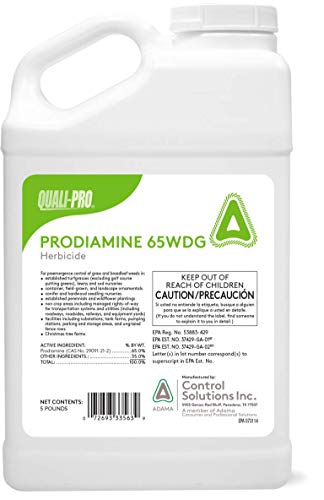
Quali-Pro Prodiamine 65 WDG Pre-Emergent Herbicide, 5 lb
$77.00A sprayable 65 percent prodiamine for spring and fall programs that tank-mixes with fertilizer and iron, where a 5 lb bottle lasts many seasons.
Best for: sprayer owners treating big lawns
Check price on Amazon
Syngenta Tenacity Turf Herbicide, 8 oz
$63.99Mesotrione with pre and post-emergent activity whose label allows use at seeding for listed cool-season grasses.
Best for: weed control while overseeding
Check price on AmazonWhat equipment do I need to apply pre-emergent evenly?
Uneven application leaves gaps where crabgrass breaks through. Match the tool to the product and lawn size, and see best lawn spreaders for more options.

Scotts Turf Builder EdgeGuard DLX Broadcast Spreader
$94.97A pre-calibrated push spreader that holds up to 15,000 sq ft of product, with an edge shield that keeps granules off driveways and out of storm drains.
Best for: lawns up to about a third of an acre
Check price on Amazon
My4Sons M4 Battery Powered Backpack Sprayer, 4.5 Gallon
$249.99A 12V battery backpack with a 20 to 80 psi pressure adjuster and a nozzle kit, so broadcast spraying stays consistent without hand pumping.
Best for: spraying a quarter to half acre
Check price on Amazon
Agri-Fab 15 Gallon Tow-Behind Lawn Sprayer with Boom
$389.66A 15 gallon tow sprayer with a 100 psi, 1.6 GPM pump, anti-drip boom tips and a hose and wand for spot work.
Best for: broadcast spraying 1 acre or more
Check price on AmazonHow we chose
We did not test these products in person. Picks are researched from manufacturer specifications and owner manuals, engine and safety certifications where they apply, warranty terms, public recall records, and the recurring themes in verified owner reviews. We favor established brands with large review counts and parts support, match each pick to a real yard size or task, and place it in the tier where its price and capability actually belong.
Frequently asked questions
What temperature should it be to put down crabgrass preventer?
Put down crabgrass preventer before soil 2 to 4 inches deep holds about 55 F for several days in a row, which is when crabgrass starts to germinate. Air temperature is less reliable, because soil lags behind warm spells. Measure with a soil thermometer in the morning, or check your state extension service soil temperature data, and water the product in as the label directs.
Can you apply pre-emergent too early?
Yes. Pre-emergents break down over time, so an application made weeks before crabgrass germinates may fade before the last flushes of weeds in early summer. That is one reason professionals split applications, putting part of the yearly rate down at the normal timing and the rest 6 to 8 weeks later. Keep the total within the label maximum for the year.
Does rain activate pre-emergent?
Yes. About half an inch of rain or irrigation moves most pre-emergents into the top layer of soil where they form the weed barrier, and many labels give a window of a few days to do it. A gentle soaking rain is ideal. A heavy storm soon after applying can wash granules off slopes and paved areas into storm drains, so avoid applying ahead of heavy rain.
Should I apply pre-emergent in the fall?
In warm-season lawns and in cool-season lawns you are not overseeding, a fall pre-emergent applied as soil cools prevents winter annual weeds such as Poa annua, henbit and chickweed. In the South this is often as important as the spring application. Skip it if you plan to overseed that fall, because most pre-emergents also stop grass seed from establishing.
How long after pre-emergent can I plant grass seed?
It depends on the product and rate, and labels set waiting periods that can run several months. Check the seeding interval printed on your specific label before buying seed. Mesotrione products such as Syngenta Tenacity are the exception, with labels that allow application at seeding for listed cool-season grasses. Plan fall seeding and spring pre-emergent as separate seasons.
Will pre-emergent kill existing weeds?
No. Pre-emergents stop seeds from establishing as they germinate, so weeds already visible, including crabgrass that has emerged, keep growing. Perennial weeds like dandelion, clover and nutsedge also come back from roots or tubers. Use a post-emergent product labeled for the weed and your grass type, such as quinclorac for young crabgrass or a sedge product for nutsedge.
Researched, not professional advice. This page is compiled from published specifications, manuals, labels and owner-review consensus, not hands-on testing. Follow the manufacturer's instructions and product label, and consult a qualified professional where safety, chemicals, fuel or structures are involved. As an Amazon Associate we earn from qualifying purchases.