Weed Control
Best Crabgrass Preventers and Pre-Emergents (2026)
Quick answer
The best crabgrass preventer for most lawns is a granular prodiamine such as Lesco 0-0-7 with Stonewall, spread when soil temperature holds near 55 F for several days in spring. Sprayer owners save with Quali-Pro Prodiamine 65 WDG. Seeding the same season? Use mesotrione (Tenacity) instead.
A pre-emergent herbicide forms a chemical barrier in the top layer of soil that kills weed seedlings as they germinate. It does nothing to crabgrass that has already emerged, and it stops most grass seed too. So timing is the whole game: the barrier must be down before crabgrass germinates, which begins when the top 2 to 4 inches of soil stay around 55 F for several days in a row.
Our top pick for spreader owners is Lesco 0-0-7 with 0.43% Stonewall ($79.94), a granular listed for up to 4 months of protection at 12,500 sq ft per bag, with potassium instead of spring nitrogen. Stonewall is Lesco's prodiamine brand; confirm the active ingredient on the bag. Owners of a tank or tow sprayer can treat far more area per dollar with Quali-Pro Prodiamine 65 WDG. The when to apply pre-emergent guide covers soil thermometers and split applications in depth.
On this page
- When should I put down crabgrass preventer?
- Prodiamine vs dithiopyr vs Halts: which pre-emergent is best?
- Beginner pick: a no-fertilizer granular you can spread in spring or fall
- Intermediate picks: pro granular prodiamine and a crabgrass rescue
- Expert picks: sprayable prodiamine and mesotrione for seeding years
- How do the crabgrass preventer picks compare?
- Can I overseed after applying crabgrass preventer?
- How do I apply granular pre-emergent step by step?
- What spreader do I need for crabgrass preventer?
When should I put down crabgrass preventer?
Apply crabgrass preventer when soil at 2 to 4 inches deep has held about 55 F for several consecutive days, and before crabgrass seedlings appear. Crabgrass germination accelerates as soil warms past that point. Many extension services point to a plant cue that tracks the same soil warmth: apply around the time forsythia is in full bloom, before its petals drop. A cheap soil thermometer or your state extension soil temperature map removes the guesswork.
Too early, and the barrier breaks down before the late germination flush; too late, and seedlings are already up. If you are late, a product with early post-emergent activity (dithiopyr) or a post-emergent like quinclorac becomes the fallback. Many labels also allow a split application: half the yearly rate in early spring and the rest about six to eight weeks later, which extends protection into summer.
| Region | Typical window | Soil and plant cue | Fall pre-emergent? |
|---|---|---|---|
| Florida and Gulf Coast | Late winter | Soil nearing 55 F; earliest in the country | Yes, for Poa annua in warm-season lawns |
| Deep South and Southeast | Late winter to early spring | Redbud or forsythia bloom | Yes, as soil cools below about 70 F |
| Transition zone | Early spring | Forsythia full bloom | Only if you are not overseeding |
| Mid-Atlantic and lower Midwest | Early to mid spring | Forsythia bloom, before petal drop | Rarely; fall is seeding season |
| Northeast and upper Midwest | Mid spring | Soil at 55 F several days running | No, overseed in fall instead |
| Northern Plains and northern New England | Mid to late spring | Soil at 55 F; lilac leaf-out | No |
Windows shift with each year's weather. Trust soil temperature over the calendar. See the lawn care calendar pages for your USDA zone.
Prodiamine vs dithiopyr vs Halts: which pre-emergent is best?
Prodiamine (Barricade and generics like Quali-Pro, and Lesco Stonewall) is the value and longevity leader. It binds tightly in soil, lasts a long time, and is cheap per acre, but it has no effect on crabgrass that has already emerged. Dithiopyr (sold as Dimension 2EW and in some granular crabgrass preventers) is the forgiving choice: in addition to pre-emergent control, its label covers very young crabgrass seedlings, so a slightly late application still works. Scotts Halts is a consumer granular without fertilizer; Scotts lists spring control of crabgrass, foxtail and spurge, and fall control of Poa annua, henbit and chickweed. Its active ingredient is printed on the bag.
Mesotrione (Tenacity) is in a different category: its label allows use at seeding on listed cool-season grasses, and it also kills some emerged weeds. Quinclorac (Drive XLR8) is a post-emergent rescue for crabgrass you missed.
| Active or product | Pre-emergent | Kills emerged crabgrass | Safe at seeding | Best for |
|---|---|---|---|---|
| Prodiamine (Quali-Pro 65 WDG, Lesco Stonewall) | Yes, long residual | No | No, long reseeding wait | On-time applications, lowest cost per acre |
| Dithiopyr (Dimension) | Yes | Very young seedlings per label | No | Late or uncertain timing |
| Scotts Halts | Yes | No | No | Simple granular, spring or fall |
| Mesotrione (Tenacity) | Yes | Young weeds per label | Yes, on listed cool-season grasses | Seeding and crabgrass in the same season |
| Quinclorac (Drive XLR8) | Short residual, up to 30 days | Yes | Check label | Rescue after the pre-emergent window |
Beginner pick: a no-fertilizer granular you can spread in spring or fall
A bag, a spreader and the setting on the label. Nothing to mix.

Scotts Halts Crabgrass and Grassy Weed Preventer, 20.12 lb
$49.02A granular pre-emergent applied to a dry lawn in early spring or in fall, labeled for all grass types except dichondra and bentgrass, covering 10,000 sq ft per 20.12 lb bag. Scotts says rain, snow or freezing weather after application will not affect performance.
Best for: first-time crabgrass prevention
Check price on AmazonIntermediate picks: pro granular prodiamine and a crabgrass rescue
For owners who spread every year and want a plan B for the corner that always breaks through.

Lesco 0-0-7 with 0.43% Stonewall Pre-Emergent, 50 lb
$79.94A 50 lb bag covering 12,500 sq ft, listed for up to 4 months of protection in turf and landscape beds, on a 0-0-7 potassium carrier. At its label coverage that is 4 lb of product per 1,000 sq ft, which spreads evenly through most push and tow spreaders. The seller marks it non-returnable.
Best for: granular pre-emergent without extra nitrogen
Check price on Amazon
BASF Drive XLR8 Crabgrass Killer Concentrate, 64 oz
$55.45Quinclorac that kills emerged crabgrass and foxtail on warm and cool-season turf, rainfast in under an hour, with up to 30 days of residual. Keep it for the escapes along driveways and sidewalks where heat speeds germination.
Best for: crabgrass that already came up
Check price on AmazonExpert picks: sprayable prodiamine and mesotrione for seeding years
Concentrates for sprayer owners who calibrate, keep records, and plan seeding around herbicide intervals.
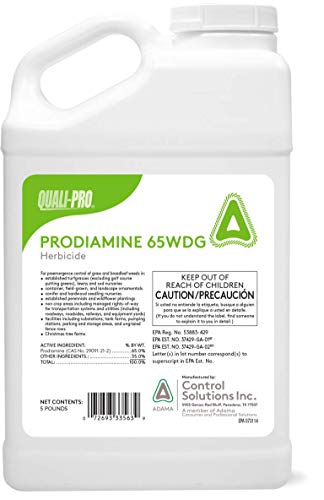
Quali-Pro Prodiamine 65 WDG Pre-Emergent Herbicide, 5 lb
$77.00A generic of Barricade: 65 percent prodiamine as a water-dispersible granular for spring and fall pre-emergent control of crabgrass, Poa annua, henbit, chickweed, spurge, foxtail and goosegrass. It tank-mixes with liquid fertilizer and iron, and a 5 lb bottle treats many seasons of a typical lawn at label rates.
Best for: sprayer owners treating large areas
Check price on Amazon
Syngenta Tenacity Turf Herbicide, 8 oz
$63.99Mesotrione with pre and post-emergent activity on listed weeds including crabgrass, goosegrass, clover, dandelion and yellow nutsedge. Its label permits application at seeding on listed cool-season species, so it is the pre-emergent to use in a spring seeding year. Treated weeds and sometimes turf bleach white temporarily.
Best for: spring seeding plus crabgrass control
Check price on AmazonWho should not buy this tier: Skip sprayable concentrates if you do not own a calibrated sprayer, cannot weigh small amounts of product accurately, or plan to overseed with anything other than a mesotrione program. Prodiamine's long residual that makes it great value also means a long wait before reseeding. Skip Tenacity on warm-season lawns unless your grass is on its label, since some warm-season turf is injured.
How do the crabgrass preventer picks compare?
| Model | Price | Type | Active ingredient | Bag size | Size | Coverage |
|---|---|---|---|---|---|---|
| Lesco 0-0-7 with 0.43% Stonewall Pre-Emergent, 50 lb | $79.94 | pre emergent | - | 50 lb | - | 12,500 sq ft |
| Quali-Pro Prodiamine 65 WDG Pre-Emergent Herbicide, 5 lb | $77.00 | pre emergent | prodiamine 65% | 5 lb | - | - |
| Scotts Halts Crabgrass and Grassy Weed Preventer, 20.12 lb | $49.02 | pre emergent | - | 20.12 lb | - | 10,000 sq ft |
| Syngenta Tenacity Turf Herbicide, 8 oz | $63.99 | crabgrass | mesotrione 40% | - | 8 oz | - |
| BASF Drive XLR8 Crabgrass Killer Concentrate, 64 oz | $55.45 | crabgrass | quinclorac | - | 64 oz | - |
Can I overseed after applying crabgrass preventer?
Usually not for months. Pre-emergents do not know the difference between crabgrass seed and grass seed, so a barrier that stops crabgrass also stops tall fescue and bluegrass from establishing. Product labels list a reseeding interval, and for long-residual actives like prodiamine it can extend through most of a season. The practical rule for cool-season lawns: choose spring for pre-emergent and fall for overseeding, and do not try to do both in the same spot in the same season.
The exception is mesotrione. Tenacity's label allows application at seeding on listed cool-season grasses, and some consumer starter products combine mesotrione with fertilizer for the same reason. If you must seed in spring, use that route and follow the overseeding guide. For seeding rates, see the best grass seed page.
How do I apply granular pre-emergent step by step?
- Check soil temperature. Confirm soil at 2 to 4 inches has held about 55 F for several days, and no crabgrass seedlings are visible.
- Measure and buy enough. Measure the lawn and buy enough bags at the label coverage; stretching a bag thins the barrier.
- Set the spreader to the label. Use the setting printed on the bag or calibrate on a measured 1,000 sq ft area, and close the gate at turns.
- Spread edges first. Crabgrass starts along hot driveway and sidewalk edges, so make a header strip around the perimeter, then fill in.
- Clean up and activate. Sweep granules off pavement back onto the turf, then water in or wait for rain as the label directs.
- Leave the barrier alone. Avoid core aerating or dethatching after application, which breaks the treated soil layer.
What spreader do I need for crabgrass preventer?
Pre-emergent only works where it lands, so gaps become crabgrass stripes. A broadcast spreader with an edge shield is the right tool for most lawns. On lots of half an acre or more, a tow-behind like the Agri-Fab 130 lb or Brinly BS361BH-A spreads a 50 lb bag in one fill and makes even overlap easy. For sprayable prodiamine, a tow sprayer such as the Agri-Fab 15 gallon gives a consistent rate across an acre. Compare options on best lawn spreaders.
How we chose
We did not test these products in person. Picks are researched from manufacturer specifications and owner manuals, engine and safety certifications where they apply, warranty terms, public recall records, and the recurring themes in verified owner reviews. We favor established brands with large review counts and parts support, match each pick to a real yard size or task, and place it in the tier where its price and capability actually belong.
Frequently asked questions
When should I apply crabgrass preventer?
Apply it when soil 2 to 4 inches deep has stayed around 55 F for several days in a row, before crabgrass seedlings appear. In much of the country that coincides with forsythia in full bloom. The window is late winter along the Gulf Coast, early spring in the transition zone and mid to late spring in the North. Soil temperature is a better guide than a calendar date.
Is prodiamine or dithiopyr better for crabgrass?
Prodiamine is usually better value and lasts longer, but it only works if applied before crabgrass germinates. Dithiopyr costs more and has somewhat shorter residual, yet its label also covers very young crabgrass seedlings, which makes it more forgiving if you apply a little late. Many lawn care pros use prodiamine for on-time spring applications and dithiopyr when timing is uncertain.
Can I seed grass after putting down crabgrass preventer?
Most crabgrass preventers stop grass seed from germinating, and their labels list a reseeding interval that can last months. Plan to apply pre-emergent in spring and overseed in fall instead. The main exception is mesotrione, sold as Tenacity, whose label allows use at seeding on listed cool-season grasses. Check the exact label of the product you used before you seed.
Does Scotts Halts work?
Scotts Halts is a granular pre-emergent that, applied on time at the label rate, prevents crabgrass, foxtail and spurge in spring and Poa annua, henbit and chickweed in fall. A 20.12 lb bag covers 10,000 sq ft, and Scotts says rain or snow after application does not affect it. Like any pre-emergent, it will not kill crabgrass that has already come up.
What do I do if crabgrass is already up?
Switch to a post-emergent. Quinclorac, as in BASF Drive XLR8, is labeled to kill emerged crabgrass and foxtail on warm and cool-season turf, and mesotrione products also control young crabgrass. Treat while plants are small and actively growing, within the label temperature limits. Then plan a pre-emergent on time next spring and thicken the lawn so crabgrass has less bare soil.
Should I water in crabgrass preventer?
Follow the product label. Many granular pre-emergents need rainfall or irrigation after application to move the active ingredient off the granules and into the top layer of soil, and labels often specify a window for that watering. Water lightly enough that it soaks in without running off onto pavement. After activation, avoid aerating or dethatching, which disturbs the herbicide barrier.
Researched, not professional advice. This page is compiled from published specifications, manuals, labels and owner-review consensus, not hands-on testing. Follow the manufacturer's instructions and product label, and consult a qualified professional where safety, chemicals, fuel or structures are involved. As an Amazon Associate we earn from qualifying purchases.