Weed Control
Broadleaf Plantain: Identification and Lawn Control
Quick answer
Broadleaf plantain is a perennial rosette weed of compacted, walked-on soil. A three-way broadleaf herbicide applied in fall kills it readily, but it returns unless you core aerate and thicken the turf, because compaction is what let it in. Hand pulling works when soil is wet.
Plantain is one of the easier perennial broadleaf weeds to kill and one of the easiest to get back, because it is really a symptom. It colonizes the paths people and dogs walk, the strip beside the driveway, and any ground packed hard enough that turf roots struggle. Kill it without changing the soil and a new rosette occupies the same spot next year.
Two species show up in lawns. Broadleaf plantain has wide oval leaves, and buckhorn plantain has narrow lance-shaped ones. Both respond to the same treatment. Measure the area you are treating with the lawn size calculator, since herbicide coverage and aerator passes are both quoted per 1,000 square feet.
On this page
How do I identify broadleaf plantain?
| Trait | Broadleaf plantain |
|---|---|
| Weed type | Broadleaf |
| Life cycle | Perennial; the crown survives winter and regrows |
| Season | Cool season growth in spring and fall, persisting through summer |
| How it spreads | Seed, produced in large quantities, plus regrowth from the crown |
| Leaf | Broad oval leaves with 5 to 9 prominent parallel veins running end to end, in a flat ground-hugging rosette |
| Leaf stalk | Thick and channeled, staying tough when you pull, with fibrous strings inside |
| Seedhead | Narrow rat-tail spike standing above the rosette, densely packed with tiny seeds |
| Roots | Short, thick taproot with a dense fibrous mass, anchoring well in packed soil |
| What it says about the lawn | Compaction, foot traffic, and sometimes soil that stays wet |
Buckhorn plantain has narrow lance-shaped leaves and a short cone-like seedhead. Control is the same for both.
Why do I have plantain in my lawn?
Because something is packing the soil. Plantain tolerates compaction that turf roots cannot handle, so it lines up along walking routes, gates, play areas and parking strips. Its flat rosette also survives mowing at any height, and its parallel-veined leaves shed the light mowing damage that would set other weeds back.
Wet soil adds to it. Ground that stays saturated compacts more easily under traffic and holds less oxygen for grass roots, which hands plantain another advantage. Core aeration is the direct answer, and it pairs naturally with fall overseeding. See how to aerate a lawn and core vs spike aerators, since spiking presses soil aside rather than removing it and does much less for compaction.
What kills plantain without killing grass?
Plantain is susceptible to ordinary broadleaf chemistry, which makes it one of the more satisfying weeds to treat. The work is in keeping it gone.
| Method | When | What it involves |
|---|---|---|
| Core aerate | Spring or early fall, moist soil | The root cause fix. Pull plugs, then overseed so turf fills the opened ground. |
| Overseed and feed | Late summer to early fall | Dense turf shades the rosette. Thin, hungry turf lets it straight back in. |
| Hand pulling or digging | After rain, while soil is soft | Get the crown and the short taproot. Practical for scattered plants, since plantain regrows from the crown but not readily from root pieces. |
| Three-way broadleaf herbicide | Fall is best, spring works | Products with 2,4-D, dicamba and mecoprop control plantain well on a single application in most cases. |
| Weed and feed | Fall, on a wet lawn so granules stick | One pass for feeding plus broadleaf control. Check the turf list, which is narrower than for liquids. |
| Reroute traffic | Ongoing | A stepping stone path or a gate route change removes the compaction that keeps recreating the problem. |
Treat in fall where you can. Perennials move herbicide to the roots along with sugars they are storing for winter.
Which products handle plantain?
Standard broadleaf concentrates do the job. Ortho WeedClear Weed Killer for Lawns Concentrate, 1 gal lists over 250 broadleaf weeds and treats up to 64,000 sq ft, though its label excludes Floratam St. Augustine. Spectracide Large Plot Weed Stop for Lawns Concentrate, 1 gal covers 32,000 sq ft of northern turf and is rainproof after 6 hours. For a combined fall feeding and weed pass on northern lawns, Scotts Turf Builder Weed and Feed5, 33.95 lb controls 50 listed broadleaf weeds, but its label excludes St. Augustine and several other grasses, so southern lawns must check first.
On the cultural side, Agri-Fab 48 in Tow-Behind Plug Aerator pulls plugs up to 3 inches deep behind a lawn tractor with a 175 lb weight tray, and The Andersons NutraSoft OP Pelletized Gypsum, 40 lb is an OMRI-listed, pH-neutral gypsum the maker says loosens hard clay across 6,600 sq ft. Gypsum is not a substitute for aeration, but it is a reasonable companion on clay.
What gear helps with plantain?
An aerator sized to your lawn, a spreader for the fall feeding, and a sprayer for the plants that are already there. More options are in the best lawn aerators.

Yard Butler ID-6C Manual Lawn Coring Aerator
$48.95A long-handled step aerator pulling two cores per push, ideal for the compacted walking paths where plantain concentrates.
Best for: spot-aerating traffic lanes
Check price on Amazon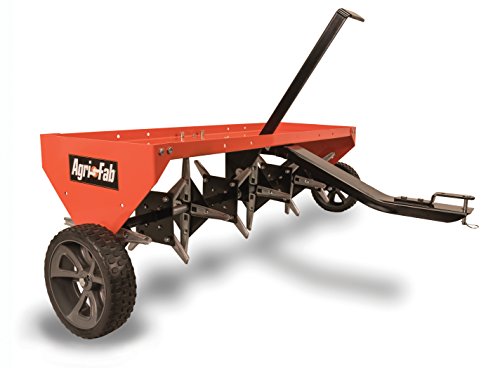
Agri-Fab 48 in Tow-Behind Plug Aerator
$319.98Thirty-two galvanized self-sharpening knives pulling plugs up to 3 inches deep, with a 175 lb weight tray and flat-free tires.
Best for: core-aerating an acre with a lawn tractor
Check price on Amazon
Chapin 16200 2-Gallon Pump Sprayer
$26.44A 2 gallon pump sprayer with an adjustable cone nozzle and in-tank filter, enough for scattered rosettes without mixing a backpack.
Best for: treating individual plants
Check price on Amazon
Scotts Turf Builder EdgeGuard DLX Broadcast Spreader
$94.97A pre-calibrated broadcast spreader holding up to 15,000 sq ft of product with an edge shield to keep granules off pavement.
Best for: feeding and overseeding after aeration
Check price on AmazonHow we chose
We did not test these products in person. Picks are researched from manufacturer specifications and owner manuals, engine and safety certifications where they apply, warranty terms, public recall records, and the recurring themes in verified owner reviews. We favor established brands with large review counts and parts support, match each pick to a real yard size or task, and place it in the tier where its price and capability actually belong.
Frequently asked questions
Does plantain mean my soil is compacted?
Usually yes. Broadleaf plantain tolerates packed soil far better than turf does, so it concentrates along walking routes, gates, play areas and driveway edges. Heavy plantain pressure in one strip and none elsewhere is a reliable compaction map of your yard. Core aeration relieves it, and rerouting the traffic with stepping stones or a path stops the problem from rebuilding each season.
Is broadleaf plantain hard to kill?
No, it is one of the more susceptible perennial broadleaf weeds. A three-way product containing 2,4-D, dicamba and mecoprop usually controls it in a single fall application, and hand pulling works when the soil is wet enough to lift the crown and short taproot. The difficulty is not killing it but keeping it out, since compacted soil simply grows a replacement.
What is the difference between broadleaf and buckhorn plantain?
Leaf shape is the giveaway. Broadleaf plantain has wide oval leaves with prominent parallel veins and a long rat-tail seed spike. Buckhorn plantain has narrow, lance-shaped leaves and a short cone-shaped seedhead on a tall ridged stalk. Both are perennials of compacted ground, both hold a flat rosette under the mower, and both respond to the same herbicides and the same aeration fix.
Researched, not professional advice. This page is compiled from published specifications, manuals, labels and owner-review consensus, not hands-on testing. Follow the manufacturer's instructions and product label, and consult a qualified professional where safety, chemicals, fuel or structures are involved. As an Amazon Associate we earn from qualifying purchases.