Snow Removal
What Size Snow Blower for a 1 Car Driveway in Heavy Snow?
Quick answer
A 1-car driveway of about 12 by 30 feet in heavy snow needs a 24 to 28-inch two-stage snow blower. A 24-inch machine clears it in 8 passes and about 5 minutes, and a 28-inch saves only one pass at the same 5 minutes, so buy a 24-inch with a 20 to 21-inch intake, such as the Husqvarna ST124.
Heavy snow changes the job from sweeping to lifting. A foot of wet snow on a single-car driveway can weigh more than three tons, which is why the recommendation jumps straight to a two-stage machine even though the driveway is small. Width, on the other hand, barely matters: 12 feet divided by a 24-inch or a 28-inch path is 8 passes or 7.
Our top pick is the Husqvarna ST124 24 in. Two-Stage Gas Snow Blower at $999.00: a 21-inch intake, all-steel chute and a 3-year bumper-to-bumper warranty. For a battery machine, the EGO SNT2405 kit ($1,649.00) has the same 24-inch path and a 20-inch intake. Compare sizes in the snow blower size chart.
On this page
- How long does a 1 car driveway take in heavy snow?
- What size snow blower for a 1 car driveway with heavy snow?
- How heavy is the snow on a 1 car driveway?
- Is a 24 inch or 28 inch snow blower better for a narrow driveway in heavy snow?
- Do heated grips and headlights matter in heavy snow?
- Which snow blowers fit a 1 car driveway in heavy snow?
How long does a 1 car driveway take in heavy snow?
| Clearing width | Passes | Time | Fit |
|---|---|---|---|
| 12 in | 15 | 10 min | Slow or underpowered |
| 18 in | 10 | 7 min | Slow or underpowered |
| 21 in | 9 | 6 min | Slow or underpowered |
| 24 in | 8 | 5 min | Recommended |
| 28 in | 7 | 5 min | Recommended |
| 32 in | 6 | 4 min | More than needed |
About 360 square feet. Recommended: 24 to 28 inch two-stage. Times assume a 15 percent overlap, walking speeds of 150, 120 and 85 feet per minute in light, moderate and heavy snow, and 20 seconds per turn.
What size snow blower for a 1 car driveway with heavy snow?
A 24 to 28-inch two-stage, and on a 12-foot-wide driveway the 24-inch end of that range is the smart buy. The 24-inch machine makes 8 passes and the 28-inch makes 7, and both finish in about 5 minutes at a heavy-snow walking pace. A 21-inch machine would need 9 passes and about 6 minutes, so even the narrowest option is not slow. What you are really paying for in heavy snow is intake height, engine output and a housing that will not clog.
The smaller two-stage frame is also easier to turn at the end of each pass and to store in a one-car garage next to a car. The single-stage vs two-stage comparison explains why a single-stage machine is the wrong tool for deep storms, even on a short driveway.
How heavy is the snow on a 1 car driveway?
Fresh snow weighs roughly 5 to 20 pounds per cubic foot depending on how much water it holds: cold, powdery snow sits at the low end and wet, heavy snow near the high end. Multiply by depth and area and the numbers explain why heavy-snow regions need a two-stage machine and why shoveling a single-car driveway can be dangerous.
| Snow depth | Volume | Dry, fluffy snow (about 5 lb per cu ft) | Wet, heavy snow (about 20 lb per cu ft) |
|---|---|---|---|
| 6 in | 180 cu ft | 900 lb | 3,600 lb |
| 12 in | 360 cu ft | 1,800 lb | 7,200 lb |
| 18 in | 540 cu ft | 2,700 lb | 10,800 lb |
| 24 in | 720 cu ft | 3,600 lb | 14,400 lb |
Volume is area times depth. Wind-packed and plowed snow can weigh more per cubic foot than fresh snow.
Is a 24 inch or 28 inch snow blower better for a narrow driveway in heavy snow?
On a narrow driveway a 24-inch two-stage with a strong engine and a tall intake beats a wider, pricier machine. These are the 24-inch two-stage machines in our catalog, with the specs that matter in deep snow. Rated capacity is a manufacturer claim with no shared test method, so compare it loosely.
| Model | Engine or power | Intake | Throw | Rated capacity | Comfort features | Price |
|---|---|---|---|---|---|---|
| Husqvarna ST124 | 212cc | 21 in | Not published | Not published | All-steel chute, 13 in tires | $999.00 |
| PowerSmart 24 212cc | 212cc OHV | 21 in | 45 ft | 2,500 lb/min | Electric start | $899.99 |
| Yard Force YF24 | B&S CR950 208cc | 21 in | 40 ft | Not published | Electric start, LED headlight | $1,099.00 |
| PowerSmart 24 B&S 208cc | B&S 208cc | Not published | Not published | Not published | Handle warmers, LED lights | $699.99 |
| WEN SB209E | 209cc | 20 in | 30 ft | Over 2,000 lb/min | Electric start | $493.77 |
| EGO SNT2405 | 56V, two 7.5Ah | 20 in | 50 ft | Not published | Headlight, self-propelled with reverse | $1,649.00 |
Specs from manufacturer listings. "Not published" means the listing does not state it, not that the feature is missing.
Do heated grips and headlights matter in heavy snow?
More than they do in light snow, because heavy storms are the ones you clear in the dark, often twice. Clearing midway through a long storm, before work and again after dark, keeps each pass inside the intake height and stops the snow from settling into a heavier, wetter layer. Handle warmers on the PowerSmart 24 B&S 208cc and the LED headlight on the Yard Force YF24 make that second session much easier.
When the snow is deeper than the intake, take half-width passes: overlap the previous path by half the housing so the auger never faces a full wall. On a 12-foot driveway that roughly doubles the passes to about 15, the same as the 12-inch row in the clearing-time table above, and adds about 5 minutes. For the next size up, see best two-stage snow blowers.
Which snow blowers fit a 1 car driveway in heavy snow?
Every pick here is a 24-inch two-stage with the intake height for deep storms. None of them needs to be wider on a 12-foot driveway.

Husqvarna ST124 24 in. Two-Stage Gas Snow Blower
$999.00A 212cc ribbon-auger two-stage with a 21-inch intake, all-steel chute and 13-inch snow tires, covered by a 3-year bumper-to-bumper and 5-year engine warranty.
Best for: two-car driveways where warranty coverage matters as much as power
Check price on Amazon
EGO Power+ SNT2405 24 in. Self-Propelled Two-Stage Snow Blower Kit
$1,649.00A complete 24-inch two-stage kit with two 7.5Ah batteries: 20-inch intake, 50-foot throw, variable-speed self-propel with reverse, and a maker-rated 18-car driveway per charge.
Best for: mid-sized driveways that get deep, wet snow and end-of-driveway plow piles
Check price on Amazon
PowerSmart 24 in. Two-Stage Gas Snow Blower with 212cc Engine
$899.99A 212cc OHV engine with electric and recoil start, rated at 2,500 pounds per minute, with 6 forward and 2 reverse speeds, a 180° chute and snow up to 12 inches deep.
Best for: standard two-car driveways that need two-stage throw distance
Check price on Amazon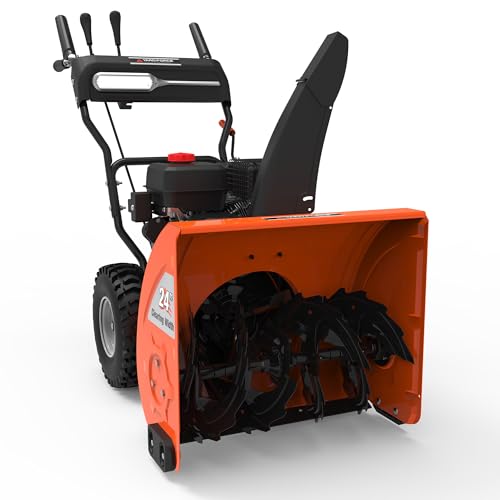
Yard Force YF24-DS21-GSB2 24 in. Two-Stage Gas Snow Blower
$1,099.00A Briggs & Stratton CR950 208cc with electric and manual start, a 12.5-inch steel auger, 21-inch intake, 40-foot throw and 6 forward and 2 reverse speeds.
Best for: buyers who want a Briggs & Stratton engine in a 24-inch frame
Check price on Amazon
PowerSmart 24 in. Two-Stage Gas Snow Blower with Briggs & Stratton 208cc
$699.99The lowest-priced Briggs & Stratton two-stage in this list, with electric start, handle warmers, LED lights and 13-inch snow tires on a 24-inch self-propelled frame.
Best for: first two-stage buyers moving up from a shovel or single-stage
Check price on Amazon
WEN SB209E 24 in. Two-Stage Gas Snow Blower
$493.77The budget two-stage: a 209cc engine moving over 2,000 pounds per minute through a 24 by 20-inch opening, with push-button start, 6 forward and 2 reverse speeds and a 2-year warranty.
Best for: tight budgets with a gravel or paved driveway that outgrew single-stage
Check price on AmazonHow we chose
We did not test these products in person. Picks are researched from manufacturer specifications and owner manuals, engine and safety certifications where they apply, warranty terms, public recall records, and the recurring themes in verified owner reviews. We favor established brands with large review counts and parts support, match each pick to a real yard size or task, and place it in the tier where its price and capability actually belong.
Frequently asked questions
How much does a foot of snow on a driveway weigh?
On a 12 by 30-foot single-car driveway, a foot of snow is 360 cubic feet. Fresh snow weighs roughly 5 to 20 pounds per cubic foot depending on moisture, so that foot of snow weighs about 1,800 pounds when it is dry and fluffy and up to about 7,200 pounds when it is wet. That is why heavy-snow regions need a two-stage machine rather than a shovel.
Is a 24 inch two-stage snow blower enough for heavy snow?
Yes, on a single-car driveway. A 24-inch two-stage makes 8 passes on a 12-foot-wide driveway and finishes in about 5 minutes, only one pass more than a 28-inch machine. Look for a 20 to 21-inch intake, electric start and a steel chute. The cases where a 24-inch struggles are drifts taller than the intake, which drift cutters or half-width passes solve.
Should I clear heavy snow during the storm or after?
During, if the storm will leave more snow than your machine's intake height. Clearing at the halfway point keeps each pass inside the housing, avoids a compacted bottom layer and spreads the physical work over two shorter sessions. On a single-car driveway each session takes about 5 minutes with a 24-inch two-stage. Wait for the street plow's last pass before clearing the end of the driveway.
What size engine does a snow blower need for heavy snow?
For a 24-inch two-stage, the 208 to 212cc engines in this class are the norm and are enough for a single-car driveway. Examples are the Husqvarna ST124 at 212cc, the Yard Force YF24 with a Briggs and Stratton 208cc, and the WEN SB209E at 209cc. Wider 28-inch machines use larger engines such as Honda's GX270, which matter on long driveways more than short ones.
Researched, not professional advice. This page is compiled from published specifications, manuals, labels and owner-review consensus, not hands-on testing. Follow the manufacturer's instructions and product label, and consult a qualified professional where safety, chemicals, fuel or structures are involved. As an Amazon Associate we earn from qualifying purchases.