Landscaping
Retaining Wall Block Calculator: Blocks, Caps and Gravel
Quick answer
Divide wall length by block length for blocks per course, and wall height plus one buried course by block height for the number of courses, then add 5 percent. A 20 foot long, 2 foot tall wall of 16 by 6 inch blocks needs 5 courses, about 79 blocks, 15 caps, 0.74 cubic yards of base gravel and 1.85 cubic yards of drainage stone.
Segmental block retaining walls are built from interlocking units stacked on a compacted gravel base, with drainage stone behind them so water pressure never builds up. Enter your wall length, exposed height and block size, and the calculator counts blocks including a buried first course and waste, plus cap stones, base gravel and drainage aggregate. Wall blocks are sold by local masonry and landscape suppliers and home centers, so treat block counts as your shopping list and confirm unit dimensions with the product you choose.
Retaining wall block calculator
Blocks needed
Tools for the base, drainage and hauling
Top matches update when you calculate.

Bully Tools Steel Hand Tamper
$71.99A made-in-USA all-steel tamper with a 3/8 in. thick plate and 49 in. handle for compacting gravel base under pavers.
Best for: compacting paver base and post-hole backfill
Check price on Amazon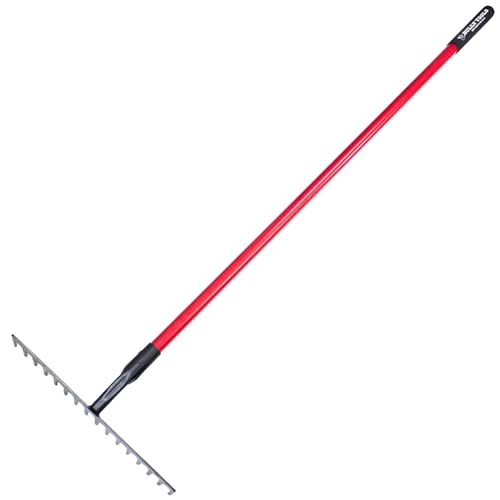
Bully Tools 7-Gauge 16-Tine Stone Rake
$69.29A made-in-USA 7-gauge steel head, thicker than standard 10-gauge rakes, on a 66 in. fiberglass handle for spreading gravel and stone.
Best for: leveling gravel pads and paver base
Check price on Amazon
DeWitt Pro-5 Weed Barrier Fabric (6 x 250 ft.)
$156.99A 5 oz commercial woven fabric that passes air and water, resists tears during install and has alignment stripes every 12 in.
Best for: large beds and gravel paths that need long-term weed control
Check price on Amazon
Jackson MP1010 10 cu ft Poly 2-Wheel Wheelbarrow
$689.94A contractor-size 10 cu ft poly tray on an all-steel undercarriage with two 16 inch pneumatic wheels, stable enough for big loads of mulch or leaves.
Best for: heavy, frequent loads
Check price on Amazon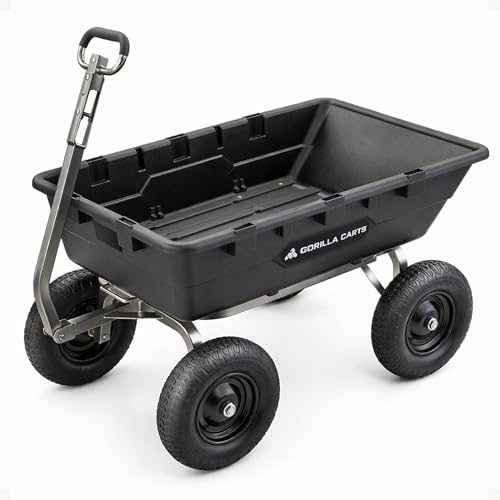
Gorilla Carts Poly Dump Cart, 1,500 lb, 10 cu ft
$389.99A 10 cu ft, 1,500 lb poly cart whose handle converts to a hitch for a lawn tractor or ATV, with 16 inch pneumatic tires and quick-release dump.
Best for: hand-pull or tow hauling on mid-size properties
Check price on Amazon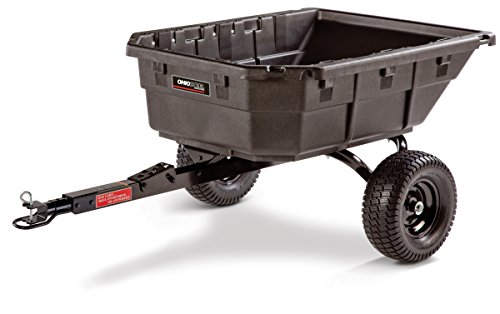
Ohio Steel 4048P-HYB 15 cu ft Poly Swivel Hybrid Dump Cart
$558.13A 15 cu ft structural-foam bed rated to 1,250 lb with a foot-pedal swivel dump across 100 degrees, rotating hitch and 16 inch commercial tires.
Best for: heavy hauling on acreage
Check price on Amazon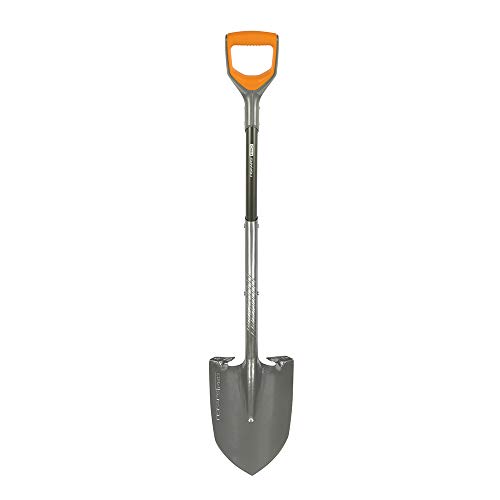
Fiskars 44 in. Pro Digging Shovel
$54.99A heavy-gauge steel blade with a sharpened edge, aluminum D-handle and teardrop shaft, covered by a lifetime warranty.
Best for: digging planting holes in hard or rocky soil
Check price on Amazon
Radius Garden Pro-Lite Carbon Steel Spade
$44.99A nursery-style carbon steel spade on a fiberglass shaft with an offset forward step for leverage, designed to reduce wrist and hand strain.
Best for: transplanting shrubs and cutting roots
Check price on AmazonOn this page
How many retaining wall blocks do I need?
| Wall | Courses incl. buried | Blocks with 5 percent waste | Caps | Base gravel | Drainage stone |
|---|---|---|---|---|---|
| 10 ft long, 1.5 ft tall | 4 | 34 | 8 | 0.37 yd | 0.74 yd |
| 20 ft long, 2 ft tall | 5 | 79 | 15 | 0.74 yd | 1.85 yd |
| 30 ft long, 2 ft tall | 5 | 121 | 23 | 1.11 yd | 2.78 yd |
| 40 ft long, 3 ft tall | 7 | 221 | 30 | 1.48 yd | 5.19 yd |
How many blocks per square foot of wall face?
| Block | Blocks per sq ft of face | Courses |
|---|---|---|
| Small garden wall block, 12 x 4 in face | 3 | 3 courses per ft of height |
| Standard wall block, 16 x 6 in face | 1.5 | 2 courses per ft of height |
| Large wall block, 18 x 8 in face | 1 | 2 courses per ft of height |
How is a retaining wall calculated?
- Courses = exposed height in inches / block height, rounded up, plus one buried course
- Blocks per course = wall length in inches / block length, rounded up
- Blocks = courses x blocks per course x 1.05 for waste and cuts
- Caps = wall length / cap length (caps are often the same length as the blocks)
- Base gravel = length x 2 ft wide x 0.5 ft deep / 27, in cubic yards
- Drainage aggregate = length x 1 ft deep x wall height including the buried course / 27
A common rule is to bury the first course, or at least 10 percent of the wall height, so the base is below grade and the wall resists sliding. Many manufacturers call for a perforated drain pipe at the base of the drainage stone on walls over about 2 feet or in wet soils, and a geotextile fabric between the drainage stone and backfill soil so fines do not clog it.
When does a retaining wall need an engineer or permit?
Many jurisdictions require a permit, and often an engineered design, for retaining walls above a set height, commonly around 3 to 4 feet measured from the bottom of the footing, or for any wall that supports a surcharge such as a driveway, parking area, structure or a steep slope above it. Tall walls also usually need geogrid reinforcement layers extending back into the soil. Rules vary widely, so check with your local building department before you start, and follow the block manufacturer's installation guide, which sets maximum unreinforced heights for its own units.
What tools and materials does a block wall need?
The base decides whether the wall stays straight. Compact the trench and base gravel with a plate compactor or, for short walls, a steel hand tamper such as the Bully Tools Steel Hand Tamper, and spread stone with a heavy rake like the Bully Tools 7-Gauge 16-Tine Stone Rake. A woven geotextile such as the DeWitt Pro-5 Weed Barrier Fabric (6 x 250 ft.) separates drainage stone from soil. Blocks commonly weigh 25 to 80 pounds each, so a sturdy two-wheel barrow like the Jackson MP1010 10 cu ft Poly 2-Wheel Wheelbarrow or a dump cart such as the Gorilla Carts Poly Dump Cart, 1,500 lb, 10 cu ft saves your back. Blocks themselves: search retaining wall blocks or buy from a local supplier, where delivery by the pallet is usually cheaper. Figure base and drainage stone tonnage with the gravel calculator, and topsoil for backfill with the topsoil calculator.
Frequently asked questions
How many blocks do I need for a 3 foot retaining wall?
For a 3 foot tall wall of 16 by 6 inch blocks, you need 6 courses above grade plus 1 buried, 7 in total. Each 10 feet of wall takes 8 blocks per course, so 10 feet of wall needs about 59 blocks with 5 percent waste, plus 8 caps. Walls this tall often need drain pipe and should be checked against local permit rules.
How deep should a retaining wall base be?
A typical small segmental block wall sits on about 6 inches of compacted crushed stone in a trench about 24 inches wide, with the first course of blocks buried below grade. Deeper trenches and bases are used for taller walls, poor soils or frost-prone areas. Always follow the block manufacturer's installation guide for your wall height.
Do retaining walls need drainage?
Yes. Water trapped behind a wall adds pressure that pushes walls out of line or topples them. Place about 12 inches of clean drainage aggregate directly behind the blocks for the full height, separate it from soil with geotextile fabric, and add a perforated drain pipe at the base on taller walls or wet sites so water can escape.
How tall can a retaining wall be without reinforcement?
It depends on the block system, soil and what the wall supports. Many segmental block manufacturers list maximum unreinforced heights of roughly 2 to 4 feet for their units in good soil with no load above. Beyond that, walls typically need geogrid reinforcement and often an engineered design and permit. Check the manufacturer guide and local code.
Can I build a retaining wall on dirt?
Not reliably. Blocks set directly on soil settle unevenly and lean as the soil compresses or freezes and thaws. A leveled trench with a compacted crushed stone base spreads the load, drains water and gives a flat surface to set the first course. Taking time to level the base course precisely is the single most important step for a straight wall.
Researched, not professional advice. This page is compiled from published specifications, manuals, labels and owner-review consensus, not hands-on testing. Follow the manufacturer's instructions and product label, and consult a qualified professional where safety, chemicals, fuel or structures are involved. As an Amazon Associate we earn from qualifying purchases.