Seasonal Lawn Care
Zone 3 Fall Lawn Care Calendar: What to Do and When
Quick answer
Fall is the most important season for a zone 3 lawn, and the shortest. Core aerate and overseed as soil falls through 65 F in late summer to early fall, feed 1 pound of nitrogen per 1,000 square feet, mulch leaves into the turf, and take the last mow down to 2.5 inches.
Everything that makes a zone 3 lawn thick is done in fall. Cool soil and shorter days push cool-season grass into root and rhizome growth and carbohydrate storage, which is what carries it through five months under snow. The constraint is the calendar: zone 3 freezes hard earlier than any other cool-season zone.
Work backward from your first hard freeze, allowing about 45 days of growing weather for new seed. Size seed with the grass seed calculator, set the feeding with the fertilizer calculator, and use the lime calculator if a test showed acidic soil, since freeze and thaw helps work lime in.
On this page
What should I do to my lawn in zone 3 in fall?
Zone 3 runs this list faster than any other cool-season zone. If you do only three things, do the aeration, the overseeding and the early fall feeding.
| Task | Trigger | Timing cue in zone 3 | Notes |
|---|---|---|---|
| Core aerate | Soil 50 to 65 F and moist, not saturated | Late summer to early fall | Pull cores, do not poke spikes. See core vs spike aerator. |
| Overseed into the open holes | Immediately after aerating | Late summer to early fall | Bluegrass at 1 to 1.5 lb per 1,000 sq ft to overseed; ryegrass at 3 to 4 lb. |
| Starter fertilizer on seeded areas | At seeding | Same day | The Scotts Turf Builder Starter Food for New Grass, 15 lb is a 24-25-4 starter. |
| Main nitrogen feed | Active growth, soil above 50 F | Early fall | 1 lb N per 1,000 sq ft. The feeding that matters most all year. |
| Broadleaf weed control | Weeds growing, air 50 to 85 F, no frost forecast | Early fall | The strongest window of the year for dandelion, clover and creeping charlie. |
| Mulch-mow or remove leaves | Leaves covering the turf | Through leaf drop | Never leave a wet mat over winter; it feeds snow mold. |
| Final feeding | Growth slowing, grass still green, soil near 50 F | Mid fall, earlier than warmer zones | A winterizer such as the Scotts Turf Builder WinterGuard Fall Lawn Food, 32.3 lb. |
| Last mow at 2.5 in | Growth has stopped | Before the ground freezes hard | Reduces matting, snow mold and vole cover. Do not scalp. |
| Drain irrigation and hoses | Before the first hard freeze | Mid fall | Zone 3 freezes early and deep. Do not postpone this one. |
Seeding rates are the extension ranges used by the grass seed calculator; nitrogen follows the annual 2 to 4 lb per 1,000 sq ft guidance for cool-season lawns.
When should I overseed a lawn in zone 3?
As soil temperature falls back through 65 F, which in zone 3 arrives in late summer. Seed germinates best between 50 and 65 F soil, and seedlings need roughly 45 days of growing weather to root before the ground freezes. Seed sown too late germinates, stays tiny and heaves out over winter.
Aerate first, then seed: core aeration leaves seed-sized pockets of open soil, the cheapest way to get the seed-to-soil contact that decides germination. Kentucky bluegrass spreads by rhizomes and is the zone 3 backbone, so the Jonathan Green Blue Panther Kentucky Bluegrass Seed, 25 lb rebuilds a thin lawn, though germination runs a slow 21 to 28 days. The Pennington Smart Seed Sun and Shade Mix North, 20 lb covers mixed light, and the GreenView Pure Grass Seed Perennial Ryegrass Blend, 20 lb germinates in 7 to 12 days when you need cover fast. Method is in how to overseed a lawn.
How much nitrogen does a zone 3 lawn need in fall?
Most of the year's total. Here is how a 2 to 3 pound annual program splits across a short zone 3 season.
| Application | Trigger | Rate | Why |
|---|---|---|---|
| Spring | Growing, soil above 55 F | 0.5 lb | Light. Heavy spring nitrogen builds leaves at the expense of roots. |
| Summer | Only if the lawn is pale | 0 to 0.5 lb | Slow release only, and skip it in heat. |
| Early fall | Soil 50 to 65 F, active growth | 1 lb | The main feeding. Drives tillering, rhizomes and root mass. |
| Late fall winterizer | Growth stopped, grass still green, soil near 50 F | 0.75 to 1 lb | Stored for spring green-up. In zone 3 this lands earlier than most guides assume. |
Pounds of product equals target nitrogen x 100 divided by the first number on the bag. A 32-0-3 such as the Lesco Basic Nutrition 32-0-3 Stabilized Nitrogen Fertilizer, 50 lb needs about 3.1 lb per 1,000 sq ft for 1 lb of nitrogen. Never exceed 1 lb of quickly available nitrogen at once.
What should I do with leaves on a zone 3 lawn?
Mulch them into the turf while they are dry, and haul away only what the mower cannot reduce. Extension research supports mulch-mowing leaves back into a lawn: repeated passes chop them into pieces that filter down and break down over the year. What you cannot leave is a wet, matted layer sitting on grass all winter, which is exactly the condition gray and pink snow mold need.
Zone 3 leaf drop is early and often lands on grass that is still growing, so stay ahead of it. The EGO Power+ LB7654 765 CFM Blower Kit with 5.0Ah Battery at 765 CFM clears beds and hardscape, the Husqvarna 350BT 50.2cc Backpack Blower backpack moves wet leaves on bigger lots, and the Agri-Fab 44 in Tow-Behind Lawn Sweeper, 28 cu ft picks up 28 cubic feet behind a tractor. For raked piles, the Rocky Mountain Goods Drawstring Leaf Tarp, 9 x 9 ft drags a load off in one trip. Sizing is in the leaf blower CFM chart.
What gear does a zone 3 fall need?
An aerator, seed, the fall feeding and a way to handle leaves before freeze-up. See the best lawn aerators and the best lawn fertilizers.

Brinly PA-42BH-A 42 in Tow-Behind Plug Aerator
$379.00Heat-treated 16-gauge spoons pull plugs up to 3 inches deep across three independently rotating sections, with a 175 pound weight tray and folding tow bar for a 42 inch swath behind a rider.
Best for: core aerating a big lawn in one narrow window
Check price on Amazon
Jonathan Green Blue Panther Kentucky Bluegrass Seed, 25 lb
$167.24Pure Kentucky bluegrass, the most cold-hardy common cool-season grass, in a 25 pound bag rated for 20,000 square feet new or 40,000 overseeded. Label germination is a slow 21 to 28 days.
Best for: rebuilding a thin northern lawn that must fill itself in
Check price on Amazon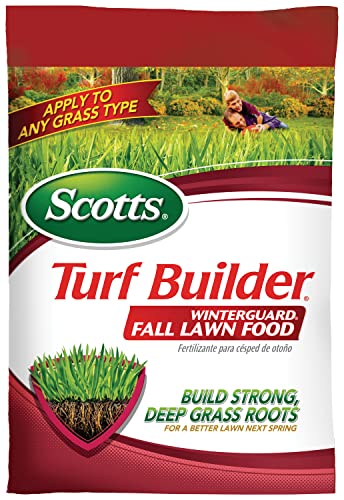
Scotts Turf Builder WinterGuard Fall Lawn Food, 32.3 lb
$46.98A fall formula labeled for any grass type at 12,000 square feet per bag, aimed at recovery from summer stress and root building before the ground freezes.
Best for: the most valuable feeding of the year
Check price on Amazon
Agri-Fab 44 in Tow-Behind Lawn Sweeper, 28 cu ft
$429.99A 28 cubic foot flow-through hopper with a 5.6 to 1 brush-to-wheel ratio that picks up leaves, clippings and pinecones and dumps from the seat.
Best for: an early, heavy leaf drop on a treed lot
Check price on AmazonHow we chose
We did not test these products in person. Picks are researched from manufacturer specifications and owner manuals, engine and safety certifications where they apply, warranty terms, public recall records, and the recurring themes in verified owner reviews. We favor established brands with large review counts and parts support, match each pick to a real yard size or task, and place it in the tier where its price and capability actually belong.
Frequently asked questions
What is the best fall fertilizer schedule for zone 3?
Two feedings: about 1 pound of nitrogen per 1,000 square feet in early fall while the lawn is actively growing, then 0.75 to 1 pound as a winterizer once top growth stops but the grass is still green and soil is near 50 F. Zone 3 hits both marks earlier than warmer zones. Skip the second if the ground is already freezing.
How late can I seed grass in zone 3?
Give seedlings roughly 45 days of growing weather before the first hard freeze, so the window closes in early fall. Perennial ryegrass germinates in 5 to 10 days and buys the most time; Kentucky bluegrass can take 14 to 30 days and needs the earliest start. Seed sown too late germinates, stays small and frost-heaves out over winter.
Should I cut my grass short for winter in zone 3?
Take the last mow to about 2.5 inches, down from a 3 to 3.5 inch summer height, but do not scalp. A shorter final cut reduces the matting that snow mold thrives in under long snow cover and gives voles less runway material. Cutting below about 2 inches strips leaf area the plant needs going into dormancy.
Researched, not professional advice. This page is compiled from published specifications, manuals, labels and owner-review consensus, not hands-on testing. Follow the manufacturer's instructions and product label, and consult a qualified professional where safety, chemicals, fuel or structures are involved. As an Amazon Associate we earn from qualifying purchases.