Seasonal Lawn Care
Zone 5 Spring Lawn Care Calendar: What to Do and When
Quick answer
Zone 5 gets roughly 150 to 180 frost-free days with last frost in mid to late spring. Put crabgrass pre-emergent down as soil at 2 inches holds 50 to 55 F, make the first mow at 3 inches on a sharp blade, feed only 0.5 pound of nitrogen per 1,000 square feet, and save seeding for fall.
Zone 5 is the heart of cool-season lawn country, and it is where spring timing starts to matter. The season is long enough that crabgrass, dandelion and clover all get a real foothold, so a missed pre-emergent window costs you the whole summer. Kentucky bluegrass, tall fescue, fine fescue and perennial ryegrass all grow well here, which means the seed aisle is genuinely a choice rather than a short list.
Keep spring nitrogen light and spend the effort on timing instead. Set the rate with the fertilizer calculator, size any patch seed with the grass seed calculator, and lime only from a soil test using the lime calculator.
On this page
What should I do to my lawn in zone 5 in spring?
The pre-emergent row is the one with a hard deadline. Everything else has slack.
| Task | Trigger | Timing cue in zone 5 | Notes |
|---|---|---|---|
| Clean up winter debris | Turf dry enough to walk on | Early spring | Light raking on matted spots. Avoid working saturated soil. |
| Soil test | Soil workable | Every 3 years | The MySoil Soil Test Kit reports pH and 13 nutrients with rate recommendations. |
| Sharpen the blade, service the mower | Any | Before the first mow | See lawn mower maintenance. |
| First mow at 3 in | Blades near 4 in | Mid spring | Never remove more than a third of the leaf at once. |
| Crabgrass pre-emergent | Soil 50 to 55 F at 2 in for 3 to 5 straight days | Mid spring, about when forsythia finishes blooming | The hard deadline of the zone 5 season. Skip it if you are seeding. |
| Light nitrogen feed | Active growth, soil above 55 F | After the second mow | 0.5 lb N per 1,000 sq ft. Save the pound for fall. |
| Spot-treat broadleaf weeds | Air 60 to 85 F, weeds actively growing | Late spring | Spot spray. Fall is still the stronger window for perennials. |
| Second split pre-emergent | 6 to 8 weeks after the first pass | Late spring | Extends control through a longer zone 5 summer. |
Soil temperature is read at 2 inches deep with a soil thermometer, in the morning, in an open part of the lawn.
When should I put down pre-emergent in zone 5?
When soil at 2 inches has held 50 to 55 F for three to five consecutive days, which in zone 5 lands in mid spring. The old field cue is that crabgrass pre-emergent goes down as forsythia finishes blooming and before lilacs open, which tracks soil temperature closely enough to be useful when you have no thermometer. Crabgrass germinates as soil crosses about 55 F, so the barrier must be in place and watered in first.
Zone 5 summers are long enough that one application often fades before crabgrass stops germinating, so split it: half rate at the 50 to 55 F trigger, half six to eight weeks later. The Quali-Pro Prodiamine 65 WDG Pre-Emergent Herbicide, 5 lb is the cheapest way to do that with a sprayer, while the Scotts Halts Crabgrass and Grassy Weed Preventer, 20.12 lb and the Lesco 0-0-7 with 0.43% Stonewall Pre-Emergent, 50 lb are the granular routes. Detail is in when to apply pre-emergent and pre-emergent vs post-emergent.
Can I seed a zone 5 lawn in spring?
You can, but it is the weaker window. Here is the honest comparison before you buy seed.
| Factor | Spring seeding | Fall seeding |
|---|---|---|
| Soil temperature | Rises through 50 to 65 F, then keeps climbing | Falls through 65 to 50 F, ideal and stable |
| Weed competition | Heavy. Crabgrass germinates alongside your seed | Almost none. Summer annuals are finished |
| Pre-emergent | Must be skipped, so crabgrass runs free | Not needed at seeding time |
| First stress test | Summer heat arrives in weeks, on shallow roots | Two cool seasons before the first summer |
| Best use | Patching bare spots and dog damage | The whole lawn, aeration and overseeding together |
If you must seed in spring, a mesotrione product such as the Syngenta Tenacity Turf Herbicide, 8 oz is labeled for use at seeding on certain cool-season grasses, which no ordinary pre-emergent allows. Follow its label exactly.
How much should I fertilize a zone 5 lawn in spring?
Half a pound of nitrogen per 1,000 square feet, after the lawn is growing on its own. A cool-season lawn uses 2 to 4 pounds per 1,000 square feet across the year, and fall should carry most of it. A heavy spring feed produces lush top growth that needs more mowing, drinks more water and enters summer with a shallow root system, which is the opposite of what a zone 5 summer demands.
Convert from the bag: pounds of product equals target nitrogen times 100 divided by the first number. A 29-0-3 such as the Jonathan Green Green-Up Lawn Food 29-0-3, 15,000 sq ft works out to about 1.7 pounds per 1,000 square feet at a half-pound rate, while the all-purpose Scotts Turf Builder Lawn Food, 37.5 lb covers 15,000 square feet per bag. Spread in two perpendicular passes with the Scotts Turf Builder EdgeGuard DLX Broadcast Spreader or the Lesco 50 lb Commercial Push Spreader. Background is in how to read a fertilizer label and liquid vs granular fertilizer.
What gear does a zone 5 spring need?
A sprayer or spreader you can rely on inside a narrow window, plus a soil test. More in the best lawn sprayers and the best crabgrass preventers.

My4Sons M4 Battery Powered Backpack Sprayer, 4.5 Gallon
$249.99A 12V battery backpack with a 20 to 80 psi rotary pressure adjuster, adjustable stainless wand and a large nozzle kit, so there is no hand pumping across a big lawn.
Best for: spraying pre-emergent and weeds in one trip
Check price on Amazon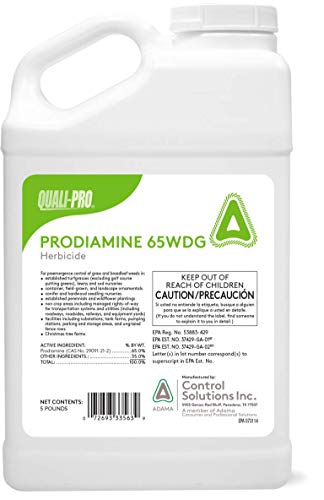
Quali-Pro Prodiamine 65 WDG Pre-Emergent Herbicide, 5 lb
$77.00The generic Barricade: a sprayable 65 percent prodiamine granule for spring and fall pre-emergent control that tank-mixes with fertilizer and iron, with a 5 pound bottle covering many seasons.
Best for: split pre-emergent programs on larger lawns
Check price on Amazon
Lesco 50 lb Commercial Push Spreader
$445.00The long-running landscaper standard with an enclosed gearbox and powder-coated carbon steel frame, and settings printed on many professional fertilizer bags.
Best for: spreading accurately several times a year
Check price on Amazon
MySoil Soil Test Kit
$34.26A prepaid mail-in lab test reporting pH and 13 plant-available nutrients in 6 to 8 days with product and rate recommendations, far more precise than color capsules.
Best for: deciding on lime and phosphorus with data
Check price on AmazonHow we chose
We did not test these products in person. Picks are researched from manufacturer specifications and owner manuals, engine and safety certifications where they apply, warranty terms, public recall records, and the recurring themes in verified owner reviews. We favor established brands with large review counts and parts support, match each pick to a real yard size or task, and place it in the tier where its price and capability actually belong.
Frequently asked questions
What temperature does crabgrass germinate at?
Crabgrass starts germinating as soil at 2 inches deep reaches about 55 F, which is why pre-emergent goes down when soil has held 50 to 55 F for three to five consecutive days. Read the soil in the morning in an open part of the lawn, not in a shaded bed. South-facing strips along driveways warm first and are where crabgrass usually appears first.
Should I bag or mulch clippings in a zone 5 spring?
Mulch them. Extension services recommend returning clippings, which break down quickly and supply part of the lawn’s nitrogen, and they do not cause thatch. Bag only if the grass got away from you and you are cutting off long clumps, or if you are dealing with a disease outbreak. Mulching is also the reason spring nitrogen can stay at half a pound.
Is it too late for pre-emergent once I see crabgrass?
Yes, for that generation. A pre-emergent stops seedlings as they germinate and does nothing to plants that have already emerged. Once crabgrass is visible, switch to a post-emergent such as a quinclorac product and treat while plants are still at the 1 to 4 leaf stage. Then plan the pre-emergent for the following spring at the 50 to 55 F trigger.
Researched, not professional advice. This page is compiled from published specifications, manuals, labels and owner-review consensus, not hands-on testing. Follow the manufacturer's instructions and product label, and consult a qualified professional where safety, chemicals, fuel or structures are involved. As an Amazon Associate we earn from qualifying purchases.