Seasonal Lawn Care
Zone 6 Spring Lawn Care Calendar: What to Do and When
Quick answer
Zone 6 has the longest cool-season spring, roughly 180 to 210 frost-free days, so crabgrass pre-emergent goes down earliest here, as soil at 2 inches holds 50 to 55 F in early to mid spring. Mow tall fescue at 3.5 inches, split the pre-emergent, and feed only 0.5 pound of nitrogen.
Zone 6 is where the transition zone begins. Tall fescue replaces Kentucky bluegrass as the default lawn across much of it, because it takes summer heat better, and a minority of warm zone 6 lawns run zoysia instead. Spring arrives early and lasts, which is good for grass and equally good for crabgrass, so this is the zone where pre-emergent timing pays the most.
Keep spring nitrogen genuinely light. Heavy spring feeding on tall fescue sets up brown patch when humid nights arrive. Set the rate with the fertilizer calculator, size seed with the grass seed calculator, and lime only from a test using the lime calculator.
On this page
What should I do to my lawn in zone 6 in spring?
The pre-emergent rows come first and they come early. A warm zone 6 spring can hit the 50 to 55 F trigger weeks before the lawn looks ready for anything.
| Task | Trigger | Timing cue in zone 6 | Notes |
|---|---|---|---|
| Clean up winter debris | Turf dry enough to walk on | Early spring | Light work only. Working saturated soil compacts it for the year. |
| Soil test | Soil workable | Every 3 years | The MySoil Soil Test Kit gives pH and nutrients with rate recommendations. |
| First pre-emergent pass | Soil 50 to 55 F at 2 in for 3 to 5 straight days | Early to mid spring, earliest of the cool zones | The deadline that matters most in zone 6. Skip it if you are seeding. |
| First mow at 3 to 3.5 in | Blades near 5 in on tall fescue | Early spring | Sharpen first. Never take more than a third of the leaf. |
| Light nitrogen feed | Active growth, soil above 55 F | Mid spring | 0.5 lb N per 1,000 sq ft. More than this feeds brown patch later. |
| Broadleaf weed control | Air 60 to 85 F, weeds actively growing | Mid to late spring | Spot spray where possible. Fall is still stronger for perennials. |
| Second split pre-emergent | 6 to 8 weeks after the first pass | Late spring | Zone 6 summers outlast a single application. |
| Zoysia lawns only: wait to feed | Zoysia fully green, soil above 65 F | Late spring | Feeding a dormant or half-green warm-season lawn wastes nitrogen and feeds weeds. |
Soil temperature is read at 2 inches deep with a soil thermometer, in the morning, in an open part of the lawn.
When should I put down pre-emergent in zone 6?
As soon as soil at 2 inches has held 50 to 55 F for three to five consecutive days, which in zone 6 can arrive in early spring, well before the lawn has fully greened up. Crabgrass germinates as soil crosses about 55 F, and along south-facing driveway edges and sidewalk strips it gets there first, which is exactly where crabgrass shows up every year.
One pass is rarely enough in zone 6. The germination window stretches across a long, warm season, so split the program: half rate at the trigger, half six to eight weeks later. The Quali-Pro Prodiamine 65 WDG Pre-Emergent Herbicide, 5 lb makes that cheap for sprayer owners, while the Scotts Halts Crabgrass and Grassy Weed Preventer, 20.12 lb and the Lesco 0-0-7 with 0.43% Stonewall Pre-Emergent, 50 lb are the granular routes. If you must seed this spring, skip all of them, or follow the label on a mesotrione product such as the Syngenta Tenacity Turf Herbicide, 8 oz. See when to apply pre-emergent.
What grass should a zone 6 lawn be?
Zone 6 straddles the line. Cool-season grasses still dominate, but this is the first zone where a warm-season lawn is a genuine option on the southern edge.
| Grass | Fit in zone 6 | Spring height | Spring behavior |
|---|---|---|---|
| Tall fescue | The zone 6 default. Deep roots handle summer heat and drought | 3.5 to 4 in | Green early, grows hard through spring |
| Kentucky bluegrass | Good in the north of the zone, struggles in southern summers | 3 to 3.5 in | Green early, spreads by rhizomes |
| Fine fescue | Good in shade and low-input areas, weak in summer heat | 3 to 4 in | Earliest green-up, fades in heat |
| Perennial ryegrass | Best as a minor share of a mix for fast cover | 2.5 to 3.5 in | Fastest establishment, poorest heat tolerance |
| Zoysiagrass | Workable on the warm edge of zone 6; hardy to about this line | 1 to 2 in | Stays dormant tan until soil passes about 65 F |
Heights match the mowing height chart. Zoysia is warm-season: it greens up weeks after the cool-season lawns nearby and should not be fertilized until it is fully green. See zoysiagrass.
How much should I fertilize a zone 6 lawn in spring?
Half a pound of nitrogen per 1,000 square feet for cool-season grass, and no more. Zone 6 is where light spring feeding stops being a preference and becomes disease management: tall fescue pushed hard with nitrogen in spring grows soft, dense leaf that brown patch exploits when nights climb above 65 F with humidity. Fall is where the pound goes.
Warm-season lawns run the opposite schedule. Zoysia should be fed only once it is fully green and growing, which happens as soil passes about 65 F in late spring, and it wants 1 to 3 pounds of nitrogen per 1,000 square feet spread across late spring and summer, the exact season when the cool-season lawn next door should be left alone. Convert any bag with the rule that pounds of product equals nitrogen wanted times 100 divided by the first number: a 24-6-12 such as the The Andersons Core 24-6-12 Professional Lawn Fertilizer, 45 lb needs about 2.1 pounds per 1,000 square feet for a half-pound rate. See how to read a fertilizer label.
What gear does a zone 6 spring need?
A spreader that can cover the lawn twice without eating the weekend, plus the pre-emergent itself. More in the best lawn spreaders and the best crabgrass preventers.

Agri-Fab 130 lb Tow-Behind Broadcast Spreader
$249.99A universal-hitch tow spreader with a 10 to 12 foot spread width, enclosed gears and a hopper rated to cover up to half an acre per fill, which makes a split program practical.
Best for: covering a big lawn twice in one spring
Check price on Amazon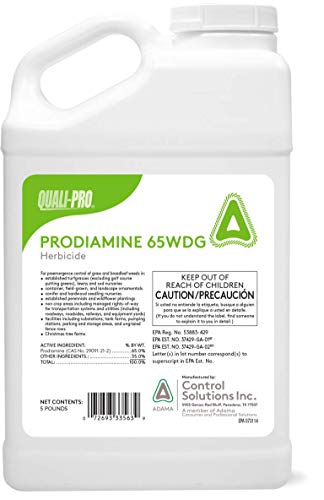
Quali-Pro Prodiamine 65 WDG Pre-Emergent Herbicide, 5 lb
$77.00The generic Barricade: a sprayable 65 percent prodiamine granule for spring and fall pre-emergent control that tank-mixes with fertilizer and iron, with a 5 pound bottle covering many seasons.
Best for: split pre-emergent on a large lawn
Check price on Amazon
EarthWay 2150 Commercial 50 lb Broadcast Spreader
$279.99A commercial push spreader with 13 inch pneumatic tires, a slide-out grate, fully enclosed gearbox and side-spread control for feathering edges along beds.
Best for: accurate spreading without a tractor
Check price on Amazon
Jonathan Green Black Beauty Tall Fescue Blend, 25 lb
$106.33A 100 percent turf-type tall fescue blend for sun and shade with a waxy leaf coating for heat tolerance, sized at 3,750 square feet new or 7,500 overseeded.
Best for: patching bare spots in the default zone 6 grass
Check price on AmazonHow we chose
We did not test these products in person. Picks are researched from manufacturer specifications and owner manuals, engine and safety certifications where they apply, warranty terms, public recall records, and the recurring themes in verified owner reviews. We favor established brands with large review counts and parts support, match each pick to a real yard size or task, and place it in the tier where its price and capability actually belong.
Frequently asked questions
Why does crabgrass appear along my driveway first?
Because pavement absorbs heat and warms the soil beside it days or weeks before the open lawn gets there. Crabgrass germinates as soil crosses about 55 F, so those strips hit the trigger first every year. Treat driveway, sidewalk and south-facing edges on the early side of your pre-emergent window, and keep those strips mowed tall so seed gets less light.
When does zoysia green up in zone 6?
Later than people expect, once soil is consistently above about 65 F in late spring, which can be several weeks after the cool-season lawns around it have greened. A zoysia lawn that still looks tan while the neighbors are mowing is usually normal rather than dead. Do not fertilize it until it is fully green and growing, because early nitrogen mostly feeds weeds.
Should I fertilize tall fescue heavily in spring?
No. Keep spring nitrogen near half a pound per 1,000 square feet. Heavy spring feeding on tall fescue produces soft, dense growth that brown patch attacks once nights stay above about 65 F with humidity, which is a real risk across zone 6. Put the bulk of the yearly 2 to 4 pounds into early and late fall instead.
Researched, not professional advice. This page is compiled from published specifications, manuals, labels and owner-review consensus, not hands-on testing. Follow the manufacturer's instructions and product label, and consult a qualified professional where safety, chemicals, fuel or structures are involved. As an Amazon Associate we earn from qualifying purchases.