Seasonal Lawn Care
Zone 9 Spring Lawn Care Calendar: What to Do and When
Quick answer
Zone 9 wakes early. Soil passes 50 to 55 F, the crabgrass pre-emergent trigger, well before most owners think about the lawn, and warm-season grass greens up at 65 F. St. Augustine and bahia dominate here, mowed at 3.5 to 4 inches, and the first nitrogen waits for full green-up.
Zone 9 runs along the Gulf Coast and through central Florida, south Texas and parts of the desert Southwest, with winter lows of 20 to 30 F. The growing season is nine to ten months long, dormancy is short and often partial, and weeds never really stop. That changes the shape of spring: instead of one big wake-up, you get a long, early ramp where timing a pre-emergent correctly matters more than anything else you will do.
Set the rates first. The fertilizer calculator converts a bag analysis into pounds per 1,000 square feet, the grass seed calculator sizes bahia seeding and plug work, and the sprinkler zone calculator matters early here because zone 9 spring is often the driest part of the year.
On this page
What does a zone 9 spring lawn care schedule look like?
Trigger everything from soil temperature at 2 inches, measured in the morning. In zone 9, calendar habits carried down from a colder state are usually several weeks too late.
| Task | Trigger | Timing cue | Notes |
|---|---|---|---|
| First crabgrass pre-emergent | Soil 50 to 55 F at 2 in for 3 to 5 days | Late winter into very early spring | Arrives early here; Quali-Pro Prodiamine 65 WDG Pre-Emergent Herbicide, 5 lb or Scotts Halts Crabgrass and Grassy Weed Preventer, 20.12 lb |
| Soil test | Any time | Early spring | Sandy soils leach potassium; MySoil Soil Test Kit |
| Second pre-emergent application | 60 to 90 days after the first, per label | Mid to late spring | Goosegrass germinates later, at 60 to 65 F |
| Start mowing at full height | Growth restarting | Early spring | St. Augustine 3.5 to 4 in, bahia 3 to 4 in, bermuda 1 to 2 in |
| Wait for full green-up | Soil steadily above 65 F | Early to mid spring | Patchy colour is not green-up |
| First nitrogen after green-up | Lawn green and mowed twice | Mid spring | 0.5 lb N per 1,000 sq ft for most grasses here |
| Take-all root rot watch | Warm wet spring weather | Mid spring | Yellowing patches with rotted dark roots on stressed St. Augustine |
| Mole cricket watch on bahia and bermuda | Soil above 65 F, nymphs small | Late spring | Spongy soil and tunneling; treat small nymphs, not adults |
| Core aerate | Grass growing hard | Late spring | Compacted, high-traffic and clay areas only |
| Sod, plug or seed | Soil 65 to 70 F | Late spring | Bahia 5 to 8 lb per 1,000 sq ft; St. Augustine only from sod or plugs |
Bahiagrass is the one common zone 9 lawn grass routinely grown from seed at a high rate, 5 to 8 lb per 1,000 sq ft for a new stand. Bermuda needs only 1 to 2 lb and centipede only 0.25 to 0.5 lb.
When should I put down pre-emergent in zone 9?
Earlier than you think, and twice. The trigger is the same 50 to 55 F soil reading used everywhere else, but in zone 9 it arrives in late winter or the first days of spring, while nights still feel cool. Most missed applications in this zone are missed by weeks, not days.
Because the season is so long, one application rarely covers it. Labels for products such as Quali-Pro Prodiamine 65 WDG Pre-Emergent Herbicide, 5 lb allow a second application on a 60 to 90 day interval within an annual limit, which carries control through the late-germinating grasses. Granular Scotts Halts Crabgrass and Grassy Weed Preventer, 20.12 lb covers 10,000 square feet and goes down on a dry lawn, then gets watered in. The same restriction applies as anywhere: it stops grass seed too, so do not use it where bahia is going in. Read when to apply pre-emergent, crabgrass and goosegrass.
How high should I mow and how much should I feed in zone 9?
Zone 9 lawns are mowed high, with bermuda the exception. Nitrogen totals are annual, spread across a long season in light applications.
| Grass | Mowing height | Nitrogen per year | Notes |
|---|---|---|---|
| St. Augustinegrass | 3.5 to 4 in standard, 2 to 2.5 in dwarf | 2 to 4 lb per 1,000 sq ft | The dominant lawn grass in humid zone 9 |
| Bahiagrass | 3 to 4 in | 1 to 2 lb per 1,000 sq ft | Low input, deep rooted; tall seed heads drive mowing frequency |
| Bermudagrass | 1 to 2 in | 2 to 5 lb per 1,000 sq ft | Needs full sun and the most nitrogen of any grass here |
| Zoysiagrass | 1 to 2 in | 1 to 3 lb per 1,000 sq ft | Dense and slow; thatch builds if over-fed |
| Centipedegrass | 1.5 to 2 in | 1 to 2 lb per 1,000 sq ft | Never push nitrogen or lime it above pH 6.0 |
No single application should exceed 1 lb of quickly available nitrogen per 1,000 sq ft. Many counties in this zone restrict nitrogen and phosphorus fertilizer during the summer rainy season, so check local rules before planning the year.
What is wrong with my St. Augustine lawn in spring?
In zone 9, spring problems on St. Augustine usually come down to three things. Take-all root rot shows as yellowing, thinning patches where the grass pulls up easily and the roots are short and dark instead of white, and it follows stress: scalping, heavy nitrogen, high pH and compacted soil all make it worse. Large patch appears as roughly circular areas with rotted leaf sheaths when nights are humid and soil sits between 50 and 70 F. Cold damage from the winter just past can also show up only at green-up.
None of the three are fixed with fertilizer, and nitrogen makes two of them worse. Mow at 3.5 to 4 inches, water before dawn rather than in the evening, and correct compaction and drainage. Mowers that hold that height include the EGO POWER+ LM2135SP 21 in. Select Cut Self-Propelled Mower Kit at 1 to 4 inches and the SENIX 22 in. Variable Speed RWD Self-Propelled Gas Mower, 201cc at 1.25 to 4 inches. Repair thin areas in late spring with plugs such as SodPods St. Augustine Seville Grass Plugs, 64 Count, since St. Augustine does not grow from seed. The profile is on the St. Augustinegrass page.
What gear does a zone 9 spring need?
A spreader that handles repeat passes, a mower that holds 4 inches, and irrigation for what is often the driest season of the year. See the best lawn spreaders.
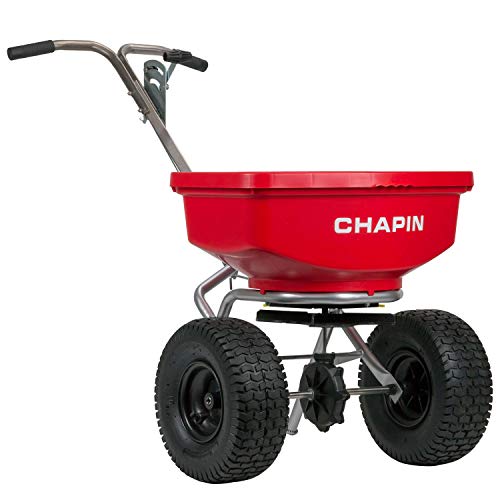
Chapin 8401C 80 lb Professional SureSpread Turf Spreader
$360.33An 80 lb push spreader on a stainless frame with an enclosed gearbox and 14 inch pneumatic tires, built for repeated passes across a season that runs nine or ten months. Not rated for lime or rock salt.
Best for: acre-sized lawns spread on foot
Check price on Amazon
EGO POWER+ LM2135SP 21 in. Select Cut Self-Propelled Mower Kit
$749.00Cuts from 1 to 4 inches, which covers a full St. Augustine or bahia height at the top and drops to zoysia height at the bottom, with a 7.5Ah battery rated up to 60 minutes.
Best for: St. Augustine lawns up to half an acre
Check price on Amazon
SodPods St. Augustine Seville Grass Plugs, 64 Count
$109.98Farm-grown 3 by 3 inch Seville plugs in eight trays of eight, listed at 144 sq ft of coverage at 18 inch spacing once mature, for the thin areas that show up at green-up.
Best for: repairing winter or disease damage
Check price on Amazon
Rachio Smart Hose Timer Bundle, 2 Valves plus WiFi Hub
$149.00Two app-controlled faucet valves and a hub, expandable to eight valves, with rain skips and flow alerts, which brings scheduling to hose sprinklers without in-ground pipe.
Best for: yards watered from spigots
Check price on Amazon
MySoil Soil Test Kit
$34.26A mail-in lab test reporting pH and 13 plant-available nutrients with rate recommendations, which is the only way to know whether the sandy soils here are short of potassium.
Best for: planning a full season of feeding
Check price on AmazonHow we chose
We did not test these products in person. Picks are researched from manufacturer specifications and owner manuals, engine and safety certifications where they apply, warranty terms, public recall records, and the recurring themes in verified owner reviews. We favor established brands with large review counts and parts support, match each pick to a real yard size or task, and place it in the tier where its price and capability actually belong.
Frequently asked questions
When should I put down pre-emergent in zone 9?
When soil at 2 inches has held 50 to 55 F for three to five consecutive days, which in zone 9 falls in late winter or the very start of spring. Because the growing season runs nine or ten months, most labels allow a second application 60 to 90 days later within an annual limit, which carries control through later-germinating grasses such as goosegrass.
When should I fertilize my lawn in zone 9?
After full green-up, when soil is steadily above 65 F and the lawn has been mowed once or twice. Start with about half a pound of nitrogen per 1,000 square feet for St. Augustine, bahia, zoysia and centipede, and up to a pound for bermuda. Check local rules first, since many counties in this zone restrict nitrogen and phosphorus during the summer rainy season.
Can I grow St. Augustine from seed in zone 9?
No. St. Augustinegrass is established from sod, plugs or sprigs, not seed, because it does not produce viable seed in commercial quantities. Plugs set into warm soil in late spring spread by stolons across the following months. Bahiagrass is the common zone 9 lawn grass that is routinely seeded, at 5 to 8 pounds per 1,000 square feet for a new stand.
What are the small tunnels and spongy soil in my bahia lawn?
Most likely mole crickets, which tunnel just under the surface and feed on roots, leaving soil that feels soft underfoot and turf that lifts easily. They are most damaging on bahia and bermuda in the coastal Southeast. Control works best while nymphs are small in late spring; treating large adults later in the season gives poor results. Confirm the pest before applying anything.
Researched, not professional advice. This page is compiled from published specifications, manuals, labels and owner-review consensus, not hands-on testing. Follow the manufacturer's instructions and product label, and consult a qualified professional where safety, chemicals, fuel or structures are involved. As an Amazon Associate we earn from qualifying purchases.