Mowers
How to Mow a Lawn: Mowing Height by Grass Type and the One-Third Rule
Quick answer
Mow often enough that you never remove more than one-third of the grass blade at once, at the right height for your grass: tall fescue 3 to 4 inches, Kentucky bluegrass 2.5 to 3.5, bermudagrass 1 to 2. Keep blades sharp, mulch clippings unless they clump, mow only dry grass and change direction each time.
Mowing is the lawn care job you do most often, and it shapes the lawn more than fertilizer does. Cut too short and the grass loses the leaf area it needs to shade out weeds and survive heat; cut too much at once and it browns and thins; cut with a dull blade and every tip frays. Get height, frequency and sharpness right and most other lawn problems shrink.
This guide covers the one-third rule, mowing heights for eight common grasses, setting your mower, how often to mow, mulching versus bagging, patterns and striping, sharp blades, and mowing through heat and drought. To see how long your lawn takes with different mowers, try the mowing time calculator.
On this page
- What is the one-third rule for mowing grass?
- What height should I mow my grass?
- How do I set the cutting height on my lawn mower?
- How often should I mow my lawn?
- Is it better to mulch or bag grass clippings?
- What is the best mowing pattern for a lawn?
- How do you get stripes in your lawn when mowing?
- How often should mower blades be sharpened?
- How should I mow during heat and drought?
- What is the best time of day to mow the lawn?
- Which mowers make it easier to mow the right way?
- How do I mow a lawn step by step?
What is the one-third rule for mowing grass?
The one-third rule says never remove more than one-third of the grass blade's height in a single mowing. University extension services recommend it for every common lawn grass because the leaf blade is where grass makes its food. Removing more than a third at once stresses the plant, slows root growth and leaves brown, scalped patches.
To use it, work backward from your target height. If you keep tall fescue at 3.5 inches, mow when it reaches about 5.25 inches (3.5 x 1.5). If the lawn has gotten away from you after a wet week or a vacation, do not cut it down in one pass: raise the deck, take off a third, and lower it again over the next two or three mowings a few days apart.
What height should I mow my grass?
These are common university extension mowing ranges. Use the higher end in summer heat, drought and shade, and the lower end in cool, moist growing weather. The "mow when it reaches" column applies the one-third rule. Full profiles are on each grass type page and in the mowing height chart.
| Grass | Type | Mowing height | Mow when it reaches | Notes |
|---|---|---|---|---|
| Tall fescue | Cool-season | 3 to 4 in | 4.5 to 6 in | Tolerates heat better at the top of the range |
| Kentucky bluegrass | Cool-season | 2.5 to 3.5 in | 3.75 to 5.25 in | Raise to 3.5 in in summer to limit stress |
| Perennial ryegrass | Cool-season | 2 to 3 in | 3 to 4.5 in | Tough blades fray fast with a dull blade |
| Fine fescue | Cool-season | 2.5 to 3.5 in | 3.75 to 5.25 in | Keep high in shade |
| Bermudagrass | Warm-season | 1 to 2 in | 1.5 to 3 in | Needs frequent mowing in summer; check your mower goes low enough |
| Zoysiagrass | Warm-season | 1 to 2.5 in | 1.5 to 3.75 in | Dense and tough on dull blades |
| St. Augustinegrass | Warm-season | 2.5 to 4 in | 3.75 to 6 in | Scalps easily if cut low |
| Centipedegrass | Warm-season | 1.5 to 2 in | 2.25 to 3 in | Low-maintenance, slow growing |
Ranges vary slightly between state extension services and cultivars. Check your local extension office for your region.
How do I set the cutting height on my lawn mower?
Deck height settings are approximate, and the numbers on the lever do not always match the real cut. To check, park the mower on a flat driveway, shut it off and disconnect the spark plug wire or remove the battery and safety key, then measure from the pavement to the lowest point of the blade tip. On turf the grass will stand slightly taller than that number because the wheels sink a little.
Make sure the mower's range covers your grass. The EGO POWER+ LM2135SP 21 in. Select Cut Self-Propelled Mower Kit adjusts from 1 to 4 inches, the Honda HRX-BE 21 in. Battery Self-Propelled Mower from 0.75 to 4 inches, and the EGO POWER+ Z6 ZT4204L 42 in. Electric Zero Turn Mower rider from 1.5 to 4.5 inches. Robot mowers vary more: the Segway Navimow i210 AWD Robot Mower cuts 2 to 3.6 inches, which suits cool-season lawns but is too high for bermudagrass kept at 1 inch, while the Husqvarna Automower 520H EPOS Robot Mower goes down to 0.8 inch for low-cut turf.
How often should I mow my lawn?
Mow by growth, not by the calendar. The one-third rule decides: whenever the grass reaches one and a half times your target height, it is time.
- Cool-season lawns (fescue, bluegrass, ryegrass) grow fastest in spring and again in fall, often needing a mow every 4 to 5 days during the spring flush, and slow down in summer heat to once a week or less.
- Warm-season lawns (bermudagrass, zoysiagrass, St. Augustinegrass, centipedegrass) peak in summer, when bermudagrass kept at 1 to 1.5 inches may need mowing twice a week.
- Dormant lawns in drought or winter need little or no mowing.
Frequent, light mowing is exactly what robot mowers do. A robot such as the Husqvarna Automower 420iQ Robot Mower trims a little every day, which keeps the lawn within the one-third rule without anyone tracking growth. See the best robot lawn mowers.
Is it better to mulch or bag grass clippings?
Mulch most of the time. Extension services widely recommend leaving clippings on the lawn ("grasscycling") because they break down quickly and return nitrogen and other nutrients, which can reduce how much fertilizer you need. Clippings do not cause thatch; thatch builds from stems, roots and runners, not the leafy, water-rich clippings.
Bag instead when:
- The grass got too tall and clippings would sit in clumps that smother the turf.
- Weeds are going to seed or the lawn has an active disease.
- Fall leaves are heavy, or you are preparing to overseed or aerate.
Mulching needs the right blade and deck. On many riders, a mulch kit such as the Husqvarna HU42 42 in. Mulch Kit with Blades (for Husqvarna 42-inch stamped decks) or mulching blades such as the Husqvarna 48 in. Mulching Blades (3 Pack) make the difference, while Husqvarna 48 in. High-Lift Bagging Blades (3 Pack) improve suction when bagging. When you side discharge, aim clippings toward the lawn, never toward the street, beds, people or cars, and blow any clippings off pavement so they do not wash into storm drains.
What is the best mowing pattern for a lawn?
Change direction every time you mow. Mowing the same lines every week wears ruts from the wheels and makes the grass lean one way, which leaves an uneven cut. Rotate through four patterns: lengthwise, crosswise, and the two diagonals.
For a clean, efficient job, mow two laps around the outside edge first. That "headland" gives you room to turn at the ends of each straight pass without scuffing the turf or leaving uncut arcs. Overlap each pass by a few inches, about 15 percent of the deck width, so no strips are missed. On slopes, the direction is set by safety rather than looks: walk-behinds go across, riding mowers go up and down (see mowing on slopes safely).
How do you get stripes in your lawn when mowing?
Lawn stripes are just light reflecting off grass blades bent in different directions. Grass bent away from you looks lighter, and grass bent toward you looks darker. A mower with a rear roller, or an add-on striping kit with a roller or flap, bends the blades more firmly for bolder stripes.
- Mow the headland laps around the edge first.
- Mow a straight line along the longest edge, using a fence or driveway as a guide.
- Turn on the headland and come back directly beside the first pass, overlapping slightly.
- For a checkerboard, repeat at 90 degrees.
Cool-season grasses like Kentucky bluegrass and ryegrass stripe best, and stripes show more at the upper end of the mowing range. Change the stripe direction regularly to avoid ruts.
How often should mower blades be sharpened?
Sharpen at least once or twice a season, and more often on large lawns; a common guideline is every 20 to 25 hours of mowing. A sharp blade slices the grass cleanly. A dull one tears it, leaving ragged tips that turn brown or whitish a day or two later and give disease an easy entry.
Look at the grass the day after mowing. If the tips look shredded, the blade is due. Sandy soil, sticks and acorns dull blades faster. Always balance a blade after sharpening, because an unbalanced blade vibrates and wears the engine bearings. The lawn mower maintenance guide covers sharpening and balancing step by step.
How should I mow during heat and drought?
- Raise the height to the top of your grass's range. Taller grass shades the soil, keeps roots cooler and loses less water.
- Mow less often. Growth slows in heat; let the one-third rule tell you when.
- Mow in the cooler part of the day, early evening or mid-morning once dew is gone, not in the heat of the afternoon.
- Leave the clippings to hold moisture at the soil surface.
- Keep the blade sharp; torn tips lose more water.
- Do not mow dormant brown grass that is not growing. Mowing and traffic on dormant turf cause damage that shows once rain returns.
Cool-season grasses like tall fescue and bluegrass often go dormant in long summer droughts and recover with fall rain. Follow local watering restrictions.
What is the best time of day to mow the lawn?
Mid-morning, once the dew has dried, or late afternoon into early evening. Wet grass clumps, clogs the deck, cuts unevenly and makes slopes slippery. Midday heat stresses both the lawn and you. Avoid mowing right before dark, when it is hard to see holes, toys and pets, and check local noise ordinances for gas mowers early in the morning.
Before you start, walk the lawn and pick up sticks, rocks, dog toys, pine cones and anything else a blade could throw. A mower blade can launch a small stone fast enough to break a window or injure someone standing nearby.
Which mowers make it easier to mow the right way?
A mower with a wide height range, good mulching and enough runtime makes the rules above easy to follow. A robot mower follows the one-third rule automatically.

Honda HRX-BE 21 in. Battery Self-Propelled Mower
$999.00Honda's twin-blade MicroCut deck and 4-in-1 Versamow mulch, bag, discharge or mix, with a 0.75 to 4 inch height range and a 12Ah battery rated for about 0.37 acre.
Best for: lawns up to about a third of an acre where cut quality matters
Check price on Amazon
EGO POWER+ LM2206SP 22 in. Aluminum Deck Self-Propelled Mower Kit
$1,299.00A cast aluminum 22-inch deck with a lifetime warranty and a 10.0Ah battery rated for up to 70 minutes, with bagging and mulching.
Best for: larger suburban lawns
Check price on Amazon
Husqvarna Automower 420iQ Robot Mower
$1,841.66Rated for 1 acre on 45 percent slopes with a 1 to 4 inch cut range, mowing a little every day so the lawn never loses more than a third at once.
Best for: cool-season lawns up to 1 acre
Check price on Amazon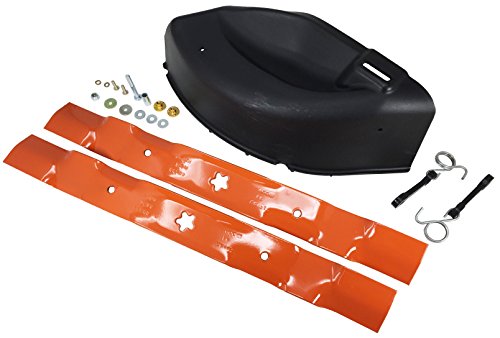
Husqvarna HU42 42 in. Mulch Kit with Blades
$44.95A mulch plate, mulching blades and hardware that let a Husqvarna 42-inch stamped deck return clippings to the lawn instead of discharging them.
Best for: Husqvarna 42 in stamped-deck riders
Check price on AmazonHow do I mow a lawn step by step?
- Check the height. Find the mowing height for your grass type and wait until the grass is one and a half times that height.
- Clear the lawn. Walk the yard and pick up sticks, rocks and toys, and bring children and pets indoors.
- Prepare the mower. With the engine cold, check oil and fuel or charge the battery, confirm the blade is sharp, and set the deck height.
- Mow the headland. Mow two laps around the edge of the lawn to create turning room.
- Mow straight passes. Mow straight lines in a different direction from last time, overlapping each pass by a few inches.
- Handle clippings. Mulch clippings in normal growth, bag when grass is overgrown or weeds are seeding, and blow clippings off pavement.
- Trim and clean up. String-trim edges and slopes too steep to mow, then clean grass from the deck with the engine off and blade stopped.
How we chose
We did not test these products in person. Picks are researched from manufacturer specifications and owner manuals, engine and safety certifications where they apply, warranty terms, public recall records, and the recurring themes in verified owner reviews. We favor established brands with large review counts and parts support, match each pick to a real yard size or task, and place it in the tier where its price and capability actually belong.
Frequently asked questions
How short should I cut my grass?
Cut it to the recommended range for your grass type and never remove more than one-third of the blade at once. Tall fescue is commonly kept at 3 to 4 inches, Kentucky bluegrass at 2.5 to 3.5 inches, perennial ryegrass at 2 to 3 inches, and bermudagrass at 1 to 2 inches. Mowing below the range weakens roots and invites weeds, especially in summer heat.
Is it bad to cut grass too short?
Yes. Scalping removes the leaf area grass needs to make food, so roots shrink, the lawn browns and thins, and weeds such as crabgrass get the sunlight they need to sprout. Cutting too short also dries out the soil faster in summer. If you scalp a lawn, raise the deck to the top of the recommended range and water deeply while it recovers.
Should I leave grass clippings on the lawn?
In most cases, yes. Clippings break down quickly and return nitrogen and other nutrients to the soil, which can reduce fertilizer needs, and they do not cause thatch. Bag them when the grass is overgrown and clippings would clump, when weeds are going to seed, when a disease is active, or before overseeding. Always blow clippings off sidewalks and streets.
How often should you mow in the summer?
Mow whenever the grass reaches one and a half times its target height. Cool-season lawns such as tall fescue slow down in summer heat and may need mowing only once a week or less, especially at a raised height. Warm-season lawns such as bermudagrass grow fastest in summer and can need mowing twice a week when kept short. Skip mowing dormant, brown grass.
Should I mow wet grass?
It is better to wait. Wet grass clumps, clogs the mower deck, tears instead of cutting cleanly and can spread disease, and wet slopes are dangerous because mowers and operators lose traction. Mow mid-morning after the dew dries or later in the afternoon. If you must mow damp grass, raise the deck, slow down, keep the blade sharp and stay off slopes.
Why does my lawn look brown after mowing?
The two usual causes are a dull blade and cutting too much at once. A dull blade tears grass tips, which turn brown or whitish within a day or two. Removing more than one-third of the blade exposes pale lower stems and stresses the plant. Sharpen the blade, raise the deck and mow more often; mowing during heat or drought also browns tips.
Researched, not professional advice. This page is compiled from published specifications, manuals, labels and owner-review consensus, not hands-on testing. Follow the manufacturer's instructions and product label, and consult a qualified professional where safety, chemicals, fuel or structures are involved. As an Amazon Associate we earn from qualifying purchases.