Landscaping
Best Tillers (2026): Tiller vs Cultivator for New Beds and Lawns
Quick answer
The best tiller for breaking sod and clay for new beds or lawn renovation is a rear-tine model such as the Earthquake Victory (209cc, counter-rotating tines, 16 inches wide, up to 10 inches deep). A cultivator such as the Mantis 7940 is better for loosening existing beds. Tillers dig new ground; cultivators maintain worked soil.
A tiller breaks up compacted or undisturbed soil with heavy rotating tines; a cultivator is a lighter machine that loosens, weeds and mixes soil that has already been worked. For homeowners, tillers earn their keep on landscaping projects: cutting new planting beds out of lawn, renovating a bare or weedy lawn before reseeding, and working compost into topsoil. Vegetable garden soil prep is covered in depth at greenhousesetup.com.
Our top pick is the Earthquake Victory rear tine tiller at $799.99, because counter-rotating tines and a cast-iron transmission handle sod and clay that stall lighter machines. For maintaining beds you already have, a Mantis 7940 or Honda FG110 is lighter and far easier to handle. Estimate compost and topsoil for a new bed with the topsoil calculator.
On this page
- Tiller vs cultivator: what is the difference?
- What type of tiller do I need for my project?
- How much compost or topsoil should I till into a new bed?
- Beginner picks: light cultivators for existing beds
- Intermediate picks: 4-cycle mini tillers and a front-tine tiller
- Expert pick: a counter-rotating rear-tine tiller
- How do the picks compare on specs?
- Should I till my lawn before reseeding?
- What should I check before buying a tiller?
Tiller vs cultivator: what is the difference?
The difference is the soil each one is built for. A tiller has larger, heavier tines, more engine and often wheels that drive or restrain the machine, so it can dig into sod and compacted ground. A cultivator is a small, light machine with narrow tines that stirs the top few inches of already loose soil, cuts weeds between plantings and blends in amendments.
- Mini cultivators such as the Mantis 7940 (24 lbs) and Honda FG110 (29 lbs) are easy to lift into beds and steer between shrubs.
- Front-tine tillers such as the Earthquake Versa put the tines ahead of the wheels. They are affordable and maneuverable but can jump in hard ground.
- Rear-tine tillers such as the Earthquake Victory put the tines behind powered wheels, which gives steady control in sod and clay. Counter-rotating tines spin against the wheels to dig more aggressively.
Honda is candid that the Honda FG110 performs best in softer or pre-tilled soil and may only dig in partially when breaking new, hard ground. That is a cultivator's limit, not a defect. More detail is on tiller vs cultivator.
What type of tiller do I need for my project?
Match the machine to the soil condition and area. These are general guidelines for landscaping projects.
| Project | Typical area | Soil condition | Machine type | Example |
|---|---|---|---|---|
| Loosen and weed existing mulch beds | Under 200 sq ft | Already worked | Cordless or corded mini cultivator | Greenworks 40V cultivator |
| Blend compost into existing beds | 100 to 500 sq ft | Loose to firm | Gas mini cultivator | Mantis 7940 |
| Tight spaces between shrubs | Small | Soft or pre-tilled | Narrow mini tiller (6 to 9 in) | Honda FG110 |
| Small new bed in loose soil | Under 300 sq ft | Firm, not sod | Corded electric tiller | Sun Joe TJ604E |
| New bed or border cut from lawn | 200 to 800 sq ft | Sod, compacted | Front-tine tiller, several passes | Earthquake Versa |
| Lawn renovation before reseeding | 1,000 sq ft plus | Compacted, weedy turf | Rear-tine, counter-rotating | Earthquake Victory |
| Clay soil, new landscape areas | Any size | Hard clay or rocky | Rear-tine, counter-rotating | Earthquake Victory |
Call 811 before tilling new ground so buried utility lines are marked. Irrigation pipes and low-voltage lighting cable are often shallow, so locate them too.
How much compost or topsoil should I till into a new bed?
A common landscaping approach is to spread 2 to 3 inches of compost or quality topsoil and till it into the top 6 to 8 inches. Cubic yards = square feet x inches / 324. Use the topsoil calculator or mulch calculator for exact figures.
| Bed or lawn area | At 2 in deep | At 3 in deep | Bags of 1 cu ft at 2 in |
|---|---|---|---|
| 50 sq ft (5 x 10 ft bed) | 0.31 cu yd | 0.46 cu yd | 8 |
| 100 sq ft | 0.62 cu yd | 0.93 cu yd | 17 |
| 200 sq ft | 1.23 cu yd | 1.85 cu yd | 33 |
| 500 sq ft | 3.09 cu yd | 4.63 cu yd | 83 |
| 1,000 sq ft lawn area | 6.17 cu yd | 9.26 cu yd | 167 |
One cubic yard = 27 cubic feet. Bag counts are rounded up. Bulk delivery usually costs less per yard above about 2 cubic yards.
Beginner picks: light cultivators for existing beds
For owners maintaining mulch beds, borders and small planting areas that are already dug. These machines are light, simple and forgiving.

Sun Joe TJ604E 13.5 Amp Electric Tiller Cultivator
$149.99A 13.5 amp corded tiller with 6 rust-proof steel tines working up to 16 in. wide and 8 in. deep, 3-position wheel adjustment for depth control and a folding handle for storage. No gas or oil to maintain.
Best for: small plots near an outlet
Check price on Amazon
Greenworks 40V 10 in. Cordless Tiller Cultivator Kit with 4.0Ah Battery
$199.99An 8.25 to 10 in. adjustable-width cultivator with 6 in. rear wheels and up to 45 minutes of runtime on the included 4.0Ah battery, which charges in 120 minutes. It carries a 3-year tool and battery warranty.
Best for: cultivating existing beds without cords or gas
Check price on Amazon
Earthquake MC33 33cc Mini Tiller Cultivator
$246.90A 33cc 2-cycle Viper engine with gear drive, adjustable wheels for transport and depth, and overhand control that reduces bouncing. Earthquake backs it with a 5-year limited warranty and US-based support.
Best for: weeding and loosening soil in small beds
Check price on AmazonIntermediate picks: 4-cycle mini tillers and a front-tine tiller
For owners who amend beds every year, dig small new borders and want 4-cycle engines that skip fuel mixing.
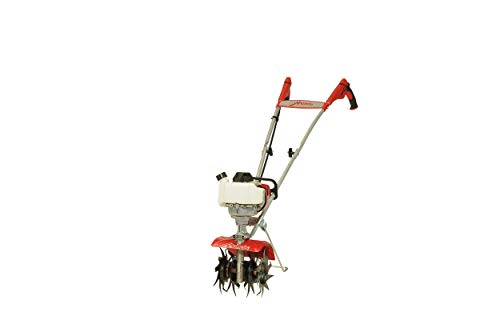
Mantis 7940 4-Cycle Honda Tiller Cultivator
$489.99A Honda 25cc 4-cycle engine spinning tines up to 240 RPM on a 24 lb frame, with a finger throttle for fine speed control, a kickstand and no fuel mixing. Made in the USA with a 2-year limited warranty.
Best for: amending and weeding established beds
Check price on Amazon
Honda FG110 Mini Tiller Cultivator
$489.00A Honda GX25 4-stroke with patented hybrid tines, half angled to dig and half to cultivate, a 9 in. width that drops to 6 in. with the outer tines removed, two-position transport wheels, an adjustable depth bar and a 2-year residential warranty.
Best for: softer or pre-tilled soil and tight spaces
Check price on Amazon
Earthquake Versa 20015 99cc Front Tine Tiller Cultivator
$499.00A 99cc 4-cycle Viper front-tine tiller with tool-less width adjustment from 11 to 21 in., tilling depth up to 11 in., an adjustable handlebar and onboard wheels. It converts between cultivator and tiller widths.
Best for: new borders and yearly soil prep
Check price on AmazonExpert pick: a counter-rotating rear-tine tiller
For lawn renovations, large new landscape areas and clay or rocky soil where lighter machines bounce and stall.

Earthquake Victory 39381 209cc Rear Tine Tiller
$799.99Counter-rotating tines turn opposite the wheels to break clay, compacted soil and sod, driven by a 209cc Viper engine through a cast-iron transmission with bronze gears. It tills 16 in. wide and up to 10 in. deep, with instant reverse, a 3-position handlebar and a 5-year limited warranty.
Best for: breaking sod, clay and large new areas
Check price on AmazonWho should not buy this tier: Skip this tier if you only refresh existing beds. A rear-tine tiller is heavy, needs a truck or trailer to move off-property and more storage space, and its power can pull through irrigation lines and roots before you react. For one lawn renovation, renting a rear-tine tiller or hiring the work out is often better value.
How do the picks compare on specs?
| Model | Price | Tines | Tilling width | Tilling depth | Engine | Voltage |
|---|---|---|---|---|---|---|
| Sun Joe TJ604E 13.5 Amp Electric Tiller Cultivator | $149.99 | - | 16 in | 8 in | - | - |
| Greenworks 40V 10 in. Cordless Tiller Cultivator Kit with 4.0Ah Battery | $199.99 | mini | 10 in | - | - | 40V |
| Earthquake MC33 33cc Mini Tiller Cultivator | $246.90 | mini | - | - | 33 cc | - |
| Mantis 7940 4-Cycle Honda Tiller Cultivator | $489.99 | mini | - | - | 25 cc | - |
| Honda FG110 Mini Tiller Cultivator | $489.00 | mini | 9 in | - | 25 cc | - |
| Earthquake Versa 20015 99cc Front Tine Tiller Cultivator | $499.00 | front | 21 in | 11 in | 99 cc | - |
| Earthquake Victory 39381 209cc Rear Tine Tiller | $799.99 | counter rotating | 16 in | 10 in | 209 cc | - |
Should I till my lawn before reseeding?
Till only when a lawn is so compacted, uneven or weed-choked that overseeding will not work, or when you are regrading. Tilling brings buried weed seeds to the surface and leaves soil fluffy enough to settle unevenly, so most thin lawns do better with core aeration and overseeding; see how to overseed a lawn and how to aerate a lawn.
When a full renovation is the right call, the usual sequence is: kill or remove existing turf, test the soil (how to test soil pH), spread compost or topsoil, till 4 to 6 inches deep, rake level, firm the seedbed with a roller, then seed at the rate for your grass type (grass seed calculator). Seed choices are on best grass seed.
What should I check before buying a tiller?
- Soil and project, not garden size alone. Sod and clay need a rear-tine or front-tine tiller; loose beds only need a cultivator.
- Weight and transport. Mini tillers at 24 to 29 lbs lift into a car trunk; rear-tine tillers do not.
- Engine type. 4-cycle engines on the Mantis 7940, Honda FG110, Earthquake Versa and Earthquake Victory run on straight gas; the Earthquake MC33 needs 2-cycle mix.
- Working width. Narrow widths fit between shrubs; wide settings cover open areas faster.
- Warranty and support. Earthquake lists 5 years on the MC33 and Victory; Mantis and Honda list 2 years.
- Soil moisture. Squeeze a handful: if it forms a sticky ball, wait. Tilling wet soil creates hard clods.
Finishing the beds? See how to mulch landscape beds.
How we chose
We did not test these products in person. Picks are researched from manufacturer specifications and owner manuals, engine and safety certifications where they apply, warranty terms, public recall records, and the recurring themes in verified owner reviews. We favor established brands with large review counts and parts support, match each pick to a real yard size or task, and place it in the tier where its price and capability actually belong.
Frequently asked questions
Is a tiller or cultivator better for flower beds?
A cultivator is better for existing flower beds, because it loosens and weeds the top few inches without chewing through roots or throwing mulch everywhere. A tiller is better for creating a new bed from lawn or compacted ground. Many homeowners rent a rear-tine tiller once to cut new beds, then own a light cultivator such as the Mantis 7940 for yearly upkeep.
Can a mini tiller break new ground?
A mini tiller can break new ground only slowly and in shallow passes, and it struggles in sod and clay. Honda notes its FG110 performs best in softer or pre-tilled soil and may only dig in partially in hard, compacted ground. For new beds cut from lawn, a front-tine tiller works, and a counter-rotating rear-tine tiller is the right tool for clay.
How deep should I till for a new lawn?
For a new lawn or full renovation, till 4 to 6 inches deep, mixing in 1 to 2 inches of compost or topsoil where the soil is poor. Deeper tilling is rarely needed for grass and leaves soil that settles unevenly. After tilling, rake level, remove debris and firm the seedbed with a lawn roller so seed contacts soil and footprints sink less than half an inch.
What is a counter-rotating tiller?
A counter-rotating tiller has tines that spin in the opposite direction from the drive wheels. The tines dig into the soil rather than pulling the machine forward, which makes it better at breaking sod, clay and compacted ground. The Earthquake Victory uses counter-rotating tines. Forward-rotating tillers are easier to push but less aggressive in hard soil.
Should I buy or rent a rear-tine tiller?
Rent a rear-tine tiller if you have one project, such as a single lawn renovation or cutting a few new beds, because you avoid storage and engine upkeep. Buy one if you regularly create new landscape areas, have large clay or rocky areas to work, or will use it every year. Owners who mainly maintain existing beds should buy a cultivator instead.
Can I use a cordless tiller?
Yes, for light work. A cordless cultivator such as the Greenworks 40V works 8.25 to 10 inches wide with up to 45 minutes per charge, which is enough to loosen and weed existing beds. Cordless machines are not built for sod, clay or new ground; for those jobs, a gas front-tine or rear-tine tiller is the practical choice.
Researched, not professional advice. This page is compiled from published specifications, manuals, labels and owner-review consensus, not hands-on testing. Follow the manufacturer's instructions and product label, and consult a qualified professional where safety, chemicals, fuel or structures are involved. As an Amazon Associate we earn from qualifying purchases.